
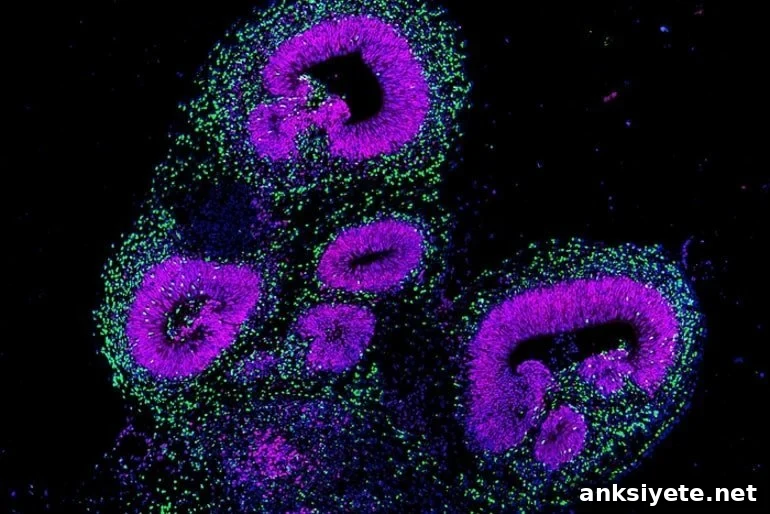
Summary: Brain organoids are enabling researchers to map the molecular, genetic, and structural changes that occur during early human brain development.
Source: ETH Zurich
The human brain is among the most complex organs in nature and has long captivated scientists. Investigating how genes and molecular switches control its development remains a major challenge, since direct study of human brain development is limited and animal models do not fully replicate human-specific features.
Traditionally, researchers have relied on animal systems—mainly mice—but findings from these models do not translate directly to humans. A mouse brain differs in structure and lacks the convoluted surface typical of the human cortex. Conventional cell cultures also fall short: when neurons are grown on flat dishes they spread in two dimensions, losing the three-dimensional architecture essential to brain development.
Mapping molecular fingerprints in organoids
A team led by Professor Barbara Treutlein at ETH Zurich’s Department of Biosystems Science and Engineering in Basel has adopted a different strategy: growing brain organoids. These millimetre-scale, self-organizing three-dimensional tissues are generated from pluripotent stem cells, which can be guided to form the many cell types found in the human brain.
When pluripotent stem cells receive the appropriate signals and are aggregated, they can self-organize into complex tissue structures reminiscent of early brain regions. In a study published in Nature, Treutlein’s group examined thousands of individual cells from human brain organoids across multiple developmental stages to capture their molecular and genetic identities at high resolution.
The researchers profiled both the transcriptome—the full set of gene transcripts that reflects gene activity—and chromatin accessibility, which reveals genomic regions available for regulation. By combining these datasets, they produced maps that describe the molecular fingerprint of each cell within an organoid, revealing how gene expression and regulatory potential change over time and across tissue regions.
These measurements generate enormous datasets: each cell carries information on roughly 20,000 genes, and each organoid comprises thousands of cells. To interpret this vast matrix, the team developed computational tools and applied machine learning to infer regulatory relationships and to predict how perturbations would affect cellular outcomes.
“We created software that builds an interaction network for every gene and predicts what happens in real cells when a gene is disrupted,” explains Jonas Fleck, a doctoral student and co-lead author on the study.
Identifying genetic switches with CRISPR
A central goal of the work was to identify genetic switches—transcription factors and regulatory genes—that critically influence the formation of neuronal types and regional identities within organoids. To test gene function systematically, the team used pooled CRISPR‑Cas9 perturbations to silence individual genes across many cells in the same organoid, screening around two dozen candidate genes in parallel.
This pooled perturbation approach, combined with single-cell transcriptomics, allowed the researchers to determine how each targeted gene contributes to cell fate decisions and to the diversity of cell states that emerge during organoid development. “This technique can be used to screen genes implicated in disease and to observe their specific effects on cell differentiation within the organoid,” says Sophie Jansen, doctoral student and co-lead author.
GLI3 reveals forebrain patterning roles in humans
To demonstrate the power of their approach, the team focused on the transcription factor gene GLI3. GLI3 encodes a DNA-binding protein that regulates downstream genes. While mutations in GLI3 are known to cause central nervous system malformations in mice and are associated with human syndromes such as Greig cephalopolysyndactyly and Pallister-Hall, its specific role during human brain patterning had not been established.
By silencing GLI3 in organoids, the researchers validated their computational predictions and observed how loss of GLI3 reshapes developmental trajectories in human tissue cultures. Their results provide direct evidence that GLI3 is required for establishing forebrain patterning in human organoids—a finding that extends prior observations from mammalian model systems to human-derived tissue.
Model systems that mirror developmental biology
“One exciting outcome of this study is the ability to use genome-wide single-cell data to infer the roles of individual genes,” Treutlein notes. “Equally striking is that these in vitro model systems reproduce developmental biology not only at the morphological level but also in gene regulation and pattern formation.”
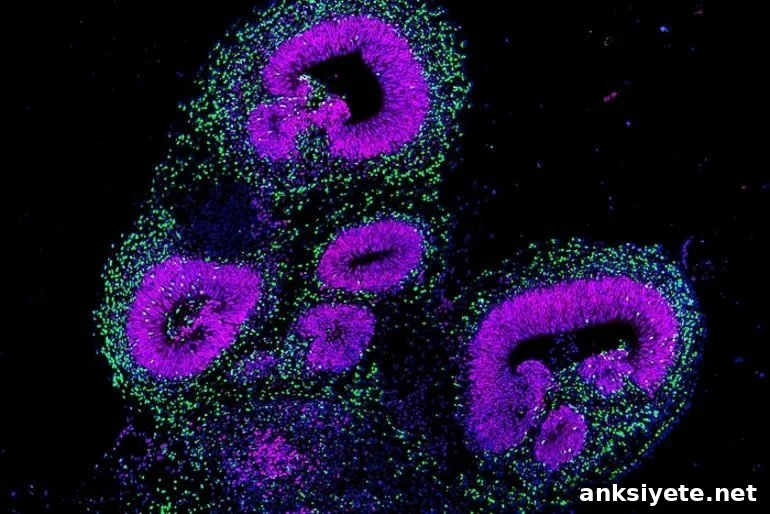
Treutlein emphasizes that the culture environment can drive stem cells to self-organize into tissue architectures that reflect key features of early brain development. Their study shows that organoids recapitulate not only structural characteristics but also the regulatory networks that guide regionalization and neuronal differentiation.
“Organoids are an excellent platform for studying human developmental biology,” she says.
Applications and challenges of brain organoids
Human organoids offer clear advantages because findings are directly relevant to human biology. They are valuable for basic research into developmental processes, for identifying genes involved in neurodevelopmental disorders, and for modeling how genetic variants affect cell behaviors. Treutlein’s group is already using organoids to investigate genetic contributors to autism and to heterotopia, a condition where neurons migrate to abnormal locations in the cerebral cortex.
Organoids can also serve as platforms for drug screening and may ultimately contribute to generating transplantable tissues or organ components, attracting interest from the pharmaceutical industry. At the same time, organoid production remains labor-intensive and variable: each aggregate develops uniquely rather than following a strictly standardized program. To address this, the team is working on refining organoid protocols and automating production to improve reproducibility and scalability.
About this brain mapping research news
Author: Peter Rueegg ([email protected])
Source: ETH Zurich
Contact: Peter Rueegg – ETH Zurich
Image: Image credit: F. Sanchís Calleja, A. Jain, P. Wahle / ETH Zurich
Original Research: Open access. “Inferring and perturbing cell fate regulomes in human brain organoids” by Barbara Treutlein et al., Nature
Abstract
Inferring and perturbing cell fate regulomes in human brain organoids
Self-organizing neural organoids derived from pluripotent stem cells, combined with single-cell genomic technologies, provide a powerful framework to study gene regulatory networks that shape human brain development.
In this work, single-cell transcriptome and chromatin accessibility data were collected across a dense time course in human organoids spanning neuroepithelial formation, regional patterning, and neurogenesis. The study identified temporally dynamic and region-specific regulatory elements.
The team developed Pando, a flexible computational framework that integrates multi-omic data and predicted transcription-factor binding sites to infer a global gene regulatory network describing organoid development. They combined pooled genetic perturbations with single-cell transcriptome readouts to assess the requirement of transcription factors for specific cell fates and states in organoids.
Results indicate that some transcription factors primarily regulate the abundance of particular cell fates, while others influence neuronal states after differentiation. The study demonstrates that GLI3 is necessary for cortical fate establishment in humans, mirroring findings from mammalian models.
By measuring transcriptome and chromatin accessibility in normal and GLI3-perturbed cells, the researchers identified two distinct GLI3 regulomes central to telencephalic fate decisions: one controlling dorsoventral patterning with HES4/5 as direct GLI3 targets, and another guiding later ganglionic eminence diversification.
Overall, the work provides a framework for how human organoid models and single-cell technologies can be combined to reconstruct and interrogate developmental processes in the human brain.