
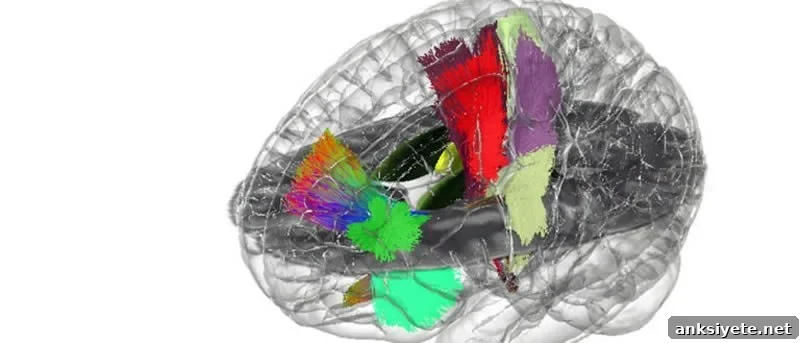
Summary: Researchers used Microsoft HoloLens mixed reality software to build an interactive holographic mapping system that reconstructs axonal pathways in the human brain.
Source: Case Western Reserve
A multidisciplinary team led by scientists and engineers at Case Western Reserve University has developed what is believed to be the first fully interactive holographic atlas of human axonal pathways, built on the Microsoft HoloLens mixed-reality platform.
The effort combines advanced visualization hardware, custom software development, and decades of neuroanatomical data into a single, immersive environment. The result is a three-dimensional, manipulable representation of major axonal trajectories that can be examined and edited in real time by experts. Researchers anticipate broad scientific, clinical, and educational uses for the platform, as well as improved collaboration between neuroanatomists and neuroimaging specialists.
Lead investigator Cameron McIntyre, Tilles-Weidenthal Professor of Biomedical Engineering at the Case Western Reserve University School of Medicine, said the holographic system already serves as a foundation for a new kind of neurosurgical navigation tool for Deep Brain Stimulation (DBS). The team has informally named this application “HoloDBS.”
“More than 100 clinicians have beta-tested the system, and the level of excitement has been exceptionally high,” McIntyre said. Early use indicates the technology can clarify anatomical relationships that are difficult to resolve with current approaches and may significantly improve the planning and targeting of certain neurosurgical procedures.
The platform merges scattered, decades-long anatomical knowledge from many sources into a cohesive, interactive 3D model. Using a HoloLens headset, neural engineers, neuroanatomists, neurologists, and neurosurgeons can view an animated atlas of the brain while simultaneously seeing and exploring axonal connections arranged spatially in front of them.
“What’s remarkable is how we’ve integrated established neuroanatomical knowledge with the latest in brain visualization,” McIntyre said. “This translates complex anatomical datasets into a format that users can manipulate, interrogate, and apply directly to research or clinical workflows.”
McIntyre collaborated with Mark Griswold, a radiology professor who leads HoloLens-related educational initiatives at the university and directs the Interactive Commons, a campus-wide resource for immersive visualization. Griswold previously led development of the HoloAnatomy application. The project team also included postdoctoral fellow Mikkel Petersen and internationally recognized neuroanatomists from the University of Rochester, Université Laval, Emory University, and the University of Pittsburgh.
Neuron paper details project
The methodology and outcomes are documented in a research paper published in the journal Neuron. The focus of the work is precisely mapping axonal pathways — the long-range projections that connect different gray-matter regions — a core topic in neural development and connectomics known as axon pathfinding.
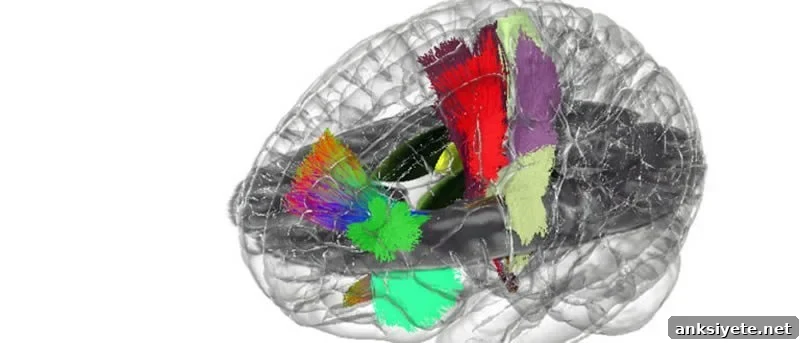
The team focused initial efforts on the subthalamic region, a common target for deep brain stimulation that has presented challenges to existing mapping techniques. Traditional tractography, which visualizes diffusion MRI data to infer fiber pathways and produces colorful “brainbows,” has been widely used for about two decades. However, tractography is an indirect method with known limitations, especially in complex regions like the subthalamic area.
To overcome those limitations, the researchers developed a workflow in which expert neuroanatomists wore HoloLens headsets and interactively defined axonal trajectories for cortical, basal ganglia, and cerebellar systems. This group-based, hands-on approach allowed anatomical expertise to be integrated directly into the 3D model rather than relying solely on algorithmic reconstructions from diffusion data.
“Through this process, we produced the first anatomically realistic model of the major axonal pathways in the human subthalamic region,” McIntyre said. The team emphasizes that this is an initial proof-of-concept that can be extended to other brain regions to build a more comprehensive holographic axonal atlas.
Source:
Case Western Reserve University
Media contacts:
Mike Scott – Case Western Reserve
Image source:
Image credited to Case Western Reserve.
Original research (citation):
“Holographic Reconstruction of Axonal Pathways in the Human Brain,” Cameron McIntyre et al., Neuron. DOI: 10.1016/j.neuron.2019.09.030. (Closed access)
Abstract
Holographic Reconstruction of Axonal Pathways in the Human Brain
Highlights
• Developed the first holographic interface for constructing axonal pathway models
• Interactive, group-based definition of axonal trajectories by expert neuroanatomists
• Consolidation of decades of anatomical knowledge into a three-dimensional human axonal pathway atlas
Summary
Accurate three-dimensional documentation of axonal pathways connecting gray-matter regions has broad scientific and clinical utility. Existing efforts to map the human structural connectome have largely depended on tractography from diffusion-weighted imaging, an indirect method with inherent limitations. Holographic visualization platforms offer a new environment to integrate histology, structural MRI, and expert anatomical knowledge while enabling collaborative interaction between neuroanatomists and imaging scientists. The team developed a holographic interface populated with human histological and MRI data, then engaged world expert neuroanatomists to interactively define cortical, basal ganglia, and cerebellar axonal trajectories. This combined approach translated decades of accumulated anatomical knowledge into a 3D axonal pathway atlas suitable for educational, scientific, and clinical applications.