
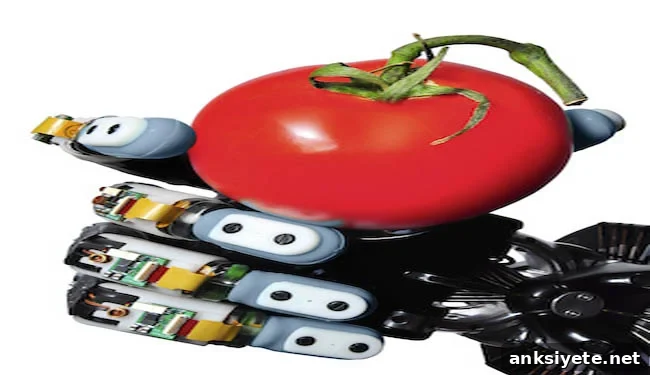
Robots with tactile sensors can identify materials by touch, advancing the development of more useful prostheses.
Until recently, robots had very limited ability to sense touch. With advances in tactile sensors, actuators and decision-making software, robots can now distinguish a wide range of materials by feel. This ability to “feel” textures opens new possibilities for prosthetic devices, assistive robots and industrial quality testing.
Researchers at the University of Southern California’s Viterbi School of Engineering report in Frontiers in Neurorobotics that a robot equipped with a fingertip-like sensor and an intelligent exploration strategy can identify natural materials by texture with accuracy that rivals or even surpasses human performance. The work demonstrates how biomimetic sensors and Bayesian decision making combine to deliver robust texture discrimination for robotics and prosthetics.
The robot uses a BioTac® tactile sensor designed to emulate many properties of the human fingertip. The sensor features a soft, flexible outer skin over a liquid-filled interior, and the skin surface includes fingerprint-like ridges that amplify vibration signals as the fingertip slides over textured surfaces. Vibrations produced by the interaction are captured by a hydrophone embedded in a rigid core, producing rich vibration signatures that correspond to texture features. In addition to texture, the sensor can detect contact forces, force direction and thermal properties, providing a multi-modal sense of touch.
To decide how to explore an object by touch, the researchers developed a decision algorithm inspired by human exploratory behavior and formalized by Bayesian principles. Humans use a variety of exploratory movements—pressing, sliding, rubbing—based on prior experience to extract relevant tactile information. The USC team adapted this concept into a computational framework they call “Bayesian Exploration,” which determines the next best exploratory action to maximize information gain about an unknown material. This approach lets the robot choose efficient, targeted movements rather than relying on random or fixed probing sequences.
Graduate researcher Jeremy Fishel built and trained the experimental system using 117 everyday materials collected from fabric, stationery and hardware stores. When given a material at random, the robot correctly identified it 95% of the time after performing an average of five intelligent exploratory movements. Errors were generally limited to cases in which two textures were so similar that even human subjects could not reliably tell them apart using touch.
Rather than replacing human judgment about what textures people prefer, the researchers emphasize practical applications where objective tactile discrimination is needed. Potential uses include integrating tactile sensors into prosthetic hands to provide amputees with richer sensory feedback, equipping personal assistive robots with better object recognition by touch, and assisting manufacturers who need reliable, repeatable assessments of material feel for quality control and product development.
The study highlights how combining biologically inspired sensors with principled, probabilistic exploration strategies can yield practical tactile intelligence for robots. The BioTac sensor’s sensitivity to vibration, force and temperature produces a high-dimensional tactile signal; Bayesian Exploration turns that signal into a sequence of informative actions that quickly narrow down material identity.
Notes about this neurorobotics research and article
The lead authors, Professor Gerald Loeb and doctoral graduate Jeremy Fishel, are affiliated with the team that developed the BioTac sensor. Loeb and Fishel are partners in SynTouch LLC, a company founded in 2008 by researchers from USC’s Medical Device Development Facility to develop and manufacture tactile sensors for robotic and prosthetic applications. SynTouch now supplies BioTac sensors to researchers and manufacturers working on industrial robots and prosthetic hands.
A related paper from the same research group in Frontiers in Neurorobotics evaluates the BioTac’s ability to measure material hardness, expanding the sensor’s demonstrated capabilities beyond texture to mechanical property discrimination.
Initial development of the BioTac sensor received funding from the Keck Futures Initiative of the National Academy of Sciences to advance prosthetic hand technology. SynTouch also received a grant from the National Institutes of Health to integrate BioTac sensors into prosthetic systems. The texture discrimination project was supported by the U.S. Defense Advanced Research Projects Agency (DARPA), and the hardness study received funding from the National Science Foundation.
Fishel completed his doctoral dissertation in biomedical engineering based on the texture research. Gerald Loeb, director of the USC Medical Device Development Facility, holds numerous patents and has published extensively on topics ranging from cochlear implants to foundational studies of muscles and nerves.
Contact: Katie Dunham – University of Southern California
Source: USC Viterbi School of Engineering press release
Image Source: Neurorobotics image adapted from a press release by USC Viterbi School of Engineering.
Original research: “Bayesian exploration for intelligent identification of textures” by Jeremy A. Fishel and Gerald E. Loeb, Frontiers in Neurorobotics, published online 18 June 2012, doi: 10.3389/fnbot.2012.00004