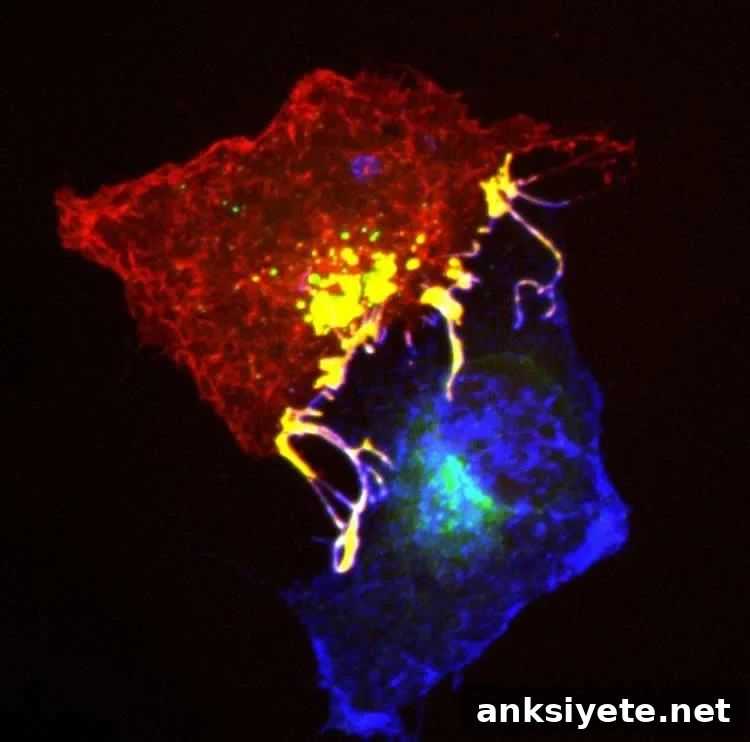
Summary: Researchers at the Max Planck Institute have identified a signaling pathway that allows cells to repel one another by internalizing membrane-bound protein complexes.
Source: Max Planck Institute
Researchers identify signaling pathway that drives cell repulsion by trans-endocytosis
Cells frequently make brief, physical contacts during development, tissue maintenance, wound repair and disease progression. These encounters allow membrane proteins on opposing cells to engage in tight lock-and-key interactions that convey directional signals. New work from the Max Planck Institute of Neurobiology in Martinsried reveals how cells rapidly break such connections by engulfing the contact site and internalizing the ligand–receptor complex, a process that enables the two cells to separate.
During development and regeneration, large numbers of cells must move into correct positions, delineate tissue boundaries, and in the nervous system, connect to distant partners. This crowded environment produces constant pushing and shoving. One effective way for a cell to influence a neighbor’s direction is to trigger repulsion after a short contact. The study shows that, rather than simply pulling apart, cells can extend their membrane over a receptor–ligand cluster and pinch that piece away from the neighboring cell, incorporating it into their own membrane to sever the tether.
Key players in many contact-mediated interactions are ephrin ligands and Eph receptors, which are widely expressed on cell surfaces. On contact, ephrin and Eph molecules form strongly bound complexes that initiate intracellular signaling leading to repulsion. Because the ephrin–Eph complex itself physically links the two cells, a mechanism is required to remove that tether. The research team demonstrates that cells accomplish this by trans-endocytosis, internalizing the entire complex from the partner cell’s membrane into their own.
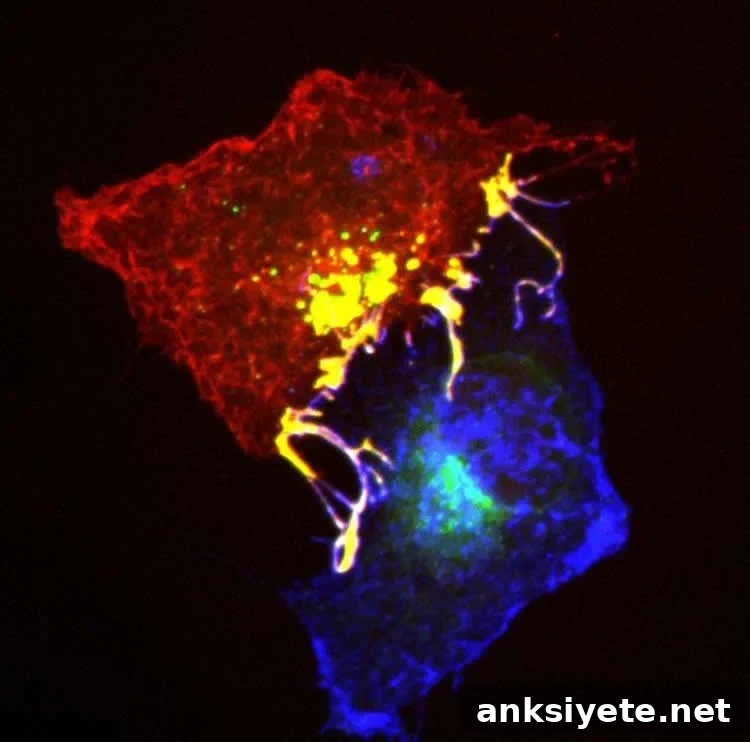
Using targeted genetic modifications and precise inactivation of individual molecular components, the scientists established that formation of the ephrin–Eph complex activates Tiam family signaling proteins. Tiam proteins then activate Rac GTPases, which drive localized remodeling of the actin cytoskeleton. This actin reorganization enables the engulfment and internalization of the ephrin–Eph complexes at the contact site. When any component of this pathway is missing, this endocytic engulfment fails, and the cells remain attached instead of repelling each other.
Live-cell imaging in the study revealed Rac-dependent accumulation of filamentous actin at sites where EphB2 receptors are internalized, highlighting the importance of actin dynamics at the moment of uptake. Systematic depletion experiments pinpointed the Rac subfamily and the Rac-specific guanine nucleotide exchange factor Tiam2 as essential for EphB2 trans-endocytosis. Notably, this pathway is required for the uptake of clustered, membrane-bound receptor–ligand complexes during cell–cell contact, but is not necessary for uptake of soluble ligands in cells that express ephrinB.
Understanding this signaling cascade clarifies a conserved mechanism that removes the physical tether between contacting cells and thus enables contact-induced repulsion. These insights improve our knowledge of how neuronal networks and other tissues are sculpted during development. They also bear relevance to cancer biology: ephrin and Eph receptors influence how cancer cells invade surrounding tissue and form metastases through their control of cell repulsion. A clearer picture of the Tiam–Rac pathway and its role in trans-endocytosis may inform future strategies to target aberrant cell migration in disease.
Source: Stefanie Merker, Max Planck Institute
Image credit: MPI of Neurobiology / Gaitanos
Original research: Abstract for “Tiam–Rac signaling mediates trans-endocytosis of ephrin receptor EphB2 and is important for cell repulsion” by Thomas N. Gaitanos, Jorg Koerner, and Ruediger Klein, Journal of Cell Biology, published online September 5, 2016. DOI: 10.1083/jcb.201512010
Abstract (summary)
The study demonstrates that Eph receptor–ephrin ligand complexes can be removed from opposing cells by a conserved trans-endocytosis pathway that depends on Tiam-mediated activation of Rac GTPases and local actin remodeling. Live imaging showed Rac-dependent F-actin enrichment at sites of EphB2 internalization. Systematic depletion experiments identified the Rac subfamily and the Rac-specific guanine nucleotide exchange factor Tiam2 as key components required for this process. The pathway is essential for uptake of clustered Eph–ephrin complexes during cell contact and for subsequent contact repulsion, but it is not necessary for uptake of soluble ligands in ephrinB-expressing cells. These results support a model in which trans-endocytosis removes the physical link between cells, thereby enabling repulsive separation.
Gaitanos TN, Koerner J, Klein R. Tiam–Rac signaling mediates trans-endocytosis of ephrin receptor EphB2 and is important for cell repulsion. Journal of Cell Biology. Published online September 5, 2016. DOI: 10.1083/jcb.201512010