
Summary: A large study of related rhesus monkeys finds that individual differences in functional connectivity between brain regions linked to fear and anxiety are heritable and relate to early-life anxious temperament.
Source: SfN.
Researchers report that variations in connectivity between regions of the brain involved in fear and anxiety are inherited, based on a large multi-generational study of rhesus macaques published in the Journal of Neuroscience. These findings shed light on biological mechanisms that may influence the risk and development of anxiety disorders.
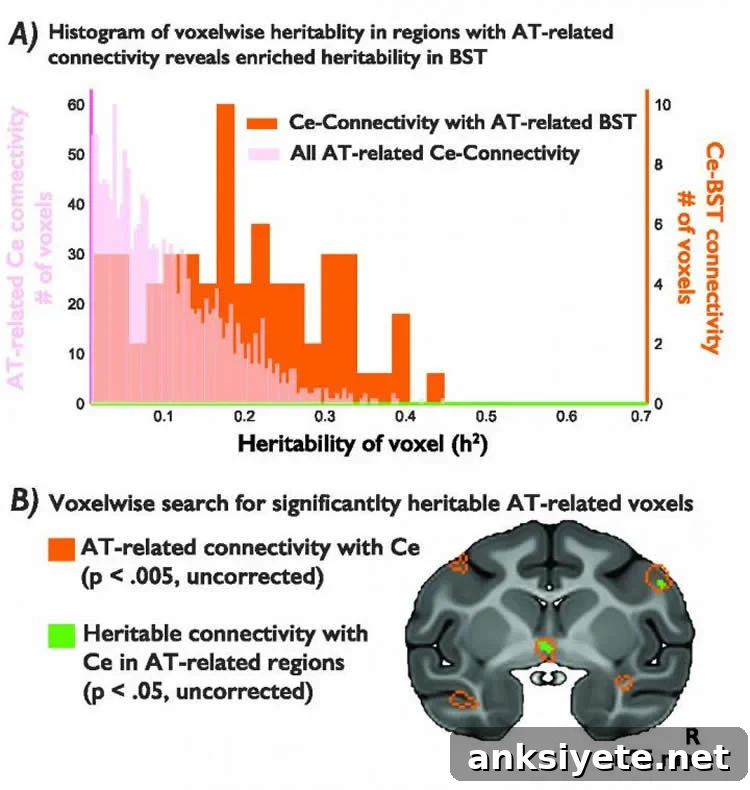
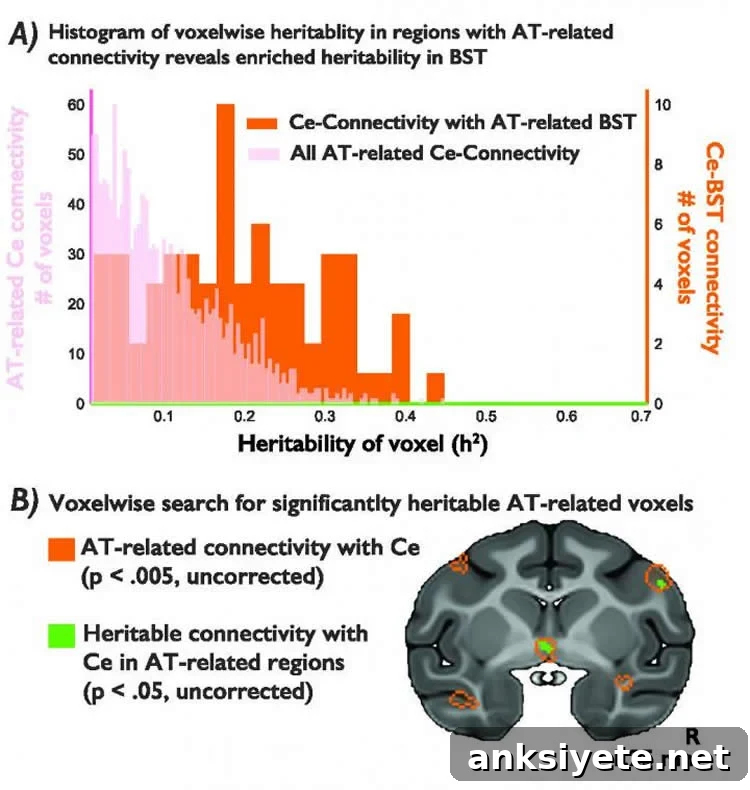
Using neuroimaging techniques commonly applied in human studies, Ned Kalin and colleagues measured functional connectivity within the central extended amygdala and examined how this connectivity relates to anxious temperament in pre-adolescent rhesus macaques. The study indicates that the strength of communication between the central nucleus of the amygdala (Ce) and the bed nucleus of the stria terminalis (BST) is not only associated with early-life anxiety traits but is also influenced by genetic factors.
Funding: This research was supported by the California National Primate Research Center, the National Institutes of Health including the National Institute of Mental Health, University of California Davis, and the University of Maryland College Park.
Source: David Barnstone – SfN
Publisher: Organized by NeuroscienceNews.com.
Image Source: Image credited to Fox et al., Journal of Neuroscience (2018).
Original Research: Abstract for “Functional connectivity within the primate extended amygdala is heritable and associated with early-life anxious temperament” by Andrew S. Fox, Jonathan A. Oler, Rasmus M. Birn, Alexander J. Shackman, Andrew L. Alexander, and Ned H. Kalin in Journal of Neuroscience. Published July 30, 2018.
doi: 10.1523/JNEUROSCI.0102-18.2018
SfN. “The Heritability of Anxiety.” NeuroscienceNews. NeuroscienceNews, 30 July 2018.
Abstract
Functional connectivity within the primate extended amygdala is heritable and associated with early-life anxious temperament
Children who display an extremely inhibited or anxious temperament early in life have an elevated risk of developing anxiety disorders and depression later on. To better understand the neural basis of this risk, researchers used a rhesus monkey model of early-life anxious temperament (AT) and applied functional magnetic resonance imaging (fMRI) to a large multi-generational family pedigree of rhesus macaques. The sample included 170 females and 208 males.
Prior work had shown that metabolic activity in the central extended amygdala (EAc)—which includes the central nucleus of the amygdala (Ce) and the bed nucleus of the stria terminalis (BST)—is associated with stable individual differences in AT. In the current study, investigators measured functional connectivity between Ce and BST and examined how this connectivity related to AT. The results demonstrate that Ce-BST functional connectivity is heritable, explains a modest but significant portion of the variance in AT, and is co-heritable with AT. Interestingly, Ce-BST functional connectivity did not correlate with AT-related BST metabolism, and the two measures accounted for different, non-overlapping portions of the variance in anxious temperament.
Exploratory analyses further suggested associations between Ce-BST functional connectivity and metabolic activity in other brain regions involved in threat-response systems, including the hypothalamus and periaqueductal gray. Altogether, these findings point to the importance of coordinated function within the extended amygdala in shaping individual differences in anxious temperament and in modulating metabolic activity in regions tied to behavioral and neuroendocrine components of anxiety.
SIGNIFICANCE STATEMENT
Anxiety disorders affect a large portion of the population and cause substantial suffering and disability worldwide. By using a nonhuman primate model and the same neuroimaging measures commonly used in human research, this study identifies a heritable neural circuit—communication between the central nucleus of the amygdala and the bed nucleus of the stria terminalis—that is linked to early-life anxious temperament. Understanding how these key components of the central extended amygdala interact to produce extreme anxiety may reveal neural targets for early interventions aimed at preventing life-long disability in children who are at increased risk for anxiety disorders.