
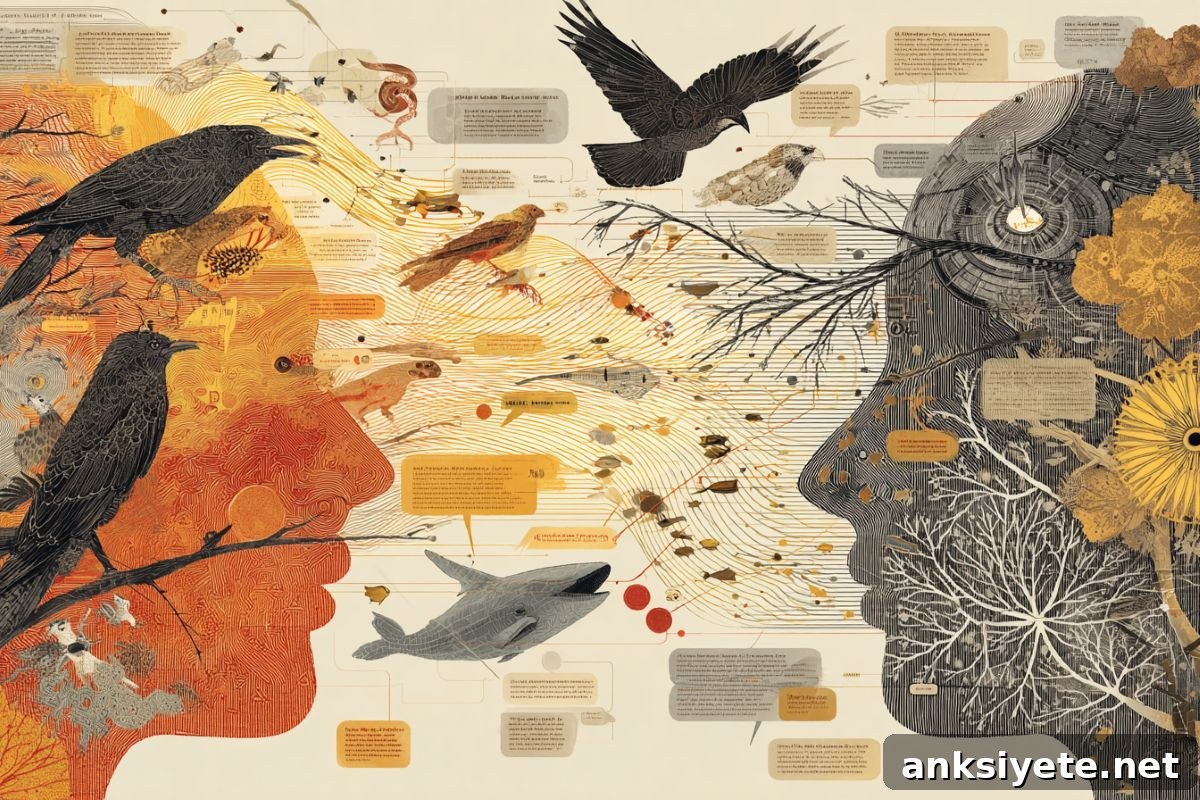
Summary: A new biocultural framework argues that human language did not arise from a single evolutionary leap but from the gradual convergence of multiple biological capacities and cultural processes. The researchers show how separate developments—such as vocal learning, the formation of linguistic structure, and social motivations to share information—followed distinct evolutionary paths before combining into the complex communication system humans use today.
Drawing on findings from linguistics, neuroscience, genetics, psychology, and comparative animal research, the international team challenges decades of single-origin models. This broader perspective clarifies how different ingredients came together over time and highlights fresh directions for studying language evolution, language learning, AI, and disorders of communication.
Key Facts:
- Multiple roots: Human language likely emerged through interactions among several biological abilities and cultural processes, rather than from a single evolutionary innovation.
- Biocultural evolution: Capacities such as vocal production learning, the creation of grammatical structure, and the social uses of language each have distinct histories that converged in humans.
- Cross-species insight: Research on birds, bats, cetaceans, primates and newly emerging sign systems provides comparative data showing shared mechanisms and unique combinations that illuminate language’s building blocks.
Source: Max Planck Institute
For centuries, thinkers have asked how human language began.
Language defines us as a species, yet its evolutionary pathway remains complex. In a collaborative paper, ten experts from complementary disciplines propose an integrated framework that brings new data and methods to this longstanding question. Their objective is not to insist on a single explanation, but to show how a multifaceted, biocultural approach—combining biological preparedness with cultural transmission—offers a clearer account of how language could have emerged.
“Our aim was not to promote a single origin theory,” says first author Inbal Arnon. “Instead, we illustrate how multiple capacities and cultural dynamics interact, and how fresh sources of data across fields can illuminate different aspects of language evolution.”
Expanding the view
The authors emphasize that no single factor fully explains language origins. Instead, language likely arose when separate biological abilities—such as the capacity to imitate and produce novel vocalizations, to detect and use abstract patterns, and to coordinate socially—met and combined with cultural mechanisms that transmit and refine communicative forms across individuals and generations.
Simon Fisher, a co-author, notes that viewing language as multifaceted opens new avenues: “Rather than seeking a lone trait that separates humans from other species, we can isolate the different facets that contribute to language and study them across species and models.”
The paper stresses that research has often stalled when disciplines worked in isolation. Progress requires integrating learning, culture, neuroscience, genetics, animal behavior, and experimental approaches. Language’s story is therefore one of connections—between biological systems and cultural practices, and between scientific fields working together.
Three case studies in focus
To demonstrate their framework, the authors synthesize evidence from three focal facets whose evolutionary roles become clearer through a biocultural lens:
- Vocal learning: Spoken language depends on our ability to learn and reproduce sounds from others. This type of vocal production learning is limited in most primates but has evolved independently in other animal lineages—certain birds, bats, cetaceans, elephants and pinnipeds provide key comparative data. Genetic, neurobiological and behavioural findings across species help reveal how human vocal learning may have been assembled from ancient systems.
- Linguistic structure: Grammar and compositional structure did not appear instantly. Evidence from emerging sign languages, laboratory studies that recreate aspects of cultural transmission, and comparative work with songbirds and primates highlight how repeated use and transmission across individuals and generations shape structural regularities. These studies suggest that structure arises from a specific constellation of biological, cognitive and cultural conditions that may be unique to humans.
- Social foundations: Language is fundamentally interactive. Social interaction plays a central role in acquiring language and in shaping other culturally transmitted communication systems, like birdsong. Humans also show an unusually strong drive to share information socially—an intrinsic motivation that supports cumulative cultural transmission and collaborative communication.
A biocultural perspective reveals both unique and shared pathways toward complex communication and suggests practical research directions for language acquisition, artificial intelligence that models human communication, and the study and treatment of communication disorders.
Key Questions Answered:
A: It proposes that language emerged from interactions among multiple biological and cultural capacities over time, rather than from a single evolutionary event.
A: Because language depends on vocal learning, pattern recognition, social interaction and cultural transmission—areas that require insights from many scientific fields.
A: Comparative studies show that different species possess components relevant to language—such as vocal learning or social learning—helping to identify evolutionary building blocks that humans combined in distinctive ways.
Editorial Notes:
- This article was edited by a Neuroscience News editor.
- The journal paper was reviewed in full by the editorial team.
- Additional context and synthesis were added by staff to make the research more accessible.
About this language evolution research news
Author: Anniek Corporaal
Source: Max Planck Institute
Contact: Anniek Corporaal – Max Planck Institute
Image: The image is credited to Neuroscience News
Original Research: Closed access.
“What enables human language? A biocultural framework” by Inbal Arnon et al. Science
Abstract
What enables human language? A biocultural framework
BACKGROUND
Explaining language origins is central to understanding human nature. The authors propose an empirical, integrative framework that leverages synergies across scientific disciplines to guide rigorous studies of language evolution. The framework views language emergence as the result of convergence among multiple capacities, each following its own evolutionary pathway.
This approach explicitly recognizes biological preparedness and cultural transmission, and their interaction. While biocultural perspectives have gained traction, a unified framework helps demonstrate how combining them with comparative and experimental data advances our understanding.
The paper develops this approach through three case studies—vocal production learning, linguistic structure, and social underpinnings—bringing together the latest evidence across fields to generate new insights and outline priorities for future work.
ADVANCES
Case study 1 examines vocal production learning: the capacity to modify and expand vocal repertoires through auditory experience. This ability is limited in most primates but appears in other branches of life, including certain birds, bats, cetaceans, elephants and pinnipeds. Integrating molecular studies of speech and language disorders, animal-model genetics, and ancient DNA research suggests that ancient neural and genetic systems were repurposed and recombined to support human vocal capabilities.
Case study 2 focuses on the origin of linguistic structure. Data from nascent sign systems, lab experiments on cultural evolution, and comparative studies of songbirds and primates illustrate how repeated social use and transmission across generations shape structural regularities. The evidence supports the view that structure emerges through a particular combination of biological, cognitive and cultural conditions, not from a single trait.
Case study 3 highlights the social foundations of communication. Social interaction fosters language learning in humans and plays a role in culturally transmitted behaviors in other species. Importantly, humans display a marked motivation to share information socially—an internal drive that appears rare outside our species and that likely supported cumulative cultural evolution of communication.
OUTLOOK
Taken together, the case studies show how modification and recombination of abilities present in other animals, combined with intra- and intergenerational cultural transmission, can produce the linguistic capacities seen in humans. The framework broadens the set of species that are relevant for comparative study, since different components of language may be distributed across the evolutionary tree.
The research emphasizes three interacting timescales that shape language evolution: the individual (learning), the community (cultural evolution), and the species (biological evolution). Progress depends on integrating data, methods and perspectives across these scales. A recurring avenue for future inquiry is the role of biological reward systems—motivation to communicate and the reinforcement of imitation and successful exchange—in driving language emergence.
This integrative, biocultural framework demonstrates how cross-disciplinary research can advance our understanding of one of the most fundamental aspects of human evolution: language.