
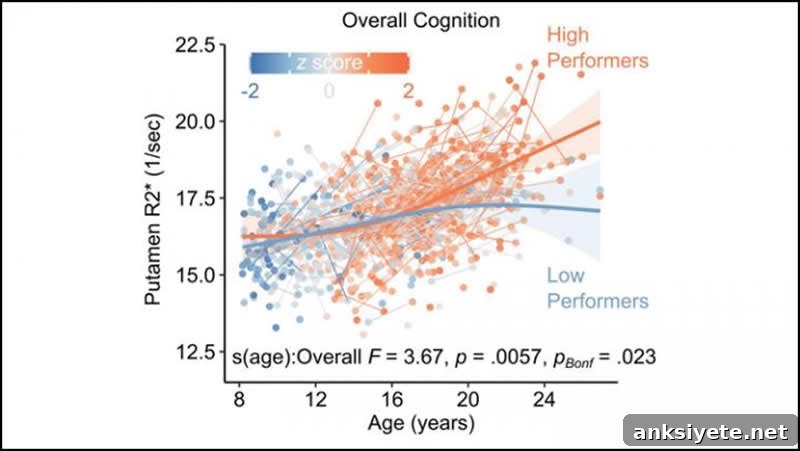
Summary: Iron concentration in the basal ganglia increases steadily from childhood through adolescence and continues to rise in some subregions into early adulthood. Lower iron levels in the putamen were associated with poorer performance on reasoning and spatial tasks. These findings indicate that adequate iron accumulation in specific brain regions is important for healthy cognitive development.
Source: SfN
Overview
New research published in the Journal of Neuroscience reports that brain iron levels, particularly within the basal ganglia, rise throughout development and are linked to cognitive performance in youth. Using longitudinal magnetic resonance imaging (MRI) measures of tissue iron, the study documents how iron concentration evolves from late childhood into the mid-twenties and shows a specific relationship between putamen iron and higher-order cognitive abilities.
Iron is an essential nutrient for the brain. It supports energy metabolism, myelination, and neurotransmitter production, and is concentrated in subcortical structures such as the basal ganglia. While extremely low or high brain iron is associated with disorders across the lifespan, comparatively little was known about normative iron trajectories during adolescence and how those trajectories relate to cognition. This study addresses that gap by examining repeated brain scans and cognitive assessments in a large developmental cohort.
In the study, lower tissue iron in the putamen correlated with weaker performance on cognitive tasks that tap reasoning and spatial processing, suggesting that iron accumulation in this subregion supports the maturation of cognitive skills that rely on flexible thinking and spatial reasoning. The results imply that adequate iron availability during adolescence may contribute to optimal development of neural systems supporting these abilities.
Source:
SfN
Media Contacts:
Calli McMurray – SfN
Image Source:
The image is credited to Larsen et al., JNeurosci 2020.
Study details
The research team analyzed MRI scans from the Philadelphia Neurodevelopmental Cohort, which provided a large sample of children and young adults. Researchers examined data from up to four multi-echo T2* MRI sessions per participant, using R2* relaxometry to estimate tissue iron concentration. They focused on four basal ganglia regions: caudate, putamen, nucleus accumbens, and globus pallidus. Longitudinal modeling allowed the team to characterize both linear and nonlinear changes in iron across the transition from childhood into adulthood.
Across the sample, R2* values increased significantly in all examined regions, reflecting a general pattern of iron enrichment in the basal ganglia during development. The most pronounced and prolonged increases were observed in the globus pallidus and putamen, indicating these regions undergo extended periods of iron accumulation. Importantly, individual differences in the developmental trajectory of putamen R2* were associated with cognitive ability: higher cognitive performance corresponded to greater iron concentration in late adolescence and early adulthood.
Original Research
“Longitudinal Development of Brain Iron Is Linked to Cognition in Youth” — Bart Larsen et al., Journal of Neuroscience
Abstract (concise summary)
The study examined longitudinal brain iron development in a large sample of youth aged 8–26 years using repeated R2* MRI measurements across the basal ganglia. Results reveal sustained increases in tissue iron throughout adolescence, with the globus pallidus and putamen showing the greatest and most extended enrichment. Critically, lower iron concentration in the putamen was associated with poorer cognitive performance on tasks involving reasoning and spatial processing. These findings suggest that maturation of basal ganglia iron content is a prolonged developmental process that relates to individual differences in cognitive ability.
Significance
By characterizing the typical developmental trajectory of basal ganglia iron in the largest longitudinal sample to date, this work highlights adolescence and the transition to adulthood as a period of dynamic iron-related brain maturation. The association between lower putamen iron and reduced cognitive performance underscores the potential role of iron in supporting the neural processes underlying reasoning and spatial skills. These observations motivate further research into nutritional, metabolic, and environmental factors that influence brain iron accumulation and whether targeted interventions could support atypical cognitive development.