
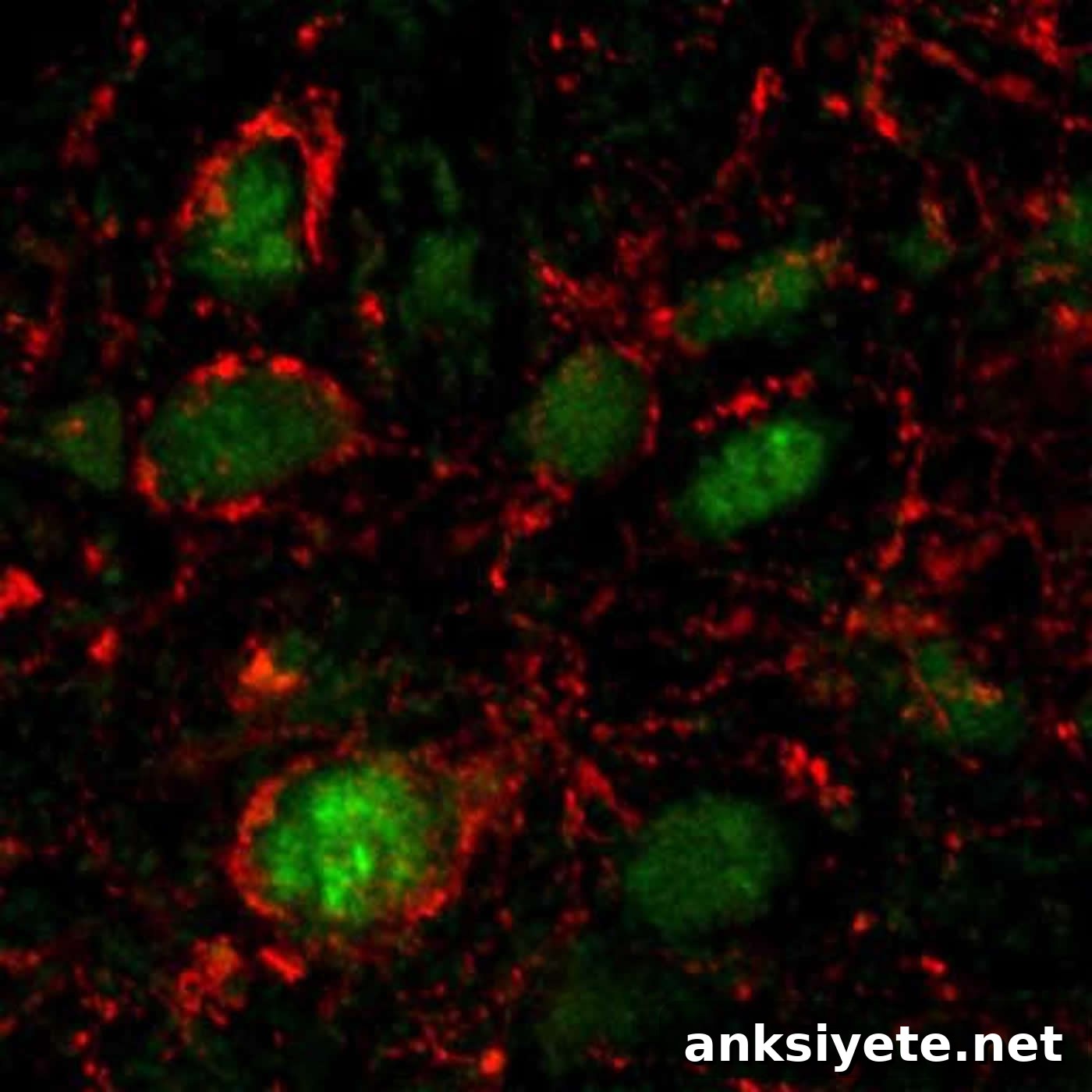
If you feel like skipping dessert, the microbes in your gut might be partly to blame. A study published November 24 in Cell Metabolism reports that, roughly 20 minutes after a meal, gut bacteria produce proteins that reduce food intake in animals. When these bacterial proteins were administered to mice and rats, they affected brain circuits and hormones linked to appetite, pointing to a direct role for gut microbes in telling the host when to stop eating.
This finding complements established models of appetite regulation that emphasize gut-derived hormones communicating with the brain to signal hunger and fullness. In this study, proteins produced by mutualistic Escherichia coli during a post-feeding growth phase were shown to influence the release of gut hormones such as peptide YY (PYY) and glucagon-like peptide-1 (GLP-1), and to activate neurons that regulate appetite in the hypothalamus.
“Many studies catalog differences in microbiota composition in disease, but relatively few probe the molecular mechanisms behind those links,” says senior author Sergueï Fetissov of Rouen University and INSERM’s Nutrition, Gut & Brain Laboratory. “Our results show that E. coli proteins can engage the same pathways the body uses to signal satiety. The next step is to understand how changes in the gut microbiome alter this physiology.”
Feeding delivers nutrients not only to the host but also to resident microbes. In response, gut bacteria divide to recover members lost during stool formation and to expand their populations. The researchers propose an ecologically plausible idea: because gut microbes rely on the host for a stable habitat and continuous nutrient supply, it is advantageous for the microbial community to keep host feeding patterns stable. Producing signals that tell the host it is satiated could help preserve a steady environment for the microbes.
In controlled laboratory experiments, Fetissov and colleagues observed that E. coli undergo a characteristic shift about 20 minutes after access to nutrients. At that point, the bacterial population reaches a stationary phase and begins to express a different protein profile than when it was nutrient-deprived. Intrigued by this timing—which parallels the early onset of post-meal satiety in animals—the team compared the bacterial proteome before and after feeding.
The researchers then tested the functional effects of those bacterial proteins. Small doses of proteins collected from E. coli in the post-feeding, stationary phase suppressed food intake when injected into both hungry and freely fed rats and mice. The post-feeding bacterial proteins also stimulated release of peptide YY, a hormone associated with reducing appetite. Conversely, proteins produced in the nutrient-deprived bacterial state did not trigger PYY release. For GLP-1, which is involved in insulin secretion as well as appetite regulation, the pattern differed, indicating a nuanced interaction between distinct bacterial proteins and host hormone responses.
A key protein identified in the study is ClpB, an E. coli protein that mimics α-MSH, a peptide linked to satiety. The team developed an assay to detect ClpB in animal blood and measured its levels after feeding. Although plasma ClpB protein concentration did not show a large immediate change at 20 minutes, its presence correlated with ClpB DNA in feces, connecting bacterial abundance and activity in the gut to signals that could reach the host circulation. Electrophysiological experiments further showed that ClpB increases the firing rate of pro-opiomelanocortin (POMC) neurons in the hypothalamus—neurons known to suppress appetite.
While ClpB emerged as a prominent candidate, the investigators emphasize that other E. coli proteins likely contribute to hunger and satiety signaling, and proteins from other bacterial species may also play roles. Establishing which bacterial factors influence specific gut hormones and brain circuits will be important for understanding how microbiome composition affects eating behavior over both the short and long term.
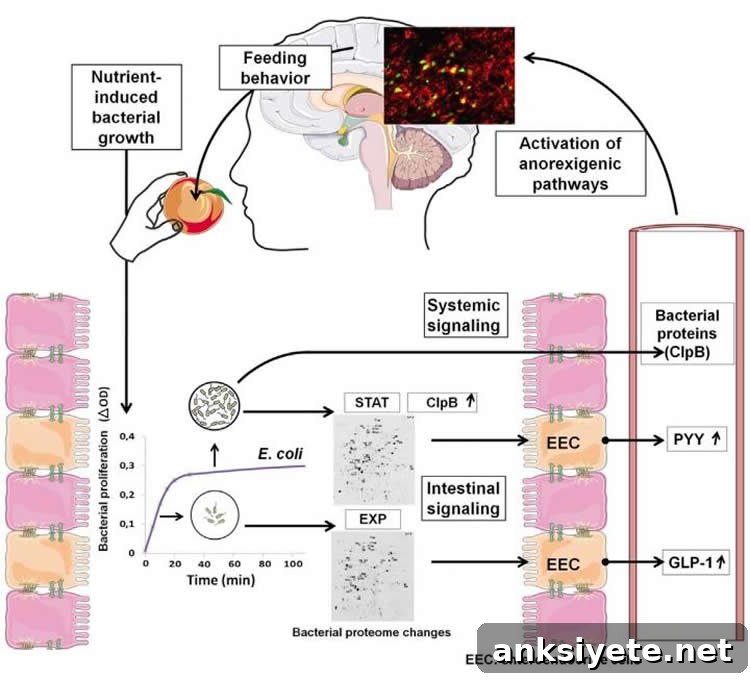
“We now think bacteria participate directly in appetite regulation immediately after food reaches the gut,” Fetissov notes. “By multiplying and changing their protein output, gut microbes can stimulate satellite gut hormones and also produce proteins that may persist in the circulation and influence brain pathways.”
Funding: The research received support from the EU INTERREG IVA 2 Seas Program, the Haute-Normandie Region (France), and the Marie Curie CIG NeuROSens program.
Source: Joseph Caputo, Cell Press. Image credit: J. Breton, N. Lucas & D. Schapman; Breton et al., Cell Metabolism 2015. Original research: “Gut Commensal E. coli Proteins Activate Host Satiety Pathways following Nutrient-Induced Bacterial Growth,” by Jonathan Breton et al., published online November 24, 2015 in Cell Metabolism (doi:10.1016/j.cmet.2015.10.017).
Abstract
Gut Commensal E. coli Proteins Activate Host Satiety Pathways following Nutrient-Induced Bacterial Growth
The composition of the gut microbiota has been linked to host metabolic traits, but whether gut bacteria can directly influence appetite was unclear. This study shows that supplying nutrients to E. coli stabilizes exponential bacterial growth and leads to a stationary phase about 20 minutes after nutrient access, accompanied by shifts in the bacterial proteome. Proteins produced during this stationary phase, when infused into the intestine, increased plasma PYY; when injected intraperitoneally they acutely suppressed food intake, activated c-Fos in hypothalamic POMC neurons, and reduced meal size with repeated administrations. The E. coli protein ClpB, upregulated in the stationary phase and structurally similar to α-MSH, was detectable in plasma in proportion to ClpB DNA in feces and heightened firing of POMC neurons. These results support a model in which bacterial proteins produced after nutrient-driven E. coli growth contribute to signaling meal termination and, with sustained exposure, may shape longer-term meal patterns.