
New neuroimaging evidence shows breastfeeding supports early brain development in infants
A recent study from Brown University using specialized, baby-friendly magnetic resonance imaging (MRI) adds to growing evidence that breastfeeding positively influences early brain development. The research found that infants who were exclusively breastfed for at least three months showed greater growth in key white matter regions of the brain by age two, compared with infants who received a mixture of breastmilk and formula or formula alone.
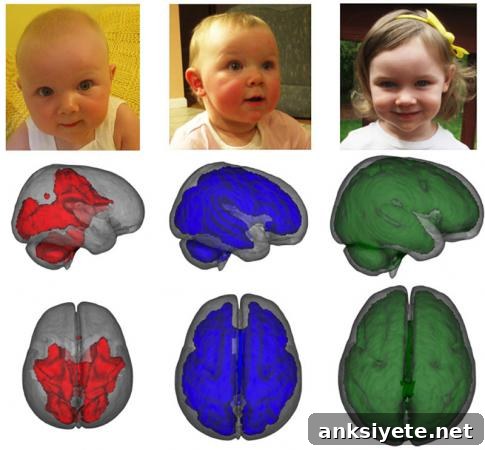
MRI images, taken while children were asleep, showed that infants who were exclusively breastfed for at least three months had enhanced development in key parts of the brain compared to children who were fed formula or a combination of formula and breastmilk. Images show development of myelination by age, left to right. Credit: Baby Imaging Lab/Brown University
The research team, led by Sean Deoni of Brown’s Advanced Baby Imaging Lab, used quiet MRI technology to scan sleeping infants and toddlers without sedation. Their MRI method estimates myelin content—the fatty, insulating material that surrounds nerve fibers and speeds communication across the brain’s white matter. By measuring myelination, the researchers were able to assess microstructural brain development in children younger than four years old.
The study enrolled 133 typically developing children aged roughly 10 months to four years. To reduce confounding from socioeconomic differences, participants came from families with similar socioeconomic backgrounds and had normal gestation durations. Based on caregiver reports, researchers divided participants into three feeding groups: exclusively breastfed for at least three months, mixed feeding (breastmilk and formula), and exclusively formula-fed. Comparing younger and older children in each group allowed the team to model growth trajectories in myelinated white matter.
Results showed a clear pattern: children who were exclusively breastfed for at least three months exhibited the most rapid white matter growth, with noticeable differences emerging by age two. Those who received both breastmilk and formula showed intermediate growth, while infants fed only formula displayed the slowest increase in myelin-related measures. Differences in growth were most prominent in regions associated with language, emotional regulation, and cognitive processing.

Mean myelin content — the fatty material that insulates nerve fibers and speeds electrical signals — rises with breastfeeding. The changes to developing brains happen early, almost from the start. Credit: Baby Imaging Lab/Brown University
Quantitatively, the research team reported substantial differences in white matter growth between feeding groups. Deoni noted that the magnitude of the effect—comparing breastfed and non-breastfed children—was on the order of 20 to 30 percent in some myelin metrics, a notable difference at such an early age. To complement imaging findings, the study also administered basic cognitive assessments to the older children. Those tests aligned with the imaging results: children in the exclusively breastfed group scored higher on measures of language, visual reception, and motor skills.
The investigators further examined breastfeeding duration. Infants breastfed for more than a year demonstrated stronger myelin development in several brain regions, particularly those involved in motor function, compared with infants breastfed for less than a year. This suggests a dose-response relationship between breastfeeding duration and certain aspects of early brain maturation.
These findings do not claim that breastfeeding is the sole determinant of brain development. However, they add to a substantial body of observational research linking breastfeeding with improved cognitive outcomes in later childhood and adolescence. By offering direct neuroimaging evidence in very young, healthy children, the study helps clarify when measurable differences in brain structure first appear.
Study details and contributors
The imaging study is reported in the journal NeuroImage. Authors include Sean C. L. Deoni, Douglas Dean, Irene Piryatinsky, Jonathan O’Muircheartaigh, Lindsay Walker, Nicole Waskiewicz, Katie Lehman, Michelle Han, and Holly Dirks of the Baby Imaging Lab at Brown University. Funding for the research came from the National Institutes of Mental Health. Image credits are attributed to the Baby Imaging Lab at Brown University.
Researchers emphasize that these results complement existing public health guidance on infant nutrition while acknowledging that individual circumstances and medical needs affect feeding choices. The study strengthens understanding of how early nutrition may influence white matter growth and related cognitive development during a critical period of brain maturation.