
Research at King’s College London has identified subtle but persistent differences in brain wiring among adult males with autism spectrum disorder (ASD), offering clues as to why some autistic symptoms continue into adulthood.
Autism spectrum disorder affects roughly 1 in 100 people in the UK and encompasses a diverse range of developmental differences. Individuals with ASD may experience challenges across core domains such as social communication and reciprocal interaction, restricted or repetitive behaviours and interests, and differences in language and nonverbal communication. Presentation varies widely from person to person.
The study, published in the journal Brain, applied advanced diffusion magnetic resonance imaging techniques to compare white matter networks in adults with and without ASD. Using Diffusion Tensor Imaging (DTI), researchers examined the organisation of white matter — the bundles of nerve fibres that connect different brain regions and support information transfer — in 61 adult males diagnosed with ASD and 61 neurotypical control participants.
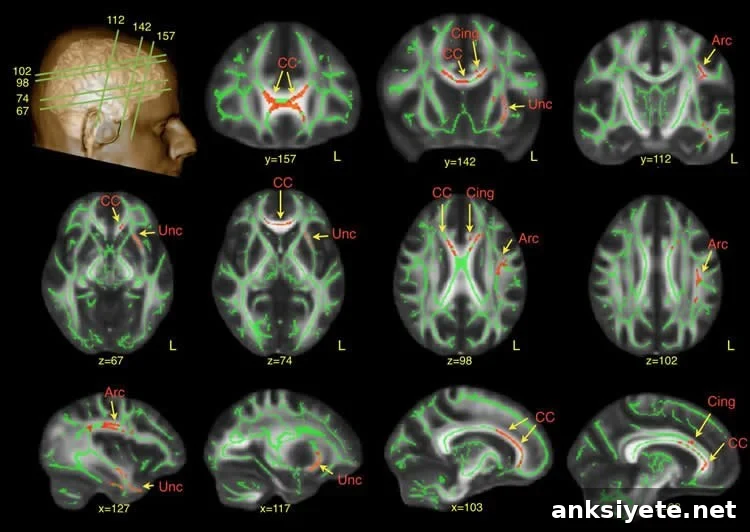
Analyses revealed that the most consistent differences were concentrated in frontal brain pathways, regions critical for language, social cognition and executive functions. In particular, the research identified atypical development of white matter on the left side of the brain in two key tracts: the arcuate fasciculus and the uncinate fasciculus.
The arcuate fasciculus links language comprehension areas with speech production regions. Men in the ASD group showed changes in this tract, including measures consistent with altered microstructure and fewer reconstructed streamlines, especially in anterior and long segments on the left side. These alterations were more pronounced in participants with a childhood history of delayed echolalia — the repeated or parrot-like echoing of words and phrases, a feature commonly observed in autism.
The left uncinate fasciculus, which connects parts of the frontal lobe with anterior temporal regions involved in face recognition and emotional processing, also showed reduced integrity in the ASD group. These differences correlated with clinical reports of atypical or inappropriate facial expression during childhood, suggesting a link between tract development and socio-emotional behaviours.
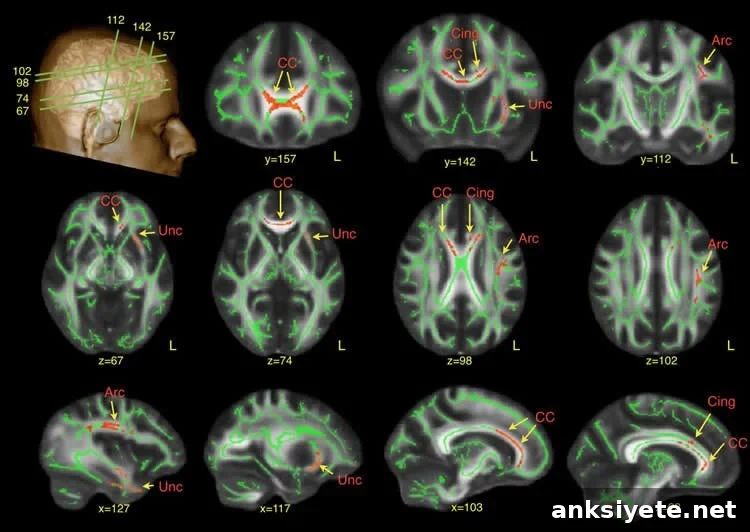
Researchers combined two complementary DTI analysis approaches. A whole-brain, voxelwise method (tract-based spatial statistics) first identified regions of lower fractional anisotropy in the autism group, indicating microstructural differences. The team then performed tractography-based, tract-specific analyses to characterise how individual pathways differed. Results showed increased diffusivity and reduced streamline counts in frontal lobe-associated tracts predominantly on the left hemisphere, and abnormalities in anterior corpus callosum sectors linking left and right frontal regions.
Lead investigator Dr Marco Catani from the Institute of Psychiatry, Psychology & Neuroscience at King’s College London explained that white matter mapping provides a window into how critical brain circuits develop during childhood. He noted that the subtle differences uncovered by these sensitive imaging methods persisted into adult life, even among men who had learned coping strategies to manage social and communication difficulties. Dr Catani emphasised that the observed differences are subtle and potentially reversible, and that future work may explore whether targeted interventions could promote healthier development or predict treatment response.
Dr Catani also highlighted a limitation of the study: it included only adult males. He suggested further research should examine whether similar patterns occur in females and in children, particularly given evidence that autistic traits and resilience may differ by sex.
Funding: This study was supported by the Medical Research Council as part of the MRC Autism Imaging Multicentre Study (MRC AIMS) Consortium.
Source: Jack Stonebridge, King’s College London
Image source: The researchers / King’s College London
Original research: Catani M., Dell’Acqua F., Budisavljevic S., et al., “Frontal networks in adults with autism spectrum disorder,” Brain, published online January 29, 2016. DOI: 10.1093/brain/awv351
Abstract (summary)
This study tested the hypothesis that autism spectrum disorder is associated with atypical connectivity of higher-order association regions, focusing on frontal networks in a sizeable sample of adult males. Using tract-based spatial statistics and tractography on diffusion tensor MRI data, researchers found reduced fractional anisotropy and other diffusion abnormalities in frontal pathways, especially in left-hemisphere arcuate, uncinate and cingulum tracts, as well as in anterior corpus callosum. Tract-specific alterations correlated with childhood symptom severity for language and social reciprocity. The findings support the view that autism involves aberrant developmental trajectories of frontal networks that can persist into adulthood.