
Summary: In a first-in-human study, researchers used a minimally invasive brain implant to produce a sense of touch in people who had lost tactile sensations. This approach may offer a path to restore fingertip sensation for individuals with paralysis, neuropathy or other sensory loss.
Source: Feinstein Institute for Medical Research
Researchers at The Feinstein Institutes for Medical Research have demonstrated that targeted stimulation of deep (sulcal) regions of the brain can evoke precise touch sensations, using minimally invasive stereoelectroencephalography (SEEG) electrodes.
Published in Brain Stimulation, this study shows that stimulating sulcal areas of primary somatosensory cortex (S1) can produce focal percepts localized to the fingertips—an advance that could improve sensory restoration strategies for millions affected by loss of touch.
Loss of tactile sensation can result from stroke, spinal cord injury, diabetes-related neuropathy and other conditions, profoundly affecting daily tasks and quality of life. When touch is absent, routine actions such as holding a cup, fastening clothing, or feeling a loved one’s hand become difficult or unsafe. Regaining even partial, localized touch can significantly enhance independence and emotional well-being.
Previous brain-computer interface (BCI) efforts have restored hand sensations by electrically stimulating cortical surface (gyral) areas. However, anatomical studies show that representations of distal fingers often extend into sulcal grooves, which are harder to reach with surface electrodes. This study tested whether stimulation delivered directly within sulci via SEEG depth electrodes can evoke more precise fingertip percepts than surface stimulation.
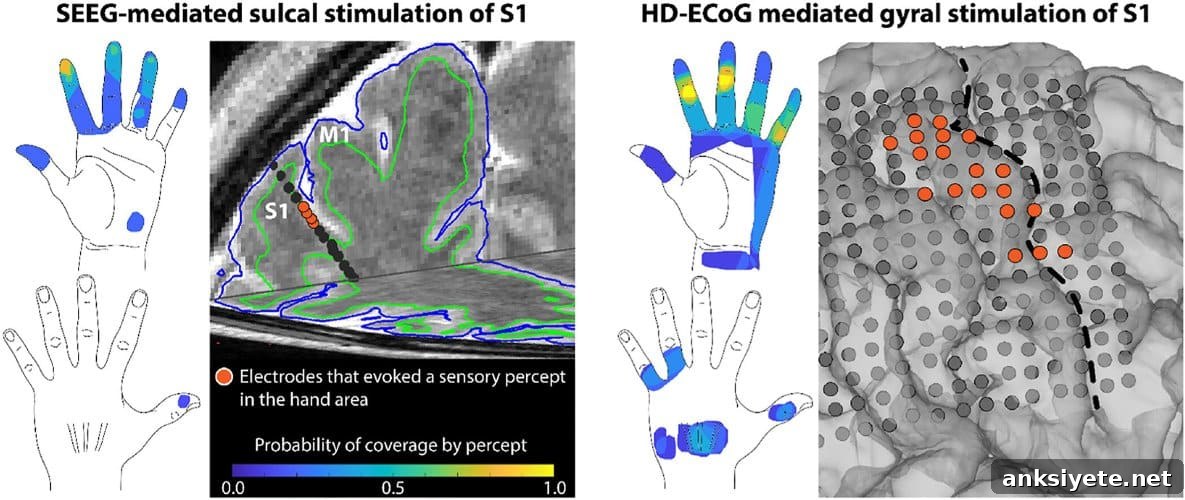
Under the guidance of neurosurgery and bioelectronic medicine teams at Feinstein, two participants undergoing evaluation for epilepsy received both high-density electrocorticography (HD-ECoG) grids on cortical surfaces and SEEG depth electrodes positioned in the sulci. During stimulation of these different sites, participants described the sensations elicited, often reporting tingling or an electrical feeling localized to the hand and fingertips.
Clinical potential and bioelectronic medicine
The Feinstein Institutes leads research in bioelectronic medicine, an interdisciplinary field combining neuroscience, molecular medicine and engineering to treat disease by targeted nerve stimulation. Restoring touch through intracranial stimulation sits squarely within this approach, which already explores treatments for conditions such as paralysis, inflammatory disorders and pulmonary hypertension.
According to study co-principal investigator Chad Bouton, professor in the Institute of Bioelectronic Medicine, the ability to generate tactile sensation even after loss opens the door to future clinical options that could restore essential sensory feedback for people with sensory deficits.
Kevin J. Tracey, MD, president and CEO of the Feinstein Institutes, noted that advances in artificial intelligence, electrode technology and bioelectronic medicine create promising opportunities to restore functions lost to spinal cord injury and stroke.
Beyond stimulation, the team used the same SEEG electrodes to record neural activity while the participants’ hands received mechanical stimulation. Those recordings showed that sulcal neural activity strongly correlated with tactile input to the fingertips, reinforcing the somatotopic mapping between specific sulcal sites and fingertip sensation.
The investigators also leveraged high-resolution functional MRI, cortical myelin maps and cortical thickness data from the Human Connectome Project to identify precise subregions of S1 associated with hand and finger representation. These multimodal maps helped target stimulation to areas most likely to produce focal fingertip percepts.
About this neurotech research news
Author: Matthew Libassi
Source: Feinstein Institute for Medical Research
Contact: Matthew Libassi – Feinstein Institute for Medical Research
Image: The image is credited to the researchers
Original Research: Open access. “Evoking highly focal percepts in the fingertips through targeted stimulation of sulcal regions of the brain for sensory restoration” by Santosh Chandrasekaran et al., Brain Stimulation
Abstract
Evoking highly focal percepts in the fingertips through targeted stimulation of sulcal regions of the brain for sensory restoration
Highlights
- •SEEG stimulation of sulcal S1 produced fingertip-localized percepts more often than gyral (surface) stimulation.
- •Functional MRI, myelin, and cortical thickness maps helped delineate hand and finger representation within sulcal S1.
- •Sulcal stimulation evoked more focal sensations than stimulation of the postcentral gyrus surface.
- •Neural recordings in sulcal sites showed strong correlation with mechanical tactile stimulation of the fingertips.
Abstract
Background
Millions worldwide experience paralysis and neuropathy accompanied by loss of somatosensation. Because distal finger representations extend into sulcal regions of S1, surface stimulation alone has been limited in producing focal fingertip percepts. This gap motivated exploration of sulcal-targeted stimulation using depth electrodes.
Objective/hypothesis
The study tested whether targeted stimulation of sulcal S1 with SEEG depth electrodes can evoke focal sensory percepts in the fingertips.
Methods
Two participants with intractable epilepsy received both gyral stimulation via HD-ECoG grids and sulcal stimulation via SEEG leads. Researchers characterized the sensations evoked and analyzed neural recordings alongside imaging-derived maps of S1.
Results
Sulcal stimulation produced highly focal fingertip percepts. Imaging data identified specific S1 subregions responsible for these sensations. Within-participant comparisons showed sulcal-evoked percepts covered significantly less area (approximately 80% smaller) and more frequently targeted fingertips than gyral-evoked sensations. Neural activity in sulcal locations during mechanical fingertip stimulation matched the somatotopic patterns observed with electrical stimulation.
Conclusions
Minimally invasive sulcal stimulation using SEEG electrodes may be a clinically viable strategy for restoring focal tactile sensations, particularly in the fingertips. These findings support further development of bioelectronic therapies aimed at sensory restoration for people with paralysis and neuropathy.