
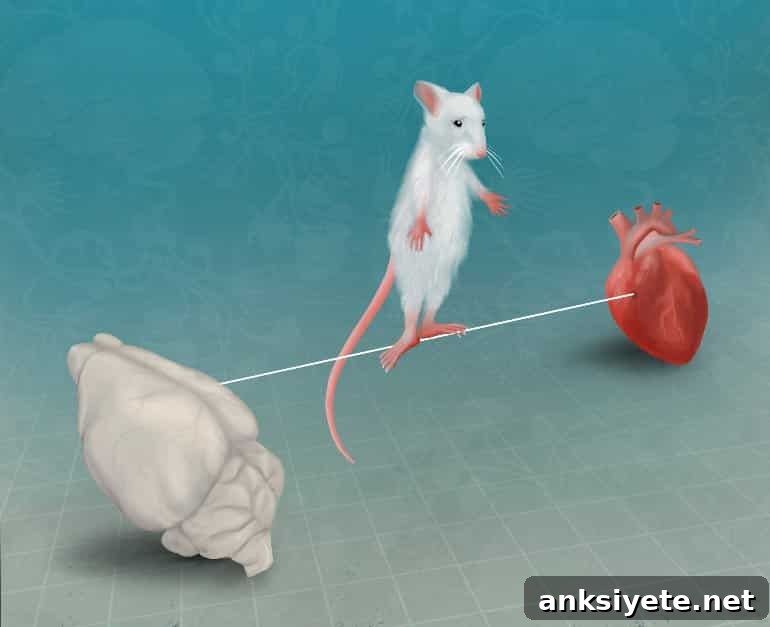
Summary: New research from the Max Planck Institute shows that the brain uses bodily feedback to regulate fear. In mice, freezing behavior slows the heart, and this cardiac slowdown reduces activity in the insular cortex, helping to balance the fear response.
Source: Max Planck Institute
Fear is vital for survival but must be kept within adaptive bounds to prevent disorders such as panic attacks or excessive risk-taking.
Researchers at the Max Planck Institute of Neurobiology have demonstrated in mice that the brain depends on signals from the body to regulate fear. Their experiments reveal that bodily responses are not merely byproducts of emotion but are actively used by the brain to maintain emotional balance.
The insular cortex, a brain region known for processing both positive and negative emotions and for receiving internal body signals, reacts strongly to cues that predict danger. However, when a mouse responds to threat by freezing, its heartbeat slows down. This deceleration generates feedback that attenuates activity in the insular cortex. By integrating these opposite signals—external danger cues and internal cardiac feedback—the insular cortex helps keep fear within an appropriate range.
We typically experience fear as unpleasant, yet it plays a critical role in preventing us from taking unsafe actions. This protective function depends on fear remaining proportional to real risk. Excessive fear underlies anxiety disorders and can severely disrupt daily life. Understanding how the brain constrains fear is therefore essential for both basic neuroscience and potential clinical applications.
Although it has long been clear that emotions produce bodily changes—such as faster heartbeats or altered breathing—the exact way the brain reads these signals to regulate emotions like fear has been unclear. The team led by Nadine Gogolla focused on the insular cortex because it integrates sensory input about the external world with interoceptive signals from organs such as the heart and lungs.
In the behavioral paradigm, researchers paired a tone with an unpleasant stimulus. After repeated pairings, mice displayed conditioned fear to the tone, expressed as freezing—a widespread defensive behavior seen across species. When the tone was later presented without the unpleasant stimulus, mice gradually reduced their fear through a process called extinction, learning that the tone no longer predicted harm.
Insular cortex regulates fear in a state-dependent way
To test the insular cortex’s role in this “fear unlearning,” the researchers temporarily inactivated this brain region during extinction. The results were surprising: the effect of insular cortex inactivation depended on the animals’ initial fear level. Highly fearful mice took longer to extinguish their fear when the insular cortex was inactivated, while less fearful mice extinguished more quickly than controls. These findings indicate that the insular cortex acts to hold fear within a functional range—promoting unlearning when fear is excessive and supporting memory maintenance when fear is low.
Recording neural activity revealed complementary patterns: in less fearful mice, insular cortex activity rose when the tone sounded, while in highly fearful mice the same tone produced a decrease in insular activity. Importantly, the decrease in activity coincided with freezing episodes.
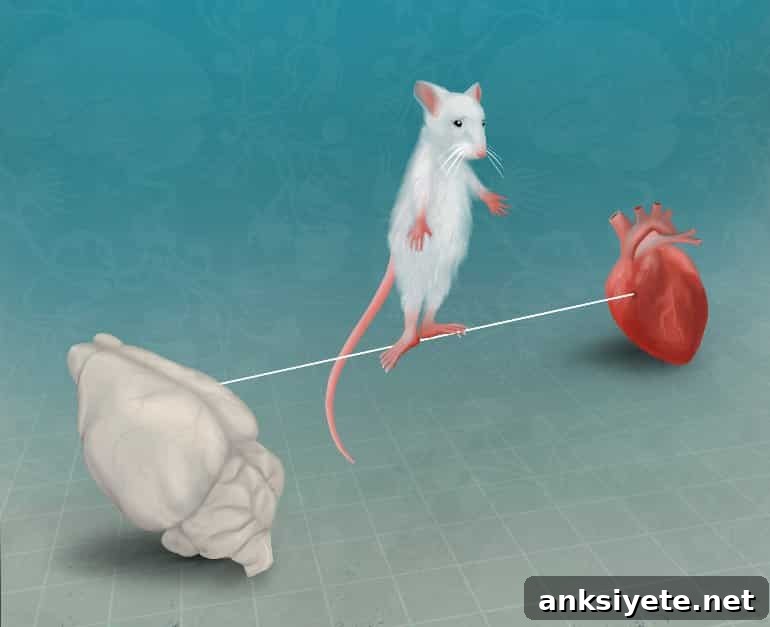
The team observed that when a mouse froze in response to the tone, its heart rate slowed and insular cortex activity dropped. Fearful animals froze more frequently and for longer durations when hearing the tone, consistent with the observed insular deactivation during those periods.
Bodily feedback via the vagus nerve shapes insular responses
To test whether cardiac feedback drives the insular response, researchers disrupted communication between the heart and brain via the vagus nerve. When this body-brain pathway was interfered with, insular cortex activity no longer dropped during freezing; it remained stable. This manipulation produced behavioral effects similar to directly inhibiting the insular cortex, demonstrating that feedback from the body is required for the insular cortex to maintain fear at an appropriate level.
The results support the view that bodily changes during freezing are integral to emotion regulation—not passive outcomes. Bodily feedback provides teaching signals that the insular cortex uses to gate extinction and maintenance of fear memories, enabling graded, bidirectional control of fear depending on the animal’s state.
Because insular cortex dysfunction in humans has been linked to various anxiety disorders, these findings open new avenues for considering how behavioral states and their bodily signals might be harnessed to regulate emotions. The study underscores the importance of studying body-brain interactions when exploring the neural basis of emotion regulation.
“Neuroscience has often treated the brain in isolation,” says Alexandra Klein, first author of the study. “Our data highlight that bodily signals are essential contributors to how emotions are regulated and should be taken into account when investigating fear and anxiety.”
About this fear research news
Author: Press Office
Source: Max Planck Institute
Contact: Press Office – Max Planck Institute
Image: The image is credited to MPI
Original Research: Closed access. “Fear balance is maintained by bodily feedback to the insular cortex in mice” by Alexandra S. Klein et al., published in Science.
Abstract
Fear balance is maintained by bodily feedback to the insular cortex in mice
How does the brain keep fear within an adaptive range? The study found that the insular cortex functions as a state-dependent regulator that balances extinction and maintenance of fear memories in mice. Insular responsiveness to cues predicting harm increased with the certainty of threat but was suppressed by negative bodily feedback arising from heart rate decelerations during freezing. Disrupting body-brain communication via vagus nerve stimulation altered the balance between extinction and maintenance in a manner similar to insular cortex inhibition. These data show that the insular cortex integrates predictive sensory and interoceptive signals to provide graded, bidirectional teaching signals that gate fear extinction and help maintain fear within a functional equilibrium.