
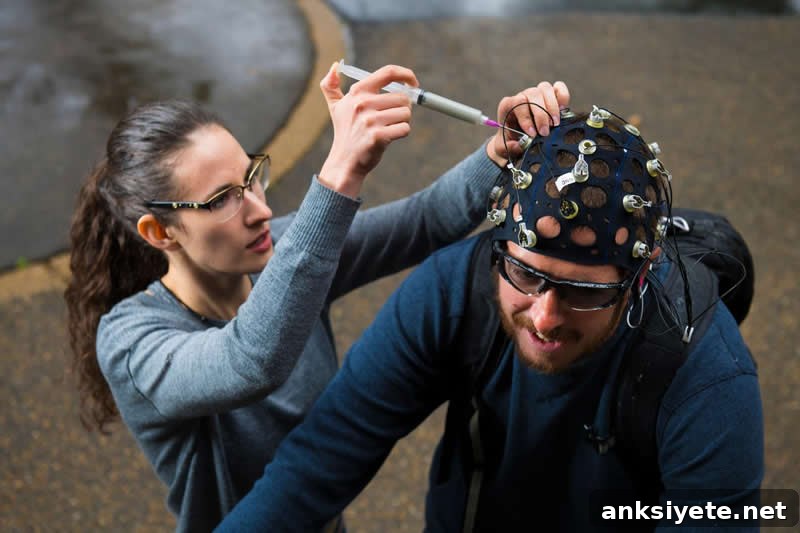
Summary: Researchers found that background sounds alter brain activity during cognitive tasks. Playing outdoor ambient noise produced the largest changes, highlighting how everyday environments influence attention and perception.
Source: University of Alberta
Background noise affects attention and brain signals, and scientists at the University of Alberta are exploring what those effects mean for both basic neuroscience and practical neurotechnology.
“Why do we prefer to perform some tasks in silence and others with ambient sound? What does the brain do to prevent distraction when we leave a quiet room?” asked Joanna Scanlon, lead author of the study and a former graduate student in the Department of Psychology. The team investigated how different background sounds change brain responses while people complete a standard cognitive task.
“Understanding how the brain handles tasks in different environments is essential for translating laboratory findings to real life.”
To create a practical baseline for how the brain responds to environmental sound, the researchers measured neural activity while participants completed an auditory oddball task under several listening conditions: silence, white noise, outdoor ecological sounds (for example, passing traffic), and a low-volume tone condition. Using electroencephalogram (EEG) recordings, they examined early event-related potentials (ERPs) that reflect sensory processing and filtering.
The main finding was clear: background noise provoked measurable and consistent changes in brain activity during the cognitive task. Specifically, the team observed an increase in the N1 component and a decrease in the P2 component of early ERPs when participants listened to outdoor ecological sounds and white noise. The most pronounced modulation occurred with outdoor sounds, such as traffic noise. Importantly, these neural changes occurred even though participants’ behavioral performance on the task — their responses to target tones — did not differ across conditions.
Scanlon emphasized the significance of these results: “We could alter brain responses during a cognitive task simply by adding natural background sounds. This demonstrates that everyday environments shape sensory processing, and suggests much laboratory research may oversimplify how the brain functions in real-world settings.”
The study also underscores the value of mobile EEG technologies. As researchers develop lightweight, wearable EEG systems, it becomes possible to study brain function in realistic settings outside the traditional laboratory. Kyle Mathewson, assistant professor who supervised the project, noted the practical implications: “If we want neurotechnology that assists people in daily life — devices that detect lapses in attention or help memory in real time — those systems must operate reliably in noisy, dynamic environments. Our results show why testing outside the lab is essential.”
Source:
University of Alberta
Media Contact:
Andrew Lyle – University of Alberta
Image Credit:
John Ulan
Original Research: Closed access
Title: “The ecological cocktail party: Measuring brain activity during an auditory oddball task with background noise” — Joanna Scanlon et al.
Psychophysiology doi: 10.1111/psyp.13435.
Abstract (summary)
Most EEG experiments take place in tightly controlled laboratory settings, which limits their applicability to everyday life. Advances in mobile EEG allow recordings outside the lab, but we first need to understand how ecological stimuli affect brain activity during cognitive tasks. In this experiment, participants performed an auditory oddball task while exposed to silence, white noise, outdoor ecological sounds, and a low-volume tone condition. The results showed significantly increased N1 and decreased P2 components when background sounds were present, with the largest effect for outdoor sounds. These ERP changes were interpreted as sensory filtering of background noise: complex, ecologically valid sounds appear to demand greater filtering than simple synthetic sounds. No behavioral differences were found for target detection, suggesting that neural processing adjusts to maintain performance. The findings indicate that cognitive neuroscience must account for real-world environments as research moves beyond the lab.