
New Method Preserves Muscle Stem Cells and Improves Transplantation Efficiency for Duchenne Muscular Dystrophy
Summary: A recent study describes a culture method that preserves the undifferentiated state of muscle satellite cells and improves their transplantation performance, a development that could advance therapies for Duchenne muscular dystrophy.
Source: IOS Press.
Satellite cells, culture challenges, and LIF
Satellite cells are the resident stem cells of skeletal muscle and are a central cell source for regenerative therapies aimed at treating degenerative muscle disorders, including Duchenne muscular dystrophy. For clinical application, these cells must be expanded in vitro to produce sufficient numbers for transplantation. However, when satellite cells are cultured outside the body they often lose their undifferentiated, stem-like state and begin to differentiate, which reduces their ability to engraft and regenerate muscle after transplantation.
Researchers have tested a variety of growth factors, cytokines, and chemical additives to preserve satellite cell potency during culture, but optimal conditions that reliably maintain undifferentiated status and maximize transplantation efficiency remain to be established. In the study reported here, investigators examined the effect of leukemia inhibitory factor (LIF) on primary satellite cells maintained in culture and then evaluated how LIF affected their capacity to form new muscle fibers after transplantation.
Key findings
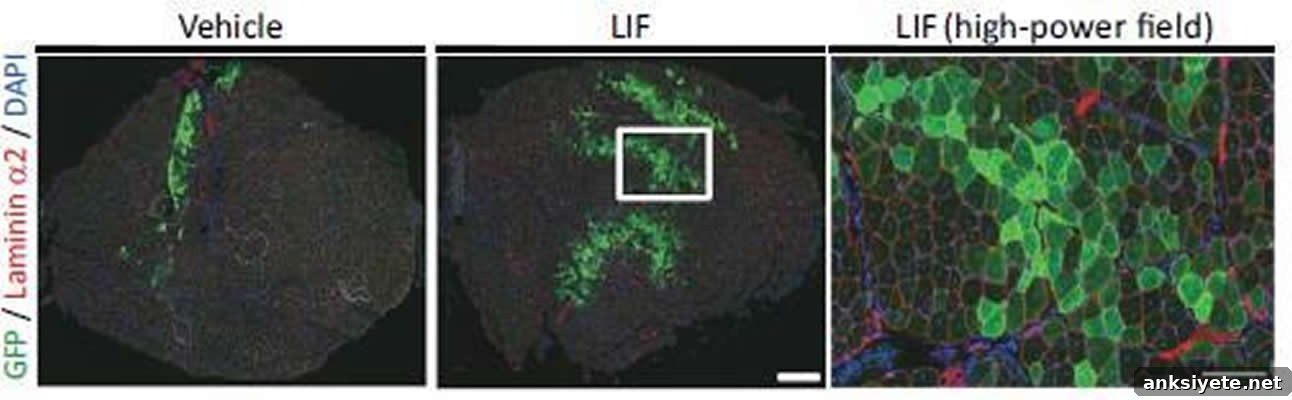
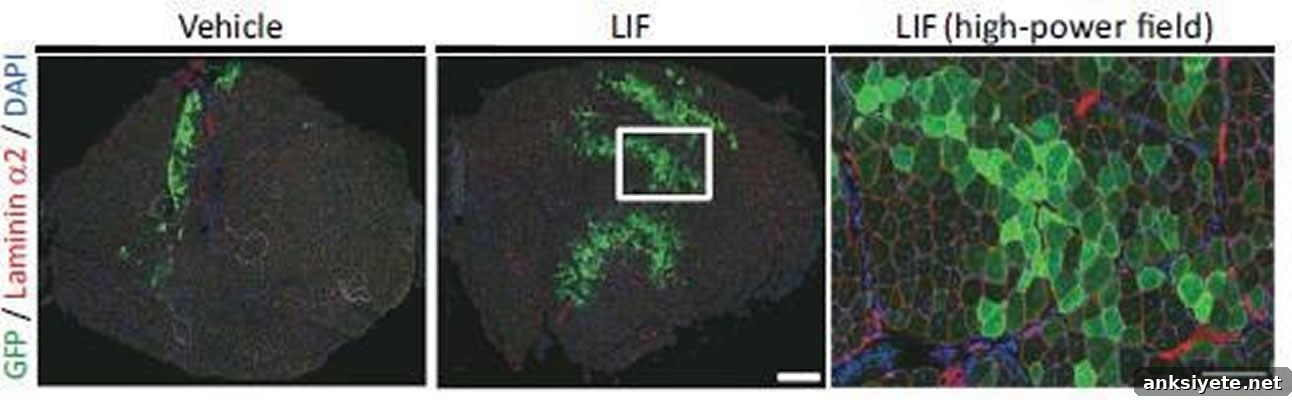
The researchers found that treating primary satellite cells with LIF during culture helped maintain markers associated with an undifferentiated state—specifically, increased expression of Pax7 was observed in LIF-treated cells. When these treated cells were transplanted into skeletal muscle in a mouse model of Duchenne muscular dystrophy, they produced substantially more new muscle fibers than control cells cultured without LIF. Quantitatively, LIF-treated cells generated roughly two to three times the number of muscle fibers compared with untreated cells, indicating a marked improvement in transplantation efficiency.
Significance and next steps
According to Shin’ichi Takeda, MD, PhD, of the Department of Molecular Therapy at the National Institute of Neuroscience, National Center of Neurology and Psychiatry in Kodaira, Japan, this study is the first to report that LIF improves the transplantation efficiency of primary satellite cells. The findings represent a step forward in defining culture conditions that preserve satellite cell potency and improve outcomes for cell transplantation therapies targeted to muscle disease.
Dr. Takeda also emphasized that while the functional benefits of LIF are clear from these experiments, the precise molecular mechanisms through which LIF enhances transplantation efficiency remain to be elucidated. Determining the downstream targets and signaling pathways engaged by LIF in muscle satellite cells will be important to fully understand its role in muscle regeneration and to optimize protocols for clinical cell transplantation.
About this research
Source: D. Watrin – IOS Press.
Image credit: IOS Press.
Original research: Ito, N.; Shimizu, N.; Tanaka, H.; and Takeda, S. “Enhancement of Satellite Cell Transplantation Efficiency by Leukemia Inhibitory Factor,” Journal of Neuromuscular Diseases. Published online June 6, 2016. doi:10.3233/JND-160156
Abstract (summary)
Background and objectives: Cell transplantation offers a promising route to treat muscle diseases such as Duchenne muscular dystrophy. Satellite cells are the key stem cell population in skeletal muscle and are a practical cell source for transplantation. However, culture-induced loss of their undifferentiated state reduces transplantation efficiency, creating a need for culture methods that preserve satellite cell potency.
Methods: Primary satellite cells were cultured with or without leukemia inhibitory factor (LIF). The investigators monitored markers of undifferentiation and differentiation, and assessed transplantation efficiency in a preclinical model.
Results: Treatment with LIF increased expression of the satellite cell marker Pax7 and enhanced transplantation efficiency in a mouse model of Duchenne muscular dystrophy, with LIF-treated cells forming substantially more muscle fibers than untreated cells.
Conclusions: LIF treatment during culture helps maintain the undifferentiated state of primary satellite cells and significantly improves their capacity to regenerate muscle after transplantation. These results contribute to the development of optimized culture conditions for satellite cell–based therapies for muscle disease.
Feel free to share this summary of the research.