
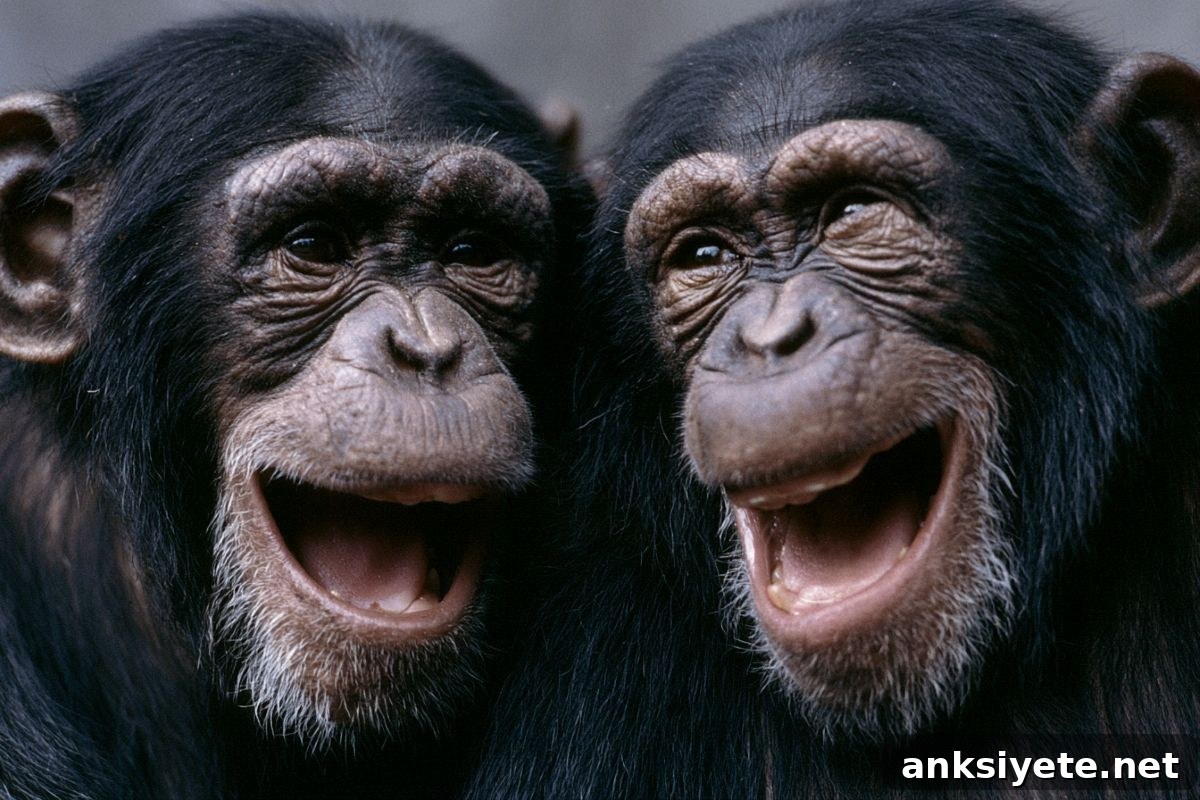
Summary: Laughter is a universal vocal behaviour shared by all living great apes—chimpanzees, bonobos, gorillas, orangutans—and by humans. New comparative research has tracked a deep evolutionary timeline for this behaviour and identified a 15‑million‑year‑old neurobiological signature hidden in the rhythm of laughter. The study reveals a conserved rhythmic structure across species that likely provided key neural and motor foundations for the later emergence of human speech.
Researchers performed detailed acoustic analyses on 140 laughter sequences collected from four orangutans, two gorillas, three bonobos, four chimpanzees and four humans. Across species, every sample showed the same basic timing pattern: an isochronous, evenly spaced rhythm between successive vocal elements. That identical rhythmic architecture indicates the fundamental timing mechanism for vocalization existed in a shared ancestor about 15 million years ago and has been retained across the hominid lineage.
Although the core rhythm is conserved, the study finds important human-specific shifts: human laughter tends to be faster, more varied in structure, and under far greater voluntary control. These changes reflect an incremental enhancement of vocal timing precision and cognitive modulation over millions of years—features that likely served as building blocks for controlled speech.
Key facts
- Conserved 15‑million‑year rhythm: All living great apes produce laughter with an identical acoustic framework of evenly spaced, rhythmic intervals.
- Evolutionary continuum: The finding challenges any claim that human vocal capacities arose abruptly; instead, human vocal traits sit on a prolonged continuum stretching back at least 15 million years.
- Human-specific expansion: Human laughter has evolved to be faster and more structurally variable, enabling richer emotional and social signalling.
- Context-dependent control: Humans uniquely exhibit sophisticated, conscious control over laughter—ranging from involuntary tickle responses to polite, nervous, or deliberately contagious laughs.
- Foundations for speech: Gradual improvements in timing and vocal‑cord modulation provided the neurological and motor scaffolding necessary for complex spoken language.
- Vocal fossil substitute: Because speech leaves no physical fossils, conserved non‑linguistic vocalizations like laughter act as living “vocal fossils” that reveal deep evolutionary change in vocal control.
Source: University of Warwick
All living great apes laugh, but until now it was unclear how that laughter changed over millions of years and how it connects to the evolution of human speech.
Published in Communications Biology, the comparative study analysed laughter recordings from orangutans, gorillas, bonobos, chimpanzees and humans. The consistent discovery across 140 laughter sequences was an isochronous rhythm—regular, evenly spaced intervals between vocal elements—present in every species sampled.
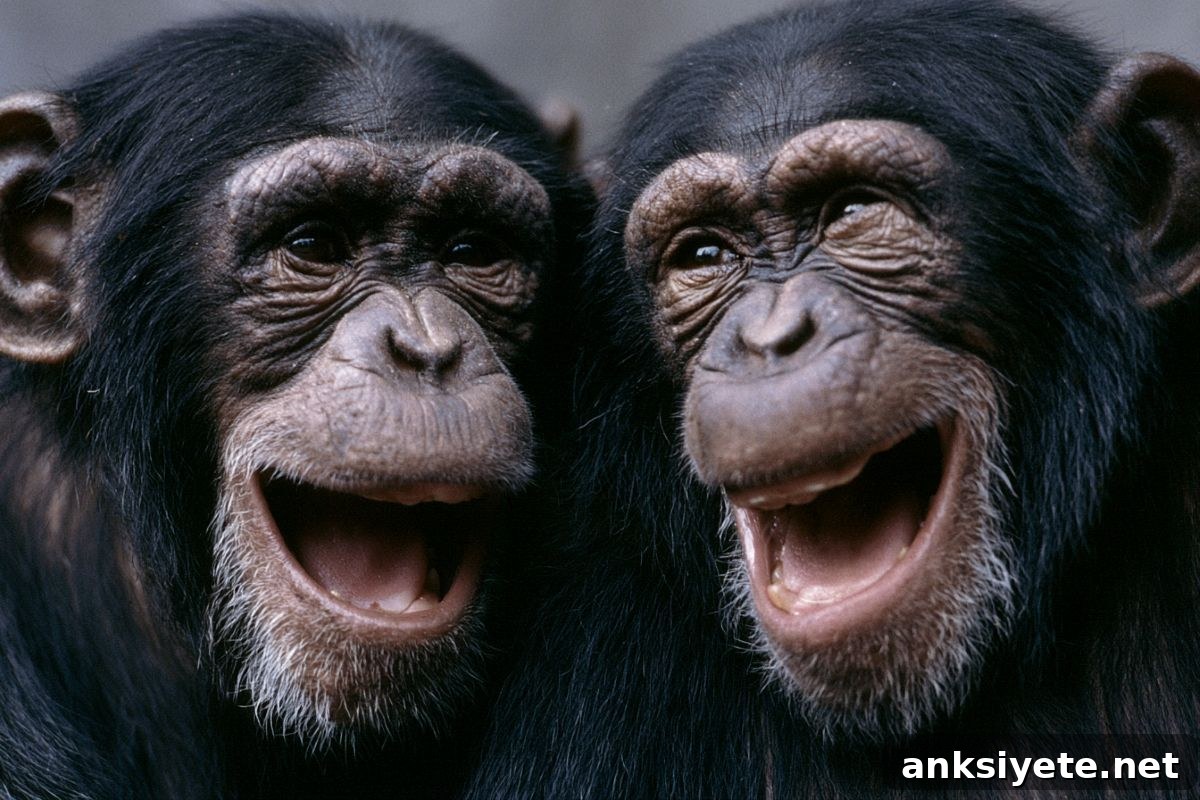
The authors argue that this basic rhythm was already present in the last common ancestor of modern great apes around 15 million years ago and has been remarkably conserved across the hominid branch. That conservation allows researchers to use laughter as a proxy for tracking evolutionary changes in vocal motor control when direct evidence of ancient speech is absent.
Dr Chiara De Gregorio, Honorary Research Associate in the Department of Psychology at the University of Warwick, commented on the significance: “Speech leaves no fossils, but laughter is shared by all living great apes. By comparing how different species laugh, we can identify a deep, conserved rhythmic structure that dates back to our common ancestor—an extraordinary window into the evolution of vocal control.”
While the timing mechanism is shared, humans have developed faster, more variable laughter and advanced cognitive control over when and how to laugh. This capacity allows humans to use laughter intentionally—to politely signal social affiliation in formal contexts, to mask discomfort with a nervous chuckle, to express uncontrollable joy during play, or to trigger contagious laughter in groups.
Dr Adriano Lameria, Associate Professor in ApeTank at the University of Warwick, added that laughter supplies a rare evolutionary window: “We cannot directly observe the vocal behaviour of extinct ancestors, but laughter—evolutionarily older and shared across great apes—reveals cumulative changes in vocal timing and control that culminated in human vocal plasticity.”
Key questions answered
A: Speech is complex and leaves no physical fossil record, so direct evidence from extinct hominids is unavailable. Laughter, however, is a primal vocalisation shared by all living great apes. Because its rhythmic properties are conserved, comparing laughter across species gives researchers a living proxy—a “vocal fossil”—to trace how primate brains gradually learned to control air and sound over millions of years.
A: Although humans share the same basic rhythmic spacing between sounds as other great apes, human laughter is generally faster and far more variable in pitch and structure. Crucially, humans possess enhanced conscious control over laughter, allowing deliberate suppression or modulation to convey social intentions unavailable to other apes.
A: Older theories that proposed a sudden, isolated genetic leap to advanced vocal control are challenged by these findings. The preserved rhythmic pattern across great apes supports a gradualist model: human vocal plasticity is the result of a prolonged evolutionary trajectory of incremental improvements in timing and motor control over at least 15 million years.
Editorial notes
- This article was edited by a Neuroscience News editor.
- The journal paper was reviewed in full by the editorial team.
- Additional context was provided by staff writers.
About this evolutionary neuroscience research news
Author: Matt Higgs
Source: University of Warwick
Contact: Matt Higgs – University of Warwick
Image credit: Neuroscience News
Original research: De Gregorio C., Davila‑Ross M., & Lameira A. R., “Rhythm and timing in laughter reveal that human vocal plasticity falls on a hominid continuum.” Communications Biology. DOI: 10.1038/s42003-026-10499-z (open access).
Abstract
Rhythm and timing in laughter reveal that human vocal plasticity falls on a hominid continuum
Laughter is a universal non‑linguistic vocal expression shared by all extant great apes, making it a valuable proxy for tracing the evolution of vocal control that ultimately enabled language. This study shows, through comparative analysis across orangutans, gorillas, bonobos, chimpanzees and humans, that the laughter of the last common ancestor was already isochronous. Over hominid evolution laughter became faster, more variable and increasingly context‑sensitive. The evolutionary trajectory of laughter’s rhythm indicates a progressive increase in vocal rhythmic plasticity, with humans following the same trend toward enhanced voluntary vocal control.