
Ultra-Rare Structural Variants at TAD Boundaries Implicated in Schizophrenia Risk
Summary: New evidence from the largest whole genome sequencing study to date suggests that very rare structural genetic variants that disrupt the boundaries of topologically associated domains (TADs) may contribute to the development of schizophrenia.
Source: UNC Health Care
Most genetic research on schizophrenia has focused on common single-nucleotide polymorphisms (SNPs), rare protein-coding mutations, or very large structural changes in the genome. While those studies have identified many risk factors, substantial portions of the genome remained unexplored in relation to schizophrenia. Researchers at the UNC School of Medicine have now conducted the largest whole genome sequencing (WGS) study of schizophrenia to date, offering a more complete look at how the entire genome might influence this complex psychiatric disorder.
Published in Nature Communications, the study was co-led by senior author Jin Szatkiewicz, PhD, associate professor in the UNC Department of Genetics. The research points to a potentially important role for ultra-rare structural variants—large mutations that can delete, duplicate, or otherwise rearrange stretches of DNA—when those variants affect the boundaries of three-dimensional genome structures called topologically associated domains (TADs).
“Our results suggest that ultra-rare structural variants that affect the boundaries of a specific genome structure increase risk for schizophrenia,” Szatkiewicz said. “Alterations in these boundaries may lead to dysregulation of gene expression, and we think future mechanistic studies could determine the precise functional effects these variants have on biology.”
Whole genome sequencing provides the most comprehensive view of genetic variation, including regions outside protein-coding exons and genomic areas poorly covered by previous methods. Historically, WGS has been used less often because of its high cost. For this study, international partners combined funding from the National Institute of Mental Health and matching support from Sweden’s SciLife Labs to perform deep WGS on 1,165 people with schizophrenia and 1,000 controls—making it the largest known WGS study focused specifically on schizophrenia.
That broader genomic view revealed previously undetectable mutations associated with the disorder. In particular, the researchers found a significant excess of extremely rare structural variants that localize to TAD boundaries in brain tissue among individuals diagnosed with schizophrenia compared with unaffected controls.
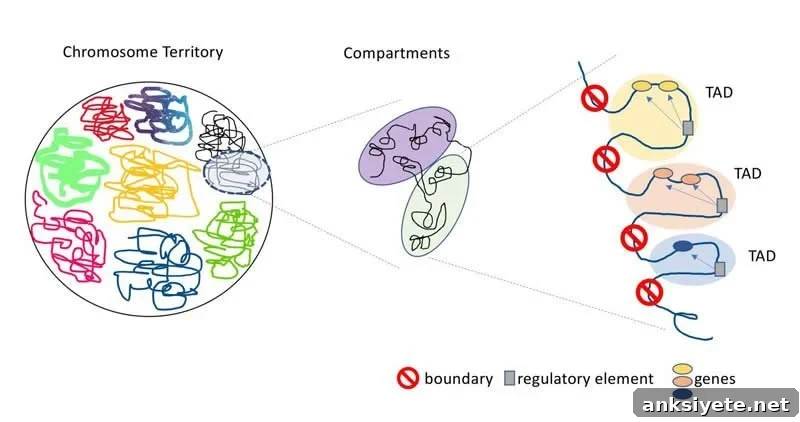
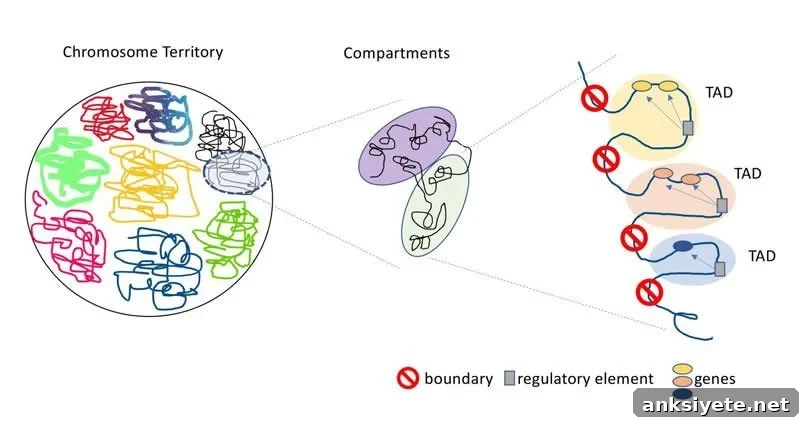
TADs are three-dimensional regions of the genome organized so that regulatory elements and genes within the same domain interact preferentially with each other while being insulated from neighboring domains. The boundaries that separate TADs are important for maintaining these regulatory neighborhoods. When a boundary is shifted, weakened, or removed by a structural variant, genes and enhancers that normally remain separate can come into contact. Such aberrant interactions can change gene expression patterns in ways that contribute to developmental disorders, congenital abnormalities, cancer, or, as this study suggests, neuropsychiatric conditions like schizophrenia.
This study is the first to report a link between structural variation at TAD boundaries and schizophrenia risk, highlighting a new class of genomic events for further functional investigation. The findings nominate TAD-boundary–affecting structural variants as promising targets for mechanistic studies that could uncover how disrupted three-dimensional genome architecture alters gene regulation in the brain.
“A possible future investigation would be to work with patient-derived cells with these TADs-affecting mutations and figure out what exactly happened at the molecular level,” Szatkiewicz added. “In the future, we could use this information about the TAD effects to help develop drugs or precision medicine treatments that could repair disrupted TADs or affected gene expressions which may improve patient outcomes.”
The study’s authors note that combining these WGS data with other large sequencing efforts will increase sample sizes and statistical power to confirm and extend these findings. Growing WGS datasets will help the research community further map the genetic architecture of schizophrenia and test how structural variants that alter three-dimensional genome organization influence brain development and function.
Co-senior author Patrick Sullivan, MD, Yeargen Distinguished Professor of Psychiatry and Genetics at the UNC School of Medicine and Director of the Center for Psychiatric Genomics, contributed to the study. Co-first authors from UNC include Matthew Halvorsen, PhD; Ruth Huh, PhD; and Jia Wen, PhD, all from the UNC Department of Genetics. Additional UNC contributors include Paola Giusto-Rodriguez, PhD; NaEshia Ancalade; Martilias Farrell, PhD; James Crowley, PhD; and Yun Li, PhD.
Funding and collaboration: This research was performed through collaboration among teams at UNC-Chapel Hill, Lund University, Chalmers University of Technology, the Karolinska Institutet, and Uppsala University, with financial support from the National Institute of Mental Health and matching funds from Sweden’s SciLife Labs.
Original research (open access): “Increased burden of ultra-rare structural variants localizing to boundaries of topologically associated domains in schizophrenia” by Matthew Halvorsen et al., Nature Communications. DOI: 10.1038/s41467-020-15707-w.
About this genetics research article
Media contact:
Mark Derewicz – UNC Health Care