
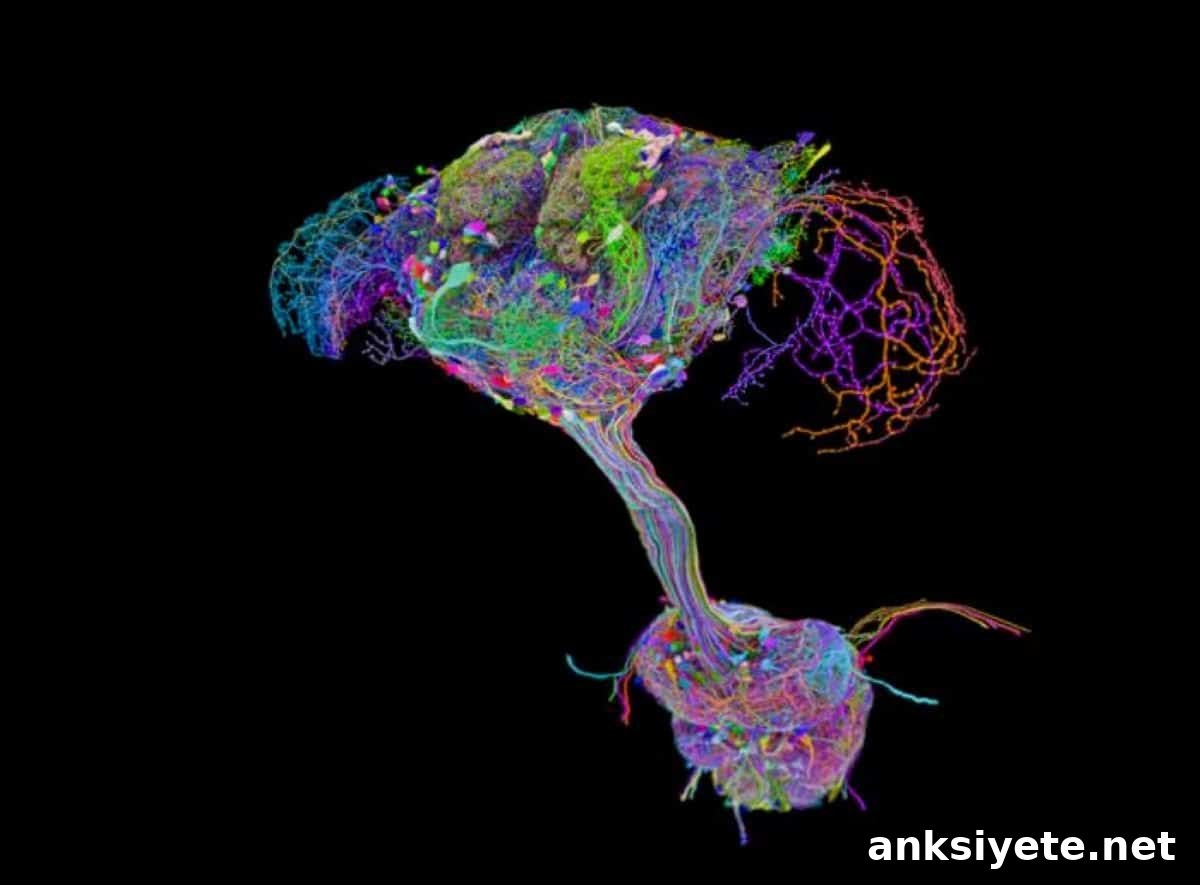
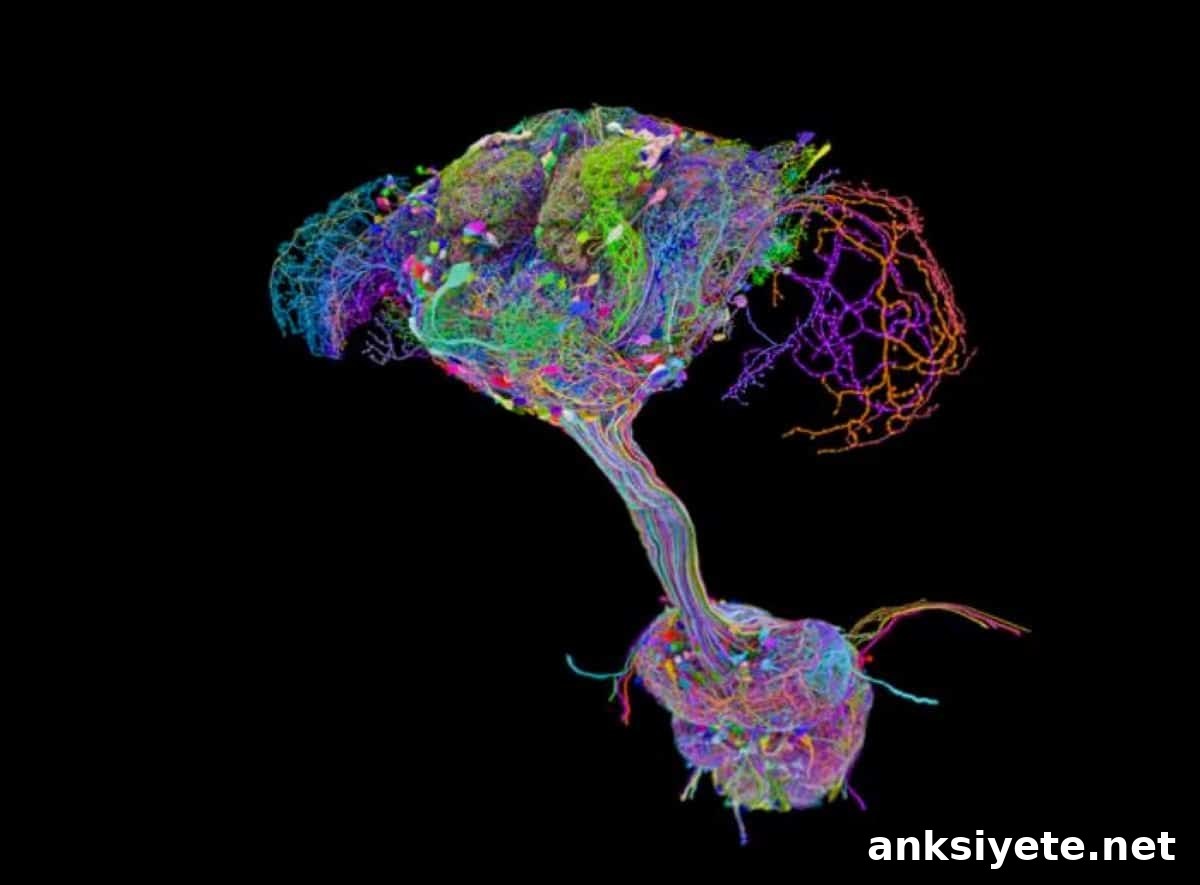
Summary: An international team led by researchers at Harvard Medical School and Princeton University has published the first complete synapse-level wiring diagram—the connectome—of an adult fruit fly’s entire central nervous system (Drosophila melanogaster). By combining a newly mapped ventral nerve cord (the fly’s spinal-cord equivalent) with an existing brain connectome, the study delivers a unified, high-resolution view of how sensory signals become coordinated motor actions across the whole animal.
Key Facts
- Complete central nervous system connectome: For the first time, scientists can trace information flow from sensory input to motor output across an intact adult invertebrate nervous system at synapse resolution.
- The BANC (Brain and Nerve Cord) dataset: High-resolution electron microscopy images from thousands of ultra-thin sections were aligned and reconstructed using custom AI tools to produce a fully integrated brain-and-nerve-cord map.
- Distributed control architecture: Structural analysis reveals that many behaviors, including walking and flying, are governed primarily by local neural circuits in the body’s appendages rather than by a single centralized brain controller.
- Extension of FlyWire work: This project builds on the 2024 FlyWire brain connectome and bridges those cerebral circuits with motor and sensory networks in the ventral nerve cord.
- Embodied connectome: Although the imaging focused on the central nervous system, identifiable neurons and existing literature were used to link synaptic maps out to peripheral sensory organs and appendages, effectively “embodying” the connectome.
- Open resource for neuroscience: Supported in part by the U.S. BRAIN Initiative, NIH, and NSF, the interactive dataset is freely available to the research community as a foundational resource for comparative and computational neuroscience.
- Implications for AI and robotics: The connectome’s decentralized wiring offers concrete design principles for building efficient, distributed control systems for artificial agents and robots.
Source: Harvard
Overview
This landmark study provides a comprehensive map of all neural connections within a single adult fruit fly’s central nervous system, uniting the brain and ventral nerve cord into one synapse-resolution dataset. The unified connectome enables researchers to examine how sensory inputs are transformed into coordinated actions such as leg movements for walking or wing movements for flight, and to test long-standing hypotheses about neural control at an unprecedented level of detail.
“For the first time we can examine the entire set of neurons and their synaptic connections as a single system and ask what that reveals about behavior,” said study co-senior author Rachel Wilson, Joseph B. Martin Professor of Basic Research in Neurobiology at Harvard Medical School. Co-senior author Wei-Chung Allen Lee of HMS and Boston Children’s Hospital emphasized that a brain-only map is incomplete without the nerve cord, which directly controls limbs and processes peripheral sensation.
How the connectome was built
The team produced thousands of thin serial sections from a single adult fly and imaged them with electron microscopy, generating millions of high-resolution images. Advanced AI alignment and reconstruction tools stitched these images into a continuous three-dimensional map that identifies individual neurons and synapses across both the brain and ventral nerve cord. Where the dataset does not explicitly image peripheral tissues, the researchers used known neuron identities and prior anatomical literature to trace many central neurons to their sensory organs and appendages.
Major scientific findings
A central conclusion is that motor control is highly distributed and modular. Motor neurons, local interneurons, and sensory inputs for a particular limb form tight local feedback loops that manage most of that limb’s mechanics. These local modules then communicate with neighboring modules via ascending and descending pathways, enabling coordinated behaviors such as walking without a single, dominant “master” controller in the brain. The authors also show that brain regions related to learning and navigation interface with these modules, supervising and modulating behavior rather than issuing moment-to-moment commands for every movement.
This distributed, embodied architecture resembles engineered control systems where parallel local controllers handle fast, precise tasks while higher-level modules provide context and guidance. The finding reframes how neuroscientists should think about sensorimotor integration and opens direct avenues for experimental validation using genetic, physiological, and behavioral methods available in Drosophila.
Applications and future directions
The open BANC connectome will serve as a resource for forming and testing detailed hypotheses about neural circuits, motor control, and sensory processing. The authors plan to augment the map with additional molecular and neurochemical information, including neuropeptide signaling, to deepen functional interpretation. Because many neural mechanisms discovered in fruit flies translate to vertebrates, the dataset may reveal general principles of nervous system organization that apply across species. Work is already underway to investigate whether the distributed control architecture found in flies also appears in mammals.
Beyond biology, the connectome provides a concrete, data-driven template for designing decentralized AI and robotic control systems that can achieve flexible, robust behavior with efficient computation.
Key questions answered
- Why map the nerve cord in addition to the brain? A brain map alone cannot explain how an organism moves. The ventral nerve cord functions like a spinal cord, directly processing sensations and controlling limbs; linking it to the brain lets scientists trace the full flow from perception to action.
- How can a tiny fly walk and fly without a central brain controller? The connectome shows that local neural modules inside appendages handle most movement control. These modules coordinate with neighbors to produce complex behaviors, while the brain provides higher-level supervision.
- How can this work help AI and robotics? The connectome reveals how many simple neurons form efficient, decentralized networks. Those biological design principles can inform more effective, lower-overhead control architectures for artificial agents and robots.
Authorship, funding, and disclosures
The study was led by teams at Harvard Medical School and Princeton University with many contributing authors and collaborators from the BANC-FlyWire Consortium. Principal authors include Rachel I. Wilson, Wei-Chung Allen Lee, Mala Murthy, H. Sebastian Seung, Alexander S. Bates, Jasper S. Phelps, Minsu Kim, Helen H. Yang, and Arie Matsliah, among others. Funding came from multiple sources including the U.S. BRAIN Initiative, National Institutes of Health, National Science Foundation, and several international and foundation grants. The authors report that Harvard filed a patent application related to GridTape and several contributors disclosed financial interests in commercial entities noted by the research teams.
About this research news
News contact: Katie Brace, Harvard Medical School. Image credit: Tyler Sloan. Original research: “Distributed control circuits across a brain-and-cord connectome.” DOI: 10.1038/s41586-026-10735-w.
Abstract (concise)
This work reports the first densely reconstructed adult fruit fly connectome that unites brain and ventral nerve cord and uses that resource to investigate neural control principles. The study finds that effector neurons—motor neurons, endocrine cells, and visceral efferents—are largely driven by local sensory inputs in the same body part, forming embodied feedback loops. These local loops link via long-range ascending and descending circuits organized into behavior-centric modules, while brain regions for learning and navigation supervise and modulate the system. The resulting architecture is distributed, parallelized, and embodied, with clear implications for neuroscience and engineered control systems.