
Summary: A new study shows that an early relative of mammals already had an enlarged brain with a neocortex-like region. Researchers report this feature in a late Permian therapsid, indicating that a neocortex-like structure appeared roughly 25 million years before the first true mammals.
Source: UDE
Researchers have discovered that a distant relative of mammals possessed an unexpectedly large brain with a neocortex-like organization. The discovery was made by Michael Laaß from the Institute of General Zoology at the University of Duisburg‑Essen (UDE) and his colleague Anders Kaestner using advanced imaging techniques to examine a fossil skull.
Modern mammals are distinguished by relatively large, efficient brains and a six-layered neocortex that supports advanced sensory processing, motor control, and cognition. How and when this neural architecture first appeared in the lineage leading to mammals has long been debated. The new study addresses that question by investigating the cranial anatomy of a late Permian therapsid.
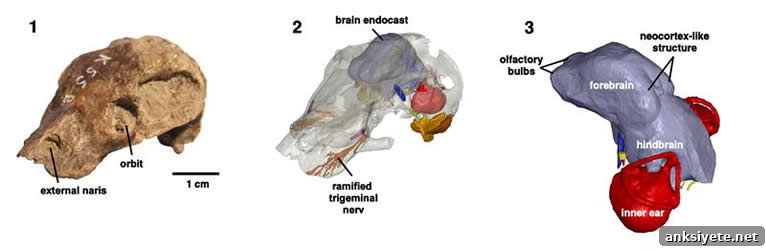
For his doctoral research, paleontologist Michael Laaß analyzed a roughly 255-million-year-old skull of the therapsid Kawingasaurus fossilis. In collaboration with Dr. Anders Kaestner at the Paul Scherrer Institute in Switzerland, Laaß used neutron tomography to create a high-resolution three-dimensional reconstruction of the internal cranial cavity and the brain endocast.
The results reveal that Kawingasaurus had a relatively large brain compared with other non-mammalian therapsids. The estimated brain volume was approximately two to three times greater than that of its contemporaries, and the forebrain showed a pronounced enlargement with two distinct cerebral hemispheres. According to Laaß, the structure is strikingly reminiscent of a neocortex-like region seen in mammals.
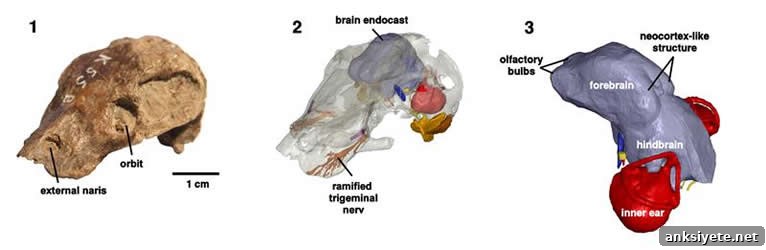
Why did Kawingasaurus evolve this brain organization? The researchers suggest a link to its fossorial (burrowing) lifestyle. Kawingasaurus shows multiple anatomical adaptations consistent with living underground: forward-facing eyes that likely improved binocular vision in dim light, highly branched trigeminal nerve canals in the snout indicating a well-developed tactile sense, and enlarged vestibular regions of the inner ear consistent with sensitivity to seismic vibrations transmitted through the ground. These sensory specializations would demand more complex and efficient neural processing, which could have driven the expansion of the forebrain and the emergence of a neocortex-like area.
Michael Laaß notes that similar ecological pressures have been proposed to explain the early evolution of neocortex-like structures in early mammals. The new fossil evidence therefore supports the hypothesis that subterranean life and enhanced sensory requirements can promote convergent evolution of complex forebrain architectures.
Importantly, Kawingasaurus is not considered a direct ancestor of mammals. The study implies that neocortex-like structures evolved independently more than once within pre-mammalian and mammalian lineages, a case of convergent evolution. In other words, comparable neural solutions to similar ecological problems arose separately in different branches of the synapsid family tree.
Source: UDE
Image credit: Michael Laaß / Verlag Wiley‑VCH
Original research: Abstract for “Evidence for convergent evolution of a neocortex-like structure in a late Permian therapsid” by Michael Laaß and Anders Kaestner, Journal of Morphology. Published online June 16, 2017. doi:10.1002/jmor.20712
UDE. “Fossil Sheds Light on the Origin of the Neocortex.” NeuroscienceNews, 26 June 2017.
Abstract (rephrased)
The neocortex is a key innovation in mammals, forming a six-layered outer region of the forebrain that underlies many advanced sensory, motor, and cognitive functions. Its evolutionary origin remains uncertain, with previous work placing the emergence of neocortex-like regions in late Triassic mammaliaform relatives. This study presents evidence of a comparable structure much earlier in a non-mammalian synapsid: the burrowing anomodont Kawingasaurus fossilis from the late Permian of Tanzania.
The endocranial cavity of Kawingasaurus is largely ossified, enabling a confident virtual reconstruction of the brain endocast. The reconstruction shows inflated cerebral hemispheres separated by a median sulcus and possibly isolated from the remainder of the endocast by a rhinal fissure. A pineal body appears as a small pit between the hemispheres, and no parietal foramen was identified. Using Eisenberg’s method, the encephalization quotient is estimated at about 0.52, two to three times higher than in other non-mammalian synapsids.
Notable peripheral features include highly branched infraorbital canals in the snout, small forward-facing eyes, and enlarged inner ear vestibules. Together, these traits indicate sensory adaptations to a subterranean environment—enhanced tactile sensitivity, binocular vision in low light, and sensitivity to ground-borne vibrations—which likely favored more complex neural processing. The combination of cranial and sensory anatomy supports the idea that a lemnothalamic visual pathway and a neocortex-like dorsal pallial region could have evolved in parallel in this therapsid and in early mammals.
The brain morphology of Kawingasaurus is consistent with the Outgroup Hypothesis, which proposes that the neocortex evolved from the dorsal pallium of an amphibian-like ancestor receiving lemnothalamic sensory input. The enlarged brain and absence of a parietal foramen may also indicate a comparatively higher metabolic rate in Kawingasaurus than in other non-mammalian synapsids.
“Evidence for convergent evolution of a neocortex-like structure in a late Permian therapsid” by Michael Laaß and Anders Kaestner, Journal of Morphology. Published online June 16, 2017. doi:10.1002/jmor.20712