
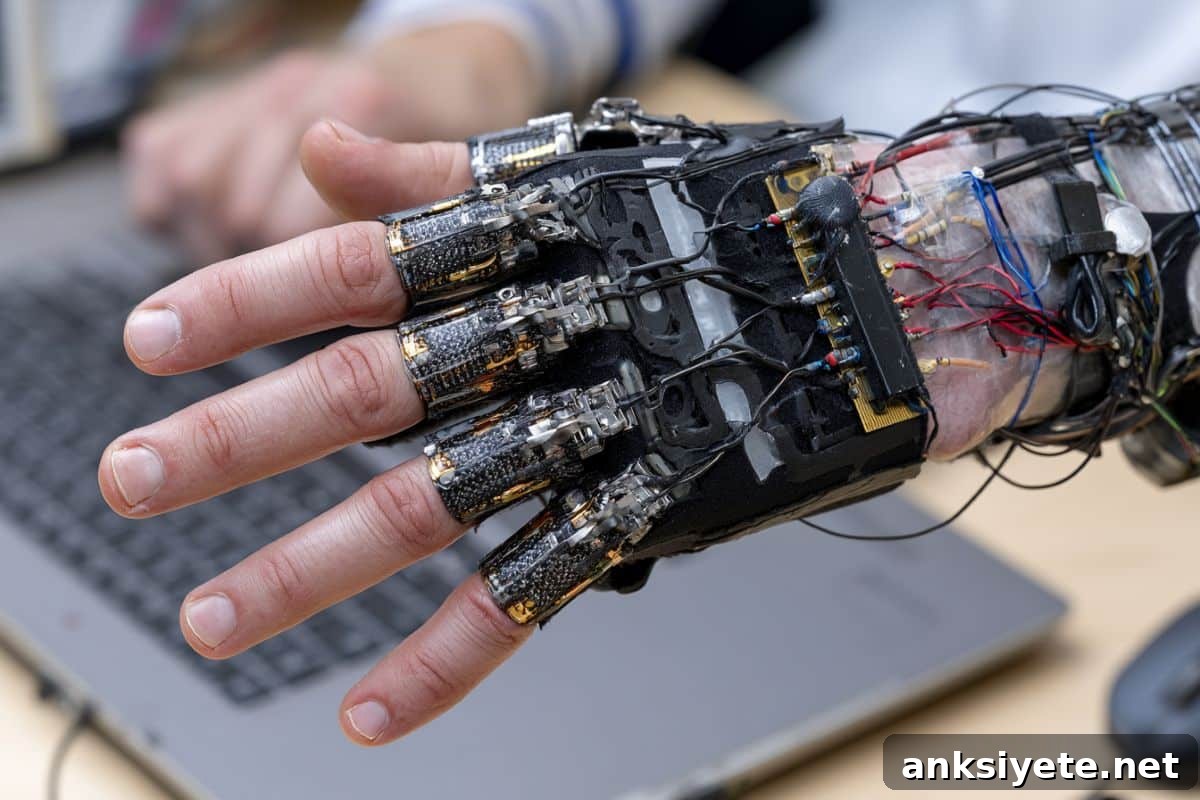
Summary: Researchers at the Technical University of Munich (TUM) have developed an affordable, intelligent soft pneumatic glove that restores intentional grasping for people with severe hand paralysis. Combining low-cost textile construction, a 13-tube pneumatic matrix and a machine-learning electromyogram (EMG) decoder, the system detects faint forearm muscle signals and inflates targeted air chambers to close the fingers and stabilize objects with up to 97% accuracy.
Key Facts
- 13-Tube Pneumatic Matrix: The glove is a textile-based exoskeleton with 13 independent air channels. Inflatable cushions on the glove’s surface allow each finger to flex or extend and provide wrist rotation for secure, precise grips.
- Machine-Learning Intent Detection: Surface EMG sensors on the forearm capture weak muscle impulses. A trained algorithm decodes the user’s grasp intent with 97% sensitivity, triggering pneumatic assistance before the hand moves.
- Anti-Drop Safety: Integrated motion sensors identify transport movements so the pneumatic grip remains locked during arm motion, preventing accidental drops until the object is placed down.
- Validated with an ALS Patient: The system was co-developed with a patient with amyotrophic lateral sclerosis (ALS) who retained movement only at the first thumb joint. By focusing on signals from the flexor pollicis longus muscle, the glove amplified those residual pulses to enable reliable grasping.
- Real-World Outcomes: The ALS participant was able to pick up and hold a fork for the first time in four years, manipulate small blocks, and feed himself. Five minutes of targeted training with a thumb-controlled video game markedly improved control.
- Economical, Reproducible Design: The glove was made from inexpensive fabrics and sewing techniques rather than costly robotic joints, so it remains accessible for patients, families and clinics with limited budgets.
- Clinical Expansion: The team is adapting the design for stroke survivors, people with peripheral nerve injuries and those with flaccid paralysis or polyneuropathy.
Source: TUM
The Technical University of Munich has engineered a soft pneumatic glove that interprets forearm muscle intent to restore grasping ability in people with paralyzed hands.
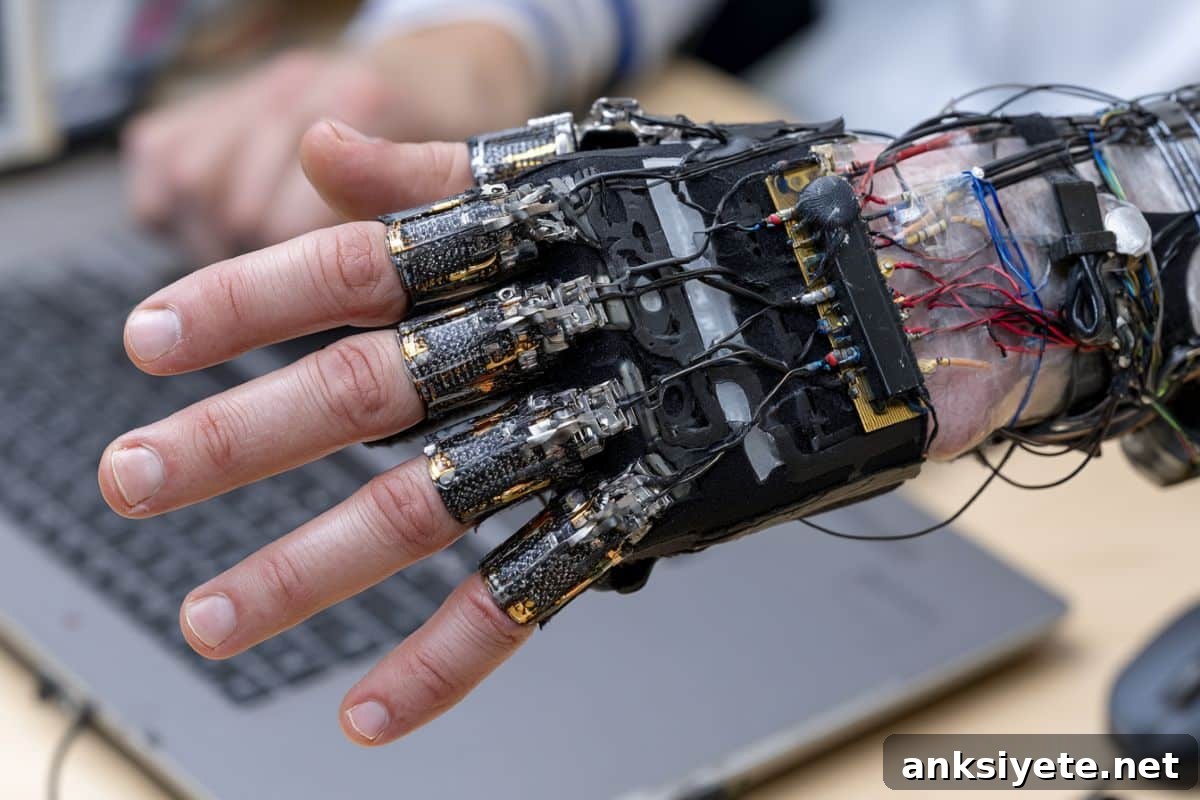
The soft-hand exoskeleton is built from textile with sewn-on inflatable cushions. Air is routed through 13 micro-tubes to specific cushions so each finger and the thumb can be actuated independently while wrist posture is supported. This arrangement provides a gentle, distributed force that mimics natural gripping without rigid, heavy actuators.
To identify when the user intends to grasp, the team places non-invasive EMG sensors on the forearm. These sensors pick up small, often noisy electrical signals from muscle activity. Machine-learning models were trained to distinguish intended grasping from other signals and background noise, yielding a reliable predictor that enables timely assistance. Motion sensing is combined with EMG decoding to prevent premature release during transport.
Co-creation and clinical validation
Development followed a co-creation approach with patients and clinicians. The researchers prioritized articulations and control strategies that matched real user needs. In the ALS pilot, the team targeted the strongest residual signal available—the flexor pollicis longus—so that even minimal voluntary thumb movement could trigger inflation of the glove’s cushions. The result was meaningful functional recovery: the patient performed a Box-and-Blocks test, manipulated small objects and fed himself with exoskeleton support.
Affordability and real-world potential
A deliberate focus on low-cost materials and simple pneumatic hardware keeps production expenses down. By shifting complexity into software—EMG decoding and motion-aware control—the design avoids the high costs typical of rigid robotic exoskeletons while delivering clinically valuable assistance. The research team is expanding trials to stroke survivors and patients with peripheral nerve injuries to evaluate broader applicability and refine device ergonomics.
Key Questions Answered:
A: The glove uses inflatable cushions sewn onto a textile base. When air is pumped through selected channels, those cushions expand and apply controlled bending forces to individual fingers and the thumb. This distributed, compliant actuation produces a secure grip without rigid motors, allowing a paralyzed hand to hold objects such as a glass.
A: Surface EMG sensors on the forearm capture residual muscle activity. A machine-learning decoder processes these faint signals and predicts intended grasping with high sensitivity (about 97%). Combined with motion sensors that detect arm transport, the system inflates and maintains grip only when the user intends to grasp and while moving the object.
A: The design intentionally uses low-cost textiles and simple pneumatic components rather than expensive mechanical systems. By moving sophistication into software and standard sensors, the device aims to be financially accessible to individuals and clinics that cannot afford high-end robotic exoskeletons.
Editorial Notes:
- This article was edited by an editor at Neuroscience News.
- The original journal paper was reviewed in full and additional context was provided by staff.
About this neurotech research news
Author: Andreas Schmitz (TUM)
Source: TUM
Contact: Andreas Schmitz – TUM
Image: Image credit: Neuroscience News
Original Research: Open access. “A Dexterous Soft Hand Exoskeleton Restores Intentional Grasping for Individuals with Severe Hand Impairment” by John Nassour, Nicolas Berberich, Daniel Utpadel-Fischler, Tobias Wächter & Gordon Cheng. Nature Machine Intelligence. DOI: 10.1038/s42256-026-01263-3
Abstract
A Dexterous Soft Hand Exoskeleton Restores Intentional Grasping for Individuals with Severe Hand Impairment
Soft hand exoskeletons offer promise for restoring grasping in people with impaired hand function, but existing devices often lack dexterity and fall short for those with severe paralysis. The TUM team developed a lightweight textile-based exoskeleton with wrist dorsiflexion and an active, opposable thumb. Using a co-creation approach, the design increased hand articulations based on patient needs. A non-invasive surface EMG grasp predictor (97% sensitivity), combined with motion data and machine-learning error correction, compensates for weak, noisy signals. The device enabled a patient with severe right-hand impairment from ALS to grasp objects, achieve measurable improvements on standardized tests and perform meaningful tasks such as self-feeding. Validation in additional patients, including stroke survivors, suggests the exoskeleton is especially effective for individuals with severe to near-complete hand paralysis, while its benefit for moderately impaired users depends on task demands.
Funding: The work was supported by the TUM Innovation Network and the eXprt initiative. Projects within this program receive multi-year funding to foster transdisciplinary teams in engineering, neuroscience and clinical neurology to translate wearable neurotechnology into practical solutions for everyday impairments.