
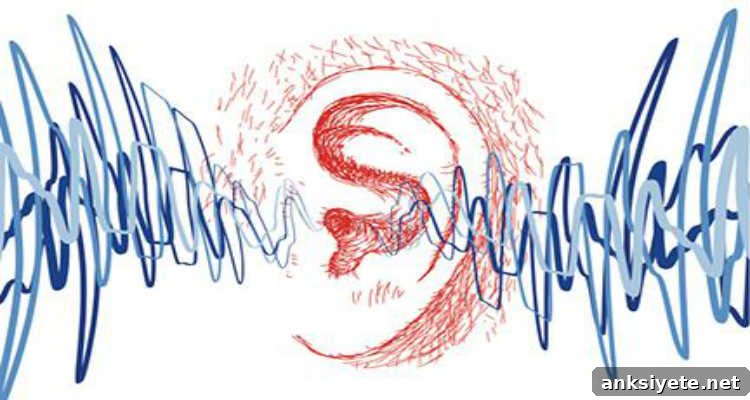
Disruption of timing from sensory nerves underlies “ringing in the ears” that affects millions, including many veterans.
For tens of millions of people, silence is never truly silent. Even in a quiet room they hear persistent ringing, buzzing, hissing, humming or other phantom sounds. This condition, known as tinnitus, ranges from a minor annoyance to a life-altering disability.
Researchers at the University of Michigan Medical School have identified new neural mechanisms that help explain what is happening inside brains affected by tinnitus. Their findings point to a promising new target for treatment, and the team already has a patent pending and a device under development based on this approach.
The study is published in the Journal of Neuroscience. Although the experiments were performed in animals, the results establish a novel, science-based approach that could be translated into human therapies.
Susan Shore, Ph.D., the study’s senior author, reports that animals with tinnitus show altered stimulus-timing dependent multisensory plasticity. This form of plasticity is extremely sensitive to the relative timing of signals arriving at a critical brain region.
The region in question is the dorsal cochlear nucleus (DCN), the first processing center in the brain for auditory signals carried from the ear by the auditory nerve. The DCN also integrates signals from other senses—particularly somatosensory inputs from the face and neck—so its neurons perform a form of multisensory “multitasking.”
Shore, who leads the Kresge Hearing Research Institute laboratory at U-M, is a Professor of Otolaryngology and Molecular and Integrative Physiology, and Professor of Biomedical Engineering across the Medical School and College of Engineering.
Her team found that when auditory input from the cochlea is reduced—commonly due to hearing damage—somatosensory signals from the face and neck can become exaggerated. “It’s as if those non-auditory signals try to compensate for the lost hearing input but end up overcompensating and creating excess noise,” Shore explains.
These results clarify the links between tinnitus, hearing loss and somatosensory input, and help explain why many people with tinnitus can change the perceived loudness or pitch of their phantom sound by clenching their jaw or moving their head and neck.
Crucially, the researchers emphasize that it is not only the presence of strong somatosensory signals combined with hearing loss that matters. The precise timing between auditory and somatosensory signals drives changes in neural plasticity mechanisms in the DCN, and those timing-dependent changes can produce hyperactivity associated with tinnitus.
Lead author Seth Koehler, Ph.D., a former U-M biomedical engineering graduate student, and colleagues note that only a subset of noise-exposed animals developed tinnitus—paralleling the human situation in which not everyone with hearing damage develops persistent tinnitus. In the study, animals that did not develop tinnitus displayed fewer changes in multisensory plasticity and did not show the same level of neuronal hyperactivity.
Building on these insights, Shore and her collaborators are developing a device that combines precisely timed sound with brief electrical stimulation of the face and neck. The goal is to restore normal timing and activity patterns in the auditory pathway, reduce hyperactive firing at tinnitus-related frequencies, and thereby reduce the phantom sounds. The group is also investigating pharmacological strategies to enhance stimulus-timed plasticity by targeting specific molecular mechanisms.
Shore cautions that effective treatment will likely need to be personalized and administered regularly, and that some patients may respond better than others. Nevertheless, the research establishes a clear, mechanistic foundation for therapies tailored to the timing-dependent interactions between auditory and somatosensory inputs.
Tinnitus is especially common among baby boomers as age-related hearing loss becomes more prevalent, and it is a leading disability among military members and veterans exposed to blasts or other loud noises. The condition can also arise after head or neck injuries, including some dental procedures.
Notes about this neurology and tinnitus research
The research was supported by National Institutes of Health grants DC004825 and P30 DC05188. Development of the device is funded by the Coulter Translational Research Partnership, supported by the Wallace H. Coulter Foundation and the University of Michigan.
Contact: Kara Gavin – University of Michigan
Source: University of Michigan press release
Image Source: Adapted from University of Michigan press material.
Original Research: Abstract for “Stimulus Timing-Dependent Plasticity in Dorsal Cochlear Nucleus Is Altered in Tinnitus” by Seth D. Koehler and Susan E. Shore in Journal of Neuroscience. Published online December 11, 2013. doi:10.1523/JNEUROSCI.2788-13.2013
#neurology, #hearing, #neuroscience