
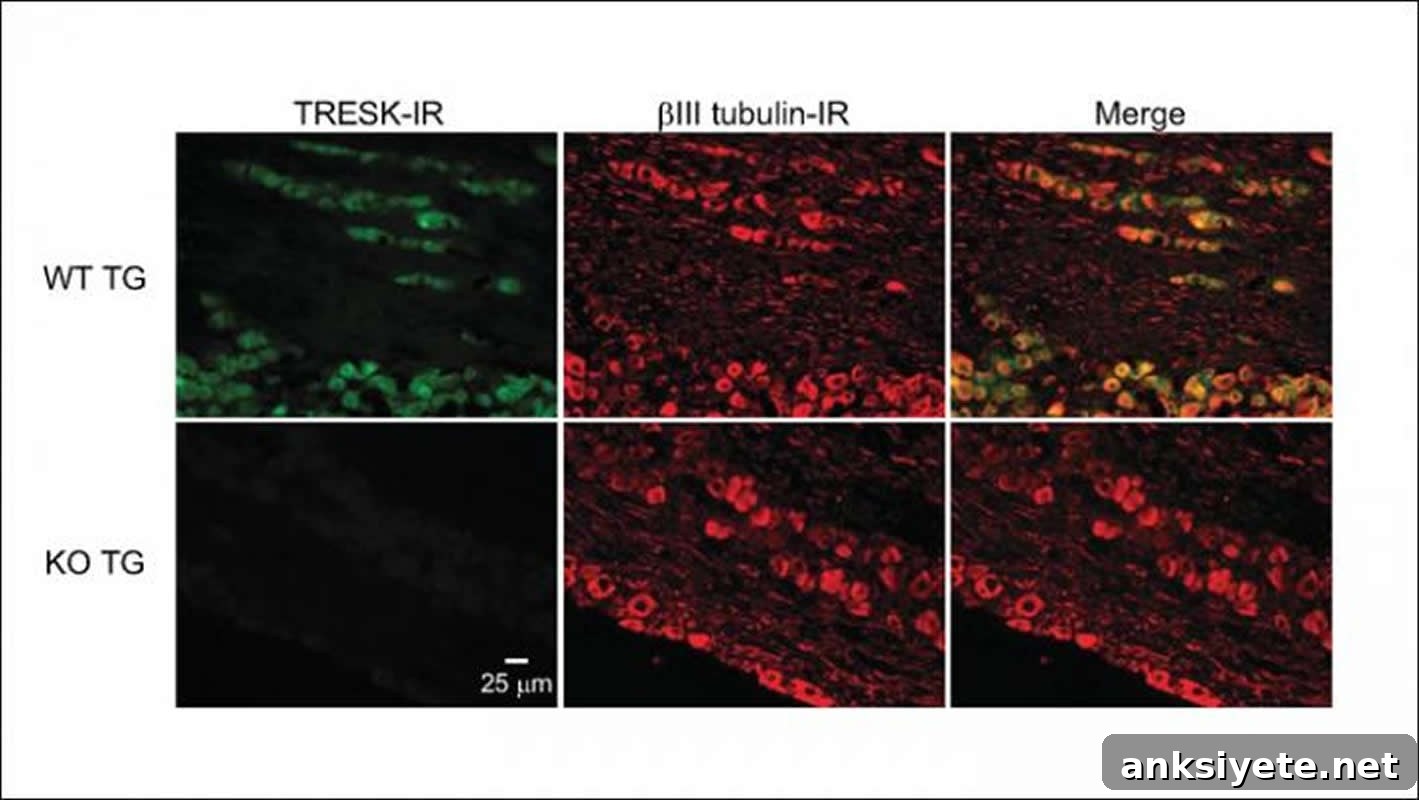
Summary: Loss of the TRESK potassium channel markedly raises the likelihood of headaches and appears to play a role in migraines.
Source: SfN
Defective potassium channels involved in pain detection can raise the risk of headache and may contribute to migraine, according to new mouse research published in eNeuro.
TRESK is a potassium channel that helps regulate the excitability of peripheral sensory neurons that detect pain, temperature, and touch. Although TRESK channels are present throughout sensory neurons that serve both the body and the face, human TRESK mutations have been associated specifically with migraine and not with general body pain. To explore this discrepancy, researchers examined how global loss of TRESK affects neural activity and pain-related behavior in mice.
Investigators led by Yu-Qing Cao at Washington University in St. Louis studied TRESK global knockout mice and monitored neuronal activity, spontaneous firing, and behavioral responses. Their experiments showed that the absence of TRESK selectively increased excitability in trigeminal (facial) nociceptors, particularly small-diameter neurons that do not bind isolectin B4 (IB4−). Those facial sensory neurons displayed elevated spontaneous activity and heightened responses to thermal and mechanical stimuli applied to the face. Correspondingly, TRESK knockout mice demonstrated stronger headache-related behaviors and increased sensitivity to heat and touch on the face, while somatic (body) and visceral pain responses remained normal.
Electrophysiological recordings revealed that loss of TRESK increased the intrinsic excitability of small trigeminal nociceptors, with the most pronounced effects in the IB4− subset. By contrast, dorsal root ganglia (DRG) neurons from adult knockout mice showed little or no change in persistent outward currents or intrinsic excitability, which offers a potential explanation for why TRESK dysfunction in humans appears linked to migraine but not to widespread body pain.
These findings indicate that TRESK serves a cell-type–specific role in regulating trigeminal nociception. When TRESK function is absent, trigeminal nociceptors become hyperexcitable and more likely to generate spontaneous activity that can drive headache-related signaling. Because this effect is selective for facial sensory pathways, TRESK and the mechanisms that modulate its activity represent promising directions for research into migraine prevention and treatment.
Source:
Society for Neuroscience (SfN)
Media contact:
Calli McMurray – SfN
Image source:
Guo et al., eNeuro 2019.
Original research:
“TRESK K+ Channel Activity Regulates Trigeminal Nociception and Headache”. Zhaohua Guo, Chang-Shen Qiu, Xinhua Jiang, Jintao Zhang, Fengxian Li, Qin Liu, Ajay Dhaka and Yu-Qing Cao. Published in eNeuro. DOI: 10.1038/s42256-019-0070-z.
Abstract
TRESK channels are expressed across primary afferent neurons in both trigeminal ganglia (TG) and dorsal root ganglia (DRG). Using TRESK global knockout mice, the researchers found that loss of TRESK selectively increases intrinsic excitability of small-diameter TG nociceptors—especially IB4− neurons—and causes hyper-excitation of small IB4− dural afferent neurons. Knockout mice of both sexes displayed stronger trigeminal nociceptive behaviors, including behaviors consistent with headache, while showing normal body and visceral pain responses. In contrast, adult DRG neurons from knockout animals did not show altered persistent outward currents or intrinsic excitability. The study concludes that TG nociceptors are particularly vulnerable to genetic loss of TRESK and that endogenous TRESK activity helps regulate trigeminal nociception; genetic loss of TRESK significantly increases the likelihood of developing headache.
Significance Statement
This work explains why dominant-negative TRESK mutations in humans are associated with migraine rather than generalized pain: ubiquitous loss of TRESK elevates excitability specifically in trigeminal nociceptors without affecting DRG neuron excitability, producing enhanced trigeminal pain and headache-related behaviors in mice. The results identify endogenous TRESK activity as a key regulator of facial pain pathways and highlight TRESK as a potential target for migraine-focused therapies.