
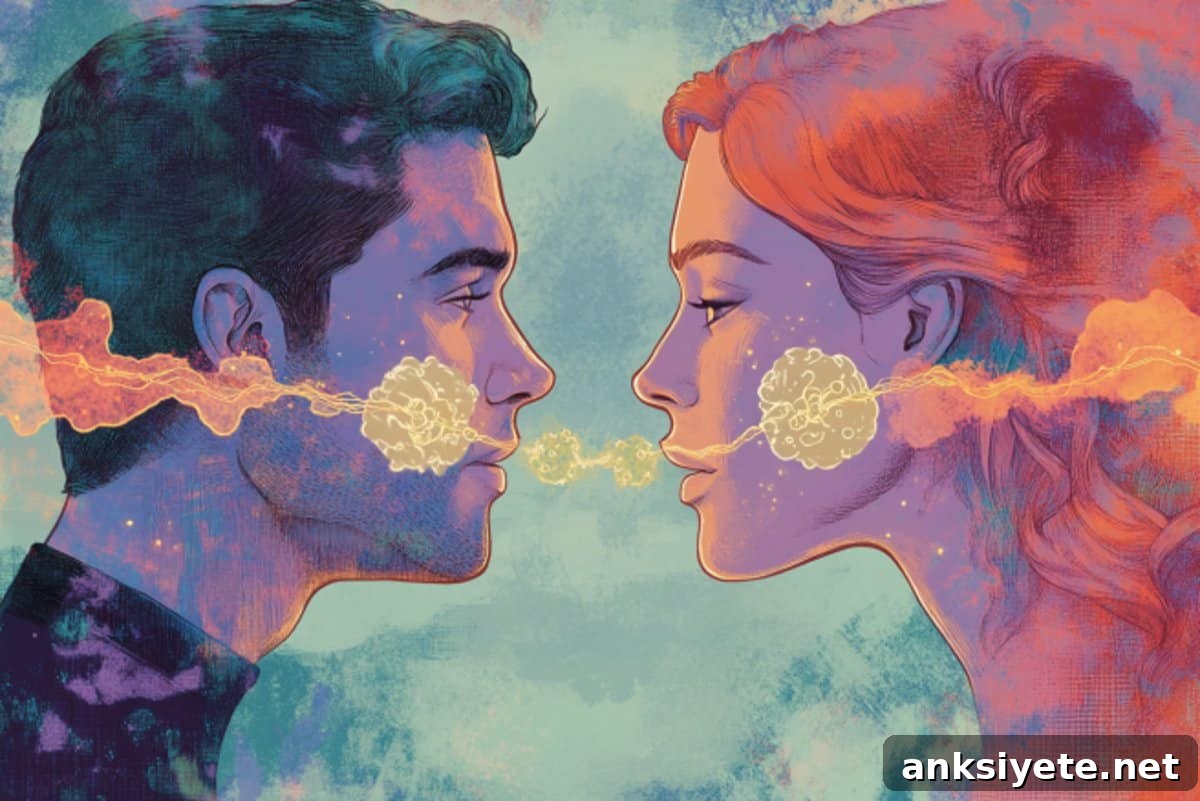
Summary: A recent study indicates that transmission of oral microbiota between newlywed partners may be associated with the development of depression and anxiety symptoms. Researchers followed couples during the first six months of marriage and observed that previously healthy spouses living with partners who had insomnia combined with depression and anxiety began to show similar mental health symptoms and more similar oral microbiome profiles.
The investigation revealed significant correlations between shared bacterial strains, shifts in salivary cortisol levels, and rising depression and anxiety scores in the healthy partners. While these results are correlational and do not prove causation, they point to a possible microbial pathway for emotional contagion within intimate relationships.
Key Facts:
- Microbial Convergence: Spouses’ oral microbiomes grew more alike over time, particularly in couples where one partner experienced depression and anxiety.
- Mood Correlation: Changes in oral microbiota composition were associated with increased salivary cortisol and worsening mental health metrics in the previously healthy partner.
- Key Bacteria Identified: Greater relative abundances of Clostridia, Veillonella, Bacillus, and members of the Lachnospiraceae family were linked to the depression-anxiety (DA) phenotype.
Source: Xia & He Publishing Inc
Background: Previous work has connected oral microbiota dysbiosis and altered salivary cortisol to mood disorders such as depression and anxiety. Given that spouses commonly exchange microbes through close contact, kissing, and shared environments, this study set out to determine whether oral microbiota transmission helps explain the onset or worsening of depression and anxiety symptoms among newly married couples.
Methods
Researchers administered validated Persian-language versions of the Pittsburgh Sleep Quality Index (PSQI), the Beck Depression Inventory-II (BDI-II), and the Beck Anxiety Inventory (BAI) to a sample of 1,740 couples who had been married for approximately six months. From these respondents, the team performed a cross-sectional comparison between 268 spouses classified as healthy controls and 268 spouses identified as affected cases. Oral microbiome composition and salivary cortisol were measured and analyzed alongside the psychological assessments using appropriate statistical techniques to test associations between microbial similarity, hormone changes, and mental health scores.
Results
At six months, partners who were initially healthy but married to a spouse with insomnia plus the depression-anxiety (DA) phenotype exhibited statistically significant increases in PSQI, BDI-II, and BAI scores compared with their own baselines. In other words, their sleep quality, depressive symptoms, and anxiety symptoms shifted in a direction more similar to their affected partners.
Concurrently, the oral microbiota composition of these healthy spouses changed markedly and became more similar to the microbiome of their affected partners (p < 0.001). These convergent microbial patterns were associated with corresponding changes in salivary cortisol levels and with the observed increases in depression and anxiety scores.
Linear discriminant analysis identified several taxa with higher relative abundance in individuals with the DA phenotype compared to healthy controls (p < 0.001). Notably, Clostridia, Veillonella, Bacillus, and members of the Lachnospiraceae family were more prevalent among insomniac participants who also exhibited the depression-anxiety profile.
Conclusions
This study suggests that oral microbiota transmission between intimate partners may play a partial role in mediating depression and anxiety symptoms. The findings are associative and therefore do not establish a causal pathway; additional longitudinal and mechanistic research is required to determine whether microbial transfer directly contributes to mood disorder onset or whether other shared environmental and behavioral factors account for the convergence.
If future work establishes causality, the implications could be substantial for research and practice in diagnostic, predictive, preventive, and personalized medicine. Understanding how partner-to-partner microbial exchange influences mental health could inform novel prevention strategies, personalized risk assessments, and targeted interventions that consider both psychosocial and microbial dimensions of mental health.
About this microbiome and mental health research news
Author: Shelly Zhang
Source: Xia & He Publishing Inc
Contact: Shelly Zhang – Xia & He Publishing Inc
Image credit: Neuroscience News
Original Research: Open access. “Oral Microbiota Transmission Partially Mediates Depression and Anxiety in Newlywed Couples” by Neil Daghnall et al., Exploratory Research and Hypothesis in Medicine. DOI: 10.14218/ERHM.2025.00013