
Brain Remapping Reversed After Pediatric Double Hand Transplant
Summary: Researchers report that massive cortical reorganization was reversed in a child who received a double hand transplant after amputation in infancy.
Source: CHOP.
Researchers have documented, for the first time in a child, large-scale changes in how touch sensations from the hands are represented in the brain — and they show those changes can reverse after a successful bilateral hand transplant.
Normally, each part of the body that senses touch sends signals to a specific area of the brain. The pattern of these connections, known as the somatosensory representation, maps body regions to precise cortical sites. When input from a body part stops, the brain can reorganize those maps.
“Studies in nonhuman primates and in adults have shown that following amputation the brain remaps itself,” said William Gaetz, PhD, a radiology researcher in the Biomagnetic Imaging Laboratory at Children’s Hospital of Philadelphia (CHOP) and first author on the report. “For example, the cortical area that originally responded to the hand can begin to respond to sensations from the lips, shifting by as much as two centimeters.”
This phenomenon, known as massive cortical reorganization (MCR), had been described in adults and animal models, but had not previously been demonstrated in a pediatric patient. The study team expected to observe MCR in their young patient and were able to document it; importantly, they also observed that the reorganization began to reverse as the transplanted hands recovered sensation and function.
The case study focuses on Zion Harvey, now 10 years old, who gained international attention in 2015 as the first child to undergo a successful bilateral hand transplant. The operation, performed in July 2015 at CHOP, involved a large multidisciplinary team led by L. Scott Levin, MD, FACS, chairman of Orthopaedic Surgery and professor of Plastic Surgery at the University of Pennsylvania, and director of the Hand Transplantation Program at CHOP.
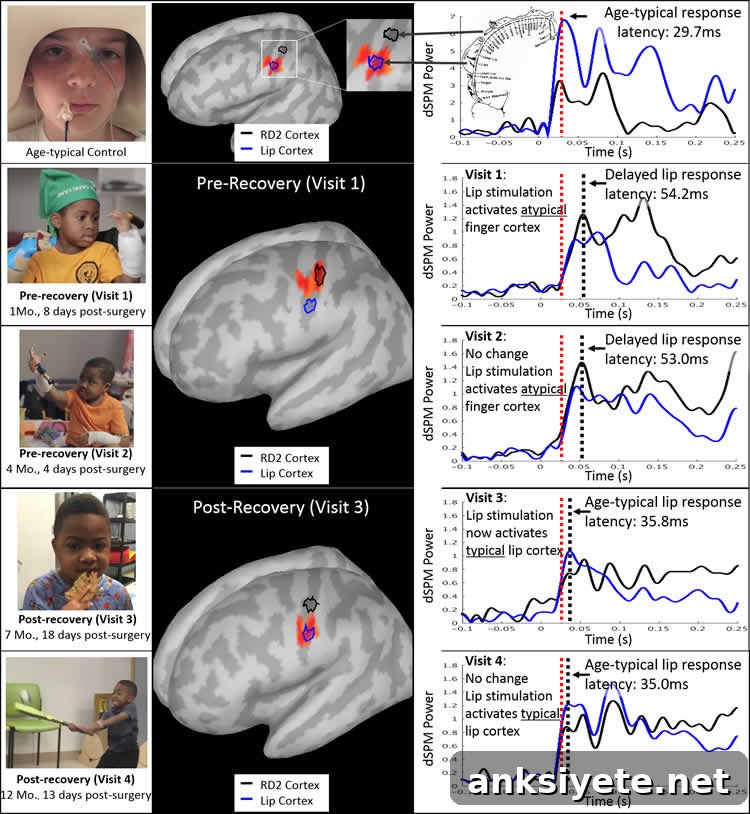
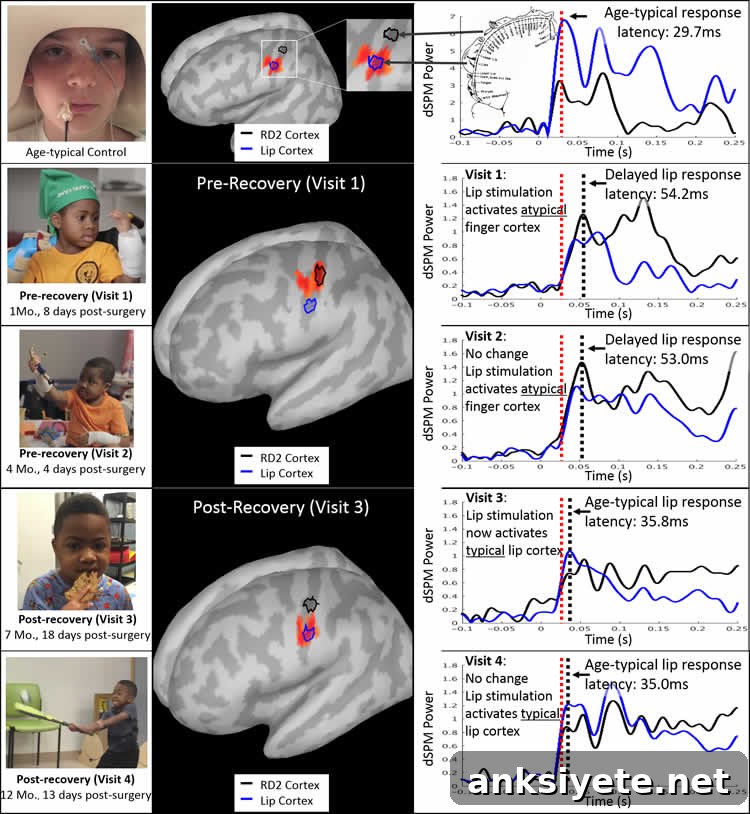
To map cortical responses, the researchers used magnetoencephalography (MEG), a noninvasive method that records the brain’s magnetic activity with high temporal resolution. They applied light tactile stimuli to the patient’s lips and fingertips and recorded where and when the brain responded. MEG sessions were conducted four times over the year after the transplant, and five healthy children of similar age served as controls for comparison.
During the first two post-transplant visits, the patient’s fingertips did not show a measurable response to tactile stimulation. Lip stimulation, however, produced cortical signals localized in the brain area normally devoted to the hands, consistent with MCR. Those lip-evoked responses were also delayed by about 20 milliseconds compared with control children, indicating altered processing.
By the third and fourth visits, the pattern had shifted again: lip responses returned to the cortical lip area and showed age-typical timing, evidence that the earlier remapping was reverting toward a normal somatotopic organization. When the fingertips were stimulated in the later visits, MEG responses appeared in the hand region of the cortex. These fingertip responses had a shorter delay by the fourth visit, though signal amplitudes were higher than typical. As Gaetz explains, “The sensory signals are arriving in the correct cortical location, but they may not yet be fully integrated into the broader somatosensory network. We expect these responses to become more age-typical with continued recovery.”
The authors note that these findings raise several new questions about brain plasticity in children: What is the optimal age for hand transplantation to maximize cortical recovery? Does MCR always follow amputation, and how does it compare in people born without hands? Could similar reversals of MCR be achieved in adults who undergo transplantation? The research team plans additional studies to explore these and related questions.
Functional follow-up data are encouraging. Levin and colleagues report that 18 months after the transplant, Zion demonstrated improved independence for activities such as writing, dressing, and feeding, important measures of quality of life after a major reconstructive procedure.
Funding: This study was funded in part by the National Institutes of Health (grants HD086984, DC008871).
Source: Ashley Moore & Abbey Anderson – CHOP
Publisher: Organized by NeuroscienceNews.com
Image Source: Image credited to Gaetz et al./Annals of Clinical and Translational Neurology
Original Research: “Massive cortical reorganization is reversible following bilateral transplants of the hands: evidence from the first successful bilateral pediatric hand transplant patient” by William Gaetz et al., Annals of Clinical and Translational Neurology. Published online December 6, 2017. doi:10.1002/acn3.501
Massive cortical reorganization is reversible following bilateral transplants of the hands: evidence from the first successful bilateral pediatric hand transplant patient
This repeated-measures case study demonstrates that sensory loss after limb amputation produces measurable changes in cortical somatotopic maps that can reverse after restoration of sensory input. Using magnetoencephalography (MEG) in a child with bilateral hand transplants, the investigators observed large-scale shifts of lip cortical representation into the anatomic hand area during sensory deprivation. Following recovery of tactile sensation in the digits, fingertip responses localized to the expected sensory cortex, although electrophysiologic features such as amplitude and frequency remained atypical during early recovery.