
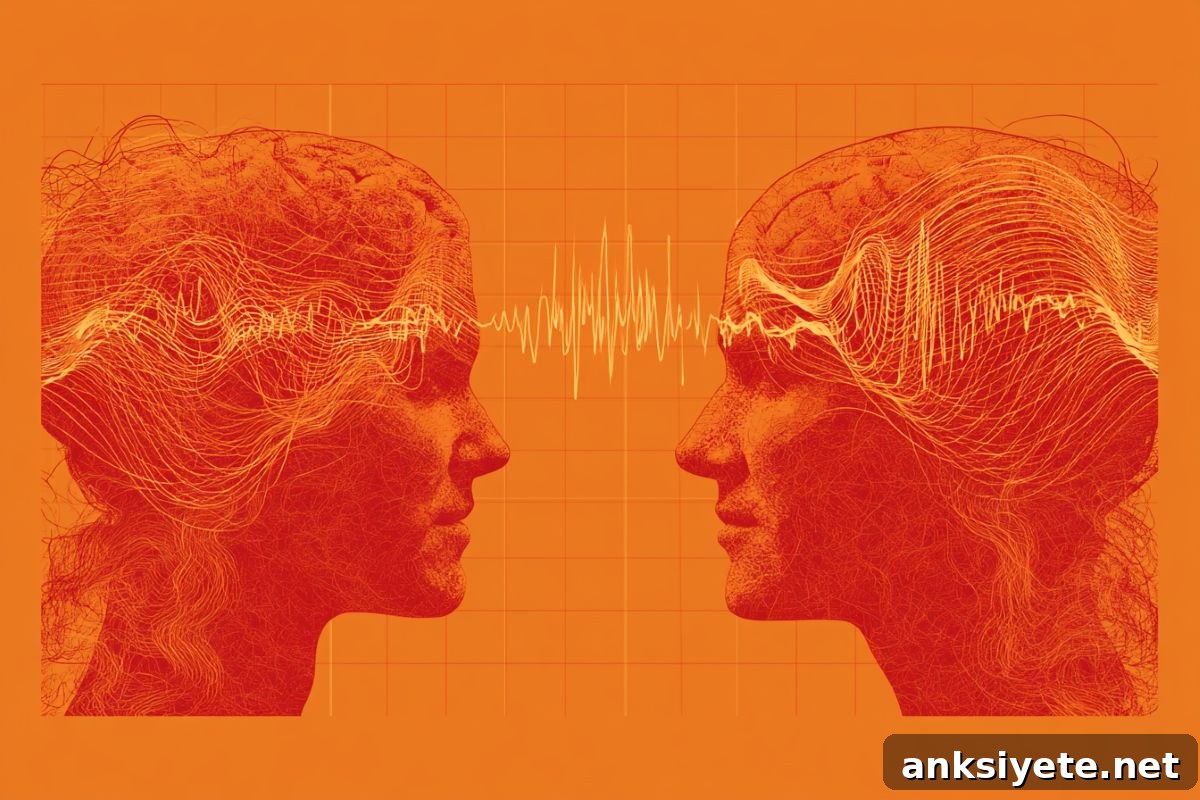
Summary: The phrase “being on the same wavelength” describes more than an emotional impression — it reflects a measurable neurobiological state. A decade of multidisciplinary research shows that during live, face-to-face interactions people’s neural rhythms align. By working with high schools, museums, and prominent performing artists, an international team of neuroscientists has mapped this social synchrony, demonstrating that shared brain states can be recorded, visualized, and deliberately cultivated to reduce loneliness and strengthen social bonds.
This retrospective analysis synthesizes studies that tracked the brain activity of thousands of participants using portable, non-invasive electroencephalogram (EEG) headsets. The consistent finding: when people are genuinely engaged with one another — whether in a classroom, a museum, or a music studio — their brainwaves often synchronize. These neural alignments correlate with rapport, engagement, and positive social outcomes.
Supported by a new $4‑million federal health grant, the research team is now translating these laboratory and field findings into clinical applications. Their goal is to develop interventions that intentionally increase brainwave synchrony between people — for example, between therapists and patients — to accelerate treatment outcomes and rebuild social cohesion.
Key Facts
- The Social Synchrony Phenomenon: Social synchrony refers to the real-time alignment of brain rhythms, body movement, and conversational patterns between people during live interaction.
- Predicting Social Rapport: Longitudinal classroom studies found that higher student-to-student brainwave synchronization predicted greater mutual liking and classroom engagement.
- The Loneliness Footprint: People who report chronic loneliness show more idiosyncratic brain activity that is less likely to synchronize during typical social exchanges.
- Studio Brain Mapping: In a 2019 project, researchers recorded portable EEG from artists during a collaborative songwriting session and displayed their brainwave alignment in real time to let them test different creative “syncing” approaches.
- Everyday Interaction as Neurobiology: Casual, unscripted face-to-face activities — banter, simple games, shared music — appear to be neurobiologically important for maintaining baseline social connectedness in communities.
- ARPA‑H Clinical Target: With ARPA‑H funding, investigators will run clinical trials to determine whether engineered brainwave synchrony can boost the effectiveness of therapeutic relationships and treatments for conditions like treatment-resistant depression, PTSD, and chronic loneliness.
Source: NYU
Overview: The research asks: can science identify and harness the feeling of being “on the same wavelength”? The answer from this body of work is yes. Using portable EEG and real-world deployments, scientists have measured inter-brain coupling across friends, strangers, students, and artists, and begun developing methods to enhance that coupling for social and clinical benefit.
The team partnered with schools, museums, and performers — including collaborations with well-known musicians and performance artists — to measure and visualize how thousands of museum visitors, festival attendees, and students fell into neural synchrony during live, face-to-face communication. Studies included diverse social settings to capture how brain alignment emerges in everyday life rather than only in controlled laboratory conditions.
Their findings point to a concept the authors call “social synchrony”: the coordinated alignment of neural rhythms, bodily behavior, and language that occurs when people connect. When synchrony appears, it is reliably linked with better social outcomes, such as increased liking, higher engagement, and greater rapport.
“Over many studies we consistently measured the once-elusive idea of being ‘on the same wavelength’ — and showed it is tied to healthy social relationships,” says Suzanne Dikker, research professor at New York University and Ghent University. “Importantly, we’ve also designed interventions that can boost synchrony.”
Contributors to the work include researchers from Zhejiang University, Shenzhen University, the University of Montreal, and collaborators at UC San Diego. Their report appears in Trends in Cognitive Sciences and synthesizes experimental results, methods, and potential applications for therapy and education.
Over ten years, the team recorded neural data from thousands of participants with portable EEG headsets that read electrical brain activity via scalp sensors. One notable project captured live neural alignment between two artists as they composed a song, giving them visual feedback on their moment-to-moment synchrony so they could explore creative strategies that promoted alignment.
The researchers emphasize that social synchrony is not merely an interesting lab effect but a practical tool. For example, in classrooms and community settings, activities that promote interpersonal synchrony — conversation, play, and shared music — can help maintain social cohesion. In clinical settings, guided interventions that increase therapist–patient synchrony could shorten the time needed to build therapeutic rapport and potentially enhance treatment responsiveness.
Key Questions Answered:
A: The team used lightweight, portable electroencephalogram (EEG) headsets to record electrical brainwave activity in real-world settings. These non-invasive devices capture neural signals via scalp sensors and allow researchers to collect synchrony data in active high schools, busy museums, and live events where natural interaction occurs.
A: Recording artists during collaborative sessions revealed that high-level creative interaction produces strong neural synchrony. Real-time visualization of their brainwave alignment let collaborators experiment with different approaches to make their brains more in phase, demonstrating that complex joint creativity can be a powerful driver of interpersonal alignment.
A: The $4‑million ARPA‑H grant supports clinical trials that will adapt social synchrony methods to therapy. By measuring and providing feedback on brainwave alignment between therapists and patients, the intervention aims to accelerate rapport-building and enhance therapeutic effects for disorders that respond to improved social connectedness.
Editorial Notes:
- This article was edited by a Neuroscience News editor.
- The journal paper was reviewed in full by editorial staff.
- Additional context was added by the reporting team.
About this neurotech and social neuroscience research news
Author: Rachel Harrison
Source: NYU
Contact: Rachel Harrison – NYU
Image: The image is credited to Neuroscience News
Original Research: Open access. Multi‑brain neurofeedback: what are we training for? by Yafeng Pan, Xiaojun Cheng, Guillaume Dumas, and Suzanne Dikker.
Journal: Trends in Cognitive Sciences.
Abstract
Multi‑brain neurofeedback: what are we training for?
Multi‑brain neurofeedback creates new opportunities to guide social interaction by capturing and modulating interpersonal neural dynamics in real time. The authors propose a hierarchical framework that targets shared sensory dynamics, socio‑cognitive processes, or broader social outcomes. The paper outlines methodological challenges and highlights promising therapeutic and educational applications for neurofeedback designed to enhance social synchrony.