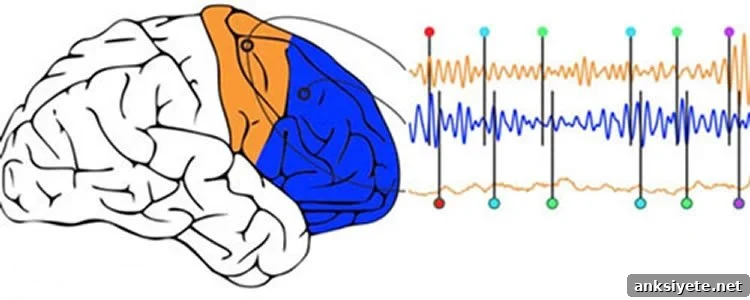
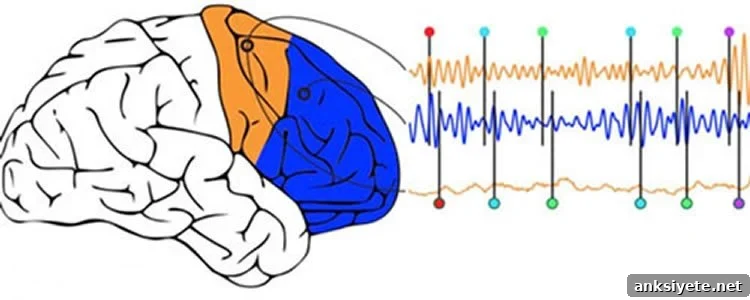
Like Duke Ellington’s 1931 jazz classic, the human brain improvises while a steady internal rhythm keeps time. New research led by UC Berkeley shows that when people tackle mentally demanding tasks, groups of neurons briefly tune into the same rhythm for fractions of a second to coordinate activity, then return to their spontaneous, improvisational patterns.
Published in Nature Neuroscience, these findings shed light on how fast, slow or erratic brain rhythms — known as neural oscillations — support healthy cognition and how their disruption may contribute to neurological and psychiatric conditions. A clearer picture of these dynamic rhythms may guide more precise treatments for disorders that feature abnormal brain-wave patterns.
Tracking how healthy human brains change their rhythmic activity during real-time tasks helps explain conditions such as Parkinson’s disease, schizophrenia and autism, all of which show characteristic deviations in brain oscillations. In musical terms, neuronal networks in these disorders may be locked into a different key, playing at the wrong tempo, or missing the subtle timing cues that let brain regions synchronize.
“With roughly 86 billion neurons communicating in an electrical, chemical and very noisy environment, the brain must rapidly assemble and disassemble functional networks,” said lead author Bradley Voytek. “Our results demonstrate a mechanism by which these networks briefly synchronize to meet task demands and then disperse.”
Using recordings from epilepsy patients who were otherwise cognitively healthy, Voytek and colleagues at UC Berkeley’s Helen Wills Neuroscience Institute measured electrical signals directly from the brain’s surface. As participants performed progressively harder mental tasks, theta waves — oscillations in the 4–8 Hz range — became more synchronized within frontal regions. That synchronization enabled the frontal lobe to coordinate with other areas, including motor cortex, to support correct responses.
“During these fleeting moments of phase alignment, neurons across regions lock onto the same rhythm and can share information quickly,” Voytek explained. “This form of coordinated timing is critical and is altered in many brain disorders.”
Earlier animal studies have shown that rhythmic activity governs when and how neurons fire. This study is among the first to apply electrocorticography — electrodes placed on the exposed brain surface — to observe how oscillatory dynamics change as people perform cognitively demanding tasks, and how those dynamics mediate communication between frontal cortical areas.
Brain rhythms are commonly categorized into five frequency bands — Gamma, Beta, Alpha, Theta and Delta — each associated with different functional roles. Theta oscillations, for example, play a central role in coordinating neuronal activity during navigation and spatial processing, making them important for tasks that require maintaining relationships between goals and actions.
Disruptions in specific frequency bands have been linked to distinct symptoms: in autism, the relationship between Alpha-band activity and neural processing of emotional images can be weakened; in Parkinson’s disease, excessive Beta oscillations in motor regions can lock neurons into an inappropriate rhythm and impede movement. Targeted interventions such as deep brain stimulation work in part by disrupting pathological Beta activity, offering symptom relief.
In the study’s experimental task, epilepsy patients watched shapes of increasing complexity on a screen and responded by pressing a button with either the index or middle finger depending on attributes such as shape, color or texture. The task began with simple, repetitive mappings and progressively required more abstract rules and finer discrimination as stimuli became layered and ambiguous.
As task demands rose, theta-phase encoding across frontal networks increased, and local neuronal population activity — measured by high gamma amplitude (80–150 Hz) — also rose. These neural signatures correlated with trial-by-trial response times, indicating that brief coordination of oscillatory phase and local activity predicted behavioral performance.
“The data reveal a precise temporal code: waves sweeping through frontal cortex briefly align neurons across regions so they can exchange information, then the networks dissolve when coordination is no longer needed,” Voytek said. “Think of it as millions of fans doing ‘The Wave’ for a moment to focus attention and action, then returning to independent cheering.”
Other co-authors on the paper include Mark D’Esposito, Robert Knight and David Fegen from UC Berkeley; David Badre from Brown University; Andrew Kayser from the Department of Veterans Affairs in Martinez, Calif.; Edward Chang from UCSF; Nathan Crone from Johns Hopkins University; and Joseph Parvizi from Stanford University.
Source: Yasmin Anwar – UC Berkeley
Image Credit: Bradley Voytek
Original Research: Abstract for “Oscillatory dynamics coordinating human frontal networks in support of goal maintenance” by Bradley Voytek et al., published online July 27, 2015 in Nature Neuroscience (doi:10.1038/nn.4071).
Abstract
Oscillatory dynamics coordinating human frontal networks in support of goal maintenance
Humans possess hierarchical cognitive control: the ability to manage immediate actions while maintaining more abstract goals. Neuropsychological and neuroimaging evidence suggests this capacity arises from frontal cortical architecture, where prefrontal regions coordinate activity in motor cortices when abstract rules guide behavior. Leveraging the high temporal resolution of intracranial electrocorticography, the study examined how frontal oscillatory networks communicate during tasks requiring hierarchical control. Increasing rule abstraction led to stronger frontal theta phase encoding (4–8 Hz) and elevated local neuronal population activity in prefrontal cortex (high gamma amplitude, 80–150 Hz), both of which predicted response time on individual trials. Coupling between theta phase encoding and high gamma amplitude during inter-regional information transfer indicates that phase-based encoding is a mechanism by which frontal subnetworks dynamically instantiate complex cognitive functions.
“Oscillatory dynamics coordinating human frontal networks in support of goal maintenance” by Bradley Voytek, Andrew S. Kayser, David Badre, David Fegen, Edward F. Chang, Nathan E. Crone, Josef Parvizi, Robert T. Knight and Mark D’Esposito. Published online July 27, 2015. doi:10.1038/nn.4071