
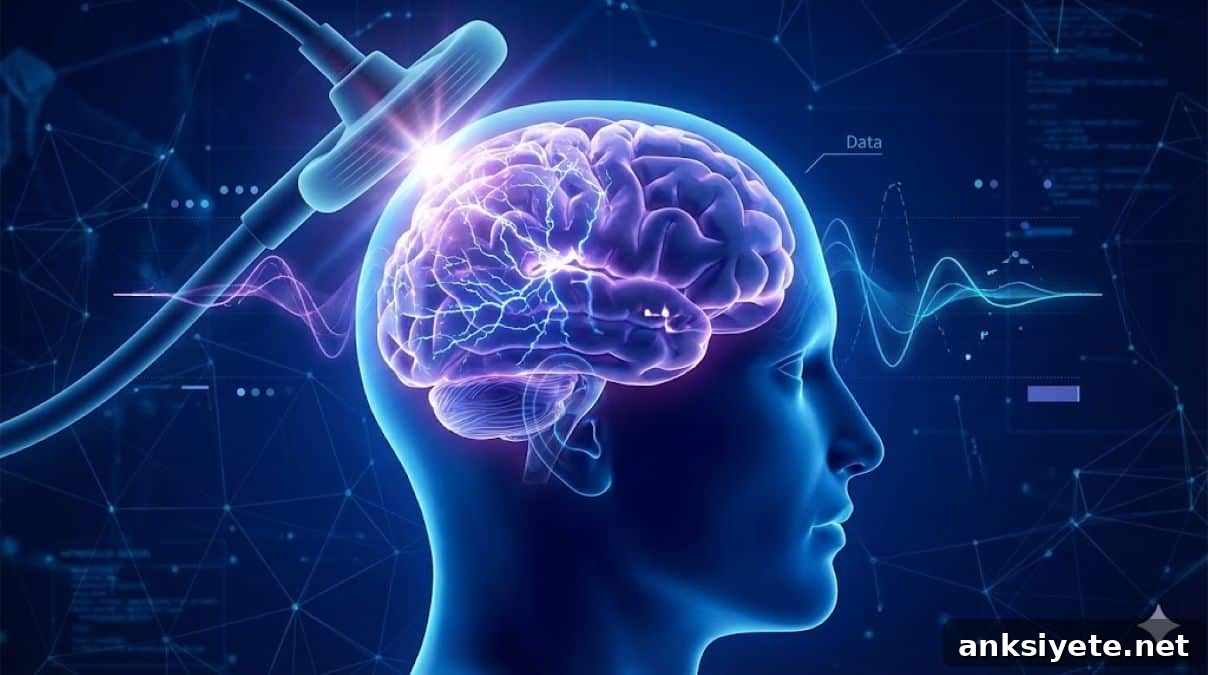
Summary: A new study finds that a measure of brain complexity—calculated from EEG responses to a single transcranial magnetic stimulation (TMS) pulse—is significantly reduced in people with Alzheimer’s disease. Previously used to distinguish levels of consciousness in disorders of consciousness, this TMS-EEG metric may offer a practical way to assess the integrity of conscious processing in dementia.
Source: Boston University School of Medicine
Key Facts:
- New Metric: Researchers applied the perturbation complexity index—state transitions (PCI-ST), derived from combined TMS and EEG recordings, to measure cortical complexity.
- Lower Complexity in AD: PCI-ST values were lower in participants with Alzheimer’s disease than in healthy older adults, across stimulation of both motor and parietal cortical sites.
- Conscious vs. Unconscious Processing: The findings match clinical observations that Alzheimer’s preferentially disrupts conscious cognitive functions (attention, working and episodic memory, executive function) while often sparing implicit, unconscious processes such as procedural memory and priming.
- Study Sample: The study compared 28 people diagnosed with Alzheimer’s disease to 27 healthy control participants, assessing cognitive function and disease severity.
Alzheimer’s disease progressively impairs complex conscious awareness and higher cognitive processes, even as more basic sensory awareness and some implicit memory systems remain relatively preserved. Functions that require conscious access—attention, working memory, episodic recall, and executive control—tend to decline with dementia progression, while procedural skills, conditioning, and priming often persist longer. As neurodegeneration spreads across cortical regions, related aspects of conscious awareness diminish and can eventually be lost.
The perturbation complexity index—state transitions (PCI-ST) quantifies how complexly the brain responds to a brief external perturbation: a TMS pulse—by recording time-resolved EEG activity that follows the stimulation. PCI-ST has previously been validated as a sensitive index of conscious level in patients with disorders of consciousness, helping to distinguish minimally conscious states from coma. The present study tested whether PCI-ST could similarly reflect altered conscious processing in people with Alzheimer’s disease.
Investigators at Boston University Chobanian & Avedisian School of Medicine report that PCI-ST was reduced in the Alzheimer’s group compared with normally aging controls. Across stimulation of the primary motor cortex (M1) and the inferior parietal lobule (IPL), mean PCI-ST in the AD group was 20.1, versus 28.2 in controls, indicating a measurable decline in cortical complexity associated with the disease.
“Despite their impaired conscious memory, individuals with Alzheimer’s disease may still rely on intact implicit forms of memory—such as procedural or ‘muscle’ memory—to carry out familiar routines at home,” says senior author Andrew Budson, MD, professor of neurology. “But when routines change or when patients travel, their disrupted conscious memory can cause disorientation and distress.” Budson is also chief of Cognitive & Behavioral Neurology and director of the Center for Translational Cognitive Neuroscience at the VA Boston Healthcare System.
The research team evaluated cognition using the Montreal Cognitive Assessment (MoCA) and measured disease severity using the Clinical Dementia Rating scale—Global (CDR-Global) and Sum of Boxes (CDR-SB). The consistent reduction of PCI-ST across both cortical sites suggests the metric may index the breakdown of conscious cognitive processes and relate to functional capacity in Alzheimer’s disease.
Lead author Brenna Hagan, a Behavioral Neuroscience PhD candidate, notes that existing pharmacological treatments—such as cholinesterase inhibitors and NMDA receptor antagonists—can modify neurotransmission and sometimes improve conscious cognitive abilities in people with Alzheimer’s. Non-pharmacological approaches that exploit relatively preserved implicit memory systems—by reinforcing habits and routines—may also enhance quality of life and daily function.
The authors highlight that measuring cortical complexity with TMS-EEG opens several research directions: linking global indices of consciousness to specific neuroanatomical changes in cortical dementia, tracking disease progression, and testing whether interventions that boost cortical complexity translate into better cognitive or functional outcomes. Such studies could clarify how alterations in cortical dynamics map onto the deterioration of conscious processes in dementia and potentially guide therapeutic strategies.
Editorial Notes
- This article was edited by a Neuroscience News editor.
- The journal paper was reviewed in full for accuracy.
- Additional context was added by editorial staff.
About this Alzheimer’s research news
- Author: Gina DiGravio
- Source: Boston University School of Medicine
- Contact: Gina DiGravio – Boston University
- Image: Image credit noted by Neuroscience News
Original Research:
Brenna Hagan, Stephanie S. Buss, Peter J. Fried, Mouhsin M. Shafi, Katherine W. Turk, Kathy Y. Xie, Brandon Frank, Brice Passera, Recep Ali Ozdemir, Andrew E. Budson, Evaluating Alzheimer’s disease with the TMS-EEG perturbation complexity index, Neuroscience of Consciousness, Volume 2026, Issue 1, 2026, niaf062.
Funding:
This work used data collected through NIH grant R01 AG060987 and support from the BrightFocus Foundation (A2021288S). Several authors and trainees received funding and fellowships from NIH, the Veterans Health Administration, the Alzheimer’s Association, and internal institutional awards, as noted by the research team.
Abstract:
The Perturbation Complexity Index—State Transitions (PCI-ST) quantifies the complexity of cortical responses to transcranial magnetic stimulation by analyzing EEG-recorded state transitions. PCI-ST is sensitive to levels of consciousness and has been applied in disorders of consciousness. Because early Alzheimer’s disease selectively disrupts conscious cognitive processes (attention, working and episodic memory, executive function) while often sparing unconscious processes (procedural memory, operant conditioning, priming), the authors hypothesized that PCI-ST would be reduced in AD compared with healthy aging. In a sample of 28 participants with Alzheimer’s disease and 27 healthy controls, cognition was assessed with the MoCA and disease severity with the CDR-Global and CDR-SB. PCI-ST values were lower in the AD group (mean = 20.1) than in controls (mean = 28.2) across TMS stimulation of both M1 and IPL sites. These results suggest that decreased cortical complexity measured by PCI-ST may reflect impaired conscious cognitive processing and functional capacity in Alzheimer’s disease. The findings motivate further studies to examine the relationship between conscious processes, global measures of consciousness, and their neuroanatomical correlates in cortical dementia, and to explore therapeutic strategies that could influence cortical complexity and clinical outcomes.