
Summary: A new “brain-on-a-chip” model uncovers the physical and biological processes that drive the formation of folds in the developing brain.
Source: Weizmann Institute of Science.
Researchers at the Weizmann Institute of Science have developed a lab-grown “brain on a chip” that reveals how the brain’s characteristic folds form during development. The work, reported in Nature Physics, combines a refined organoid culture technique with physical measurements to explain how mechanical forces and cellular biology interact to produce cortical folding—and why mutations in a single gene can prevent those folds from forming.
Human brain organoids—small, self-organizing tissue models derived from embryonic stem cells—have been used for several years to study early brain development. While the method has proven powerful, conventional organoids pose practical problems: they vary in size, their central regions can die due to lack of nutrients and oxygen in the absence of blood vessels, and thick tissue limits high-resolution optical imaging and continuous observation.
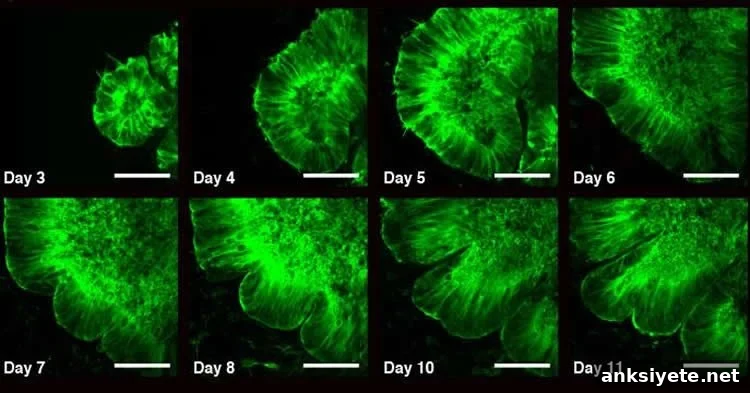
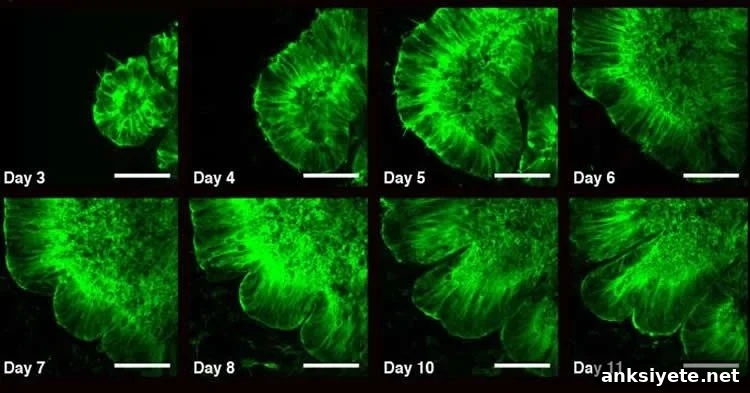
To overcome these limitations, Dr. Eyal Karzbrun in Prof. Orly Reiner’s Molecular Genetics Department developed a constrained growth method that flattens the organoid along the vertical axis. The resulting “pita”-shaped organoids are large and round but thin, with a narrow central layer. This geometry allows nutrients to reach all cells and makes the tissue accessible to live imaging and microscopy for tracking development over time. Remarkably, by the second week of growth these flat organoids began to develop surface wrinkles that deepened with time. According to Karzbrun, “This is the first time that folding has been observed in organoids, apparently due to the architecture of our system.”
Karzbrun, a physicist, approached the problem using concepts from the mechanics of elastic materials. Surface folds and wrinkles commonly result from mechanical instability: when parts of a material expand unevenly or contract under compression, the surface can buckle to relieve stress. In the constrained organoids, the team identified two sources of mechanical mismatch. Cells in the central region showed contraction of their cytoskeletons, creating inward forces, while nuclei in cells near the surface enlarged. Put simply, the outer layer of the tissue grew or expanded faster than the interior, producing compressive stress that led to buckling and surface folding.
To verify that the observed wrinkling models folding in the developing human brain, the team produced organoids carrying mutations in LIS1, a gene Prof. Reiner first identified in 1993 that is linked to lissencephaly, or “smooth brain” syndrome. This rare disorder, which affects roughly one in 30,000 births, disrupts neuronal migration during embryonic development and affects elements of the cellular cytoskeleton and motor proteins. Organoids with the LIS1 mutation reached similar overall sizes as control organoids but developed few surface folds, and the folds that did appear were different in shape and pattern.
Suspecting that altered physical properties of the cells underlie these differences, the researchers measured cellular stiffness using atomic force microscopy in collaboration with Dr. Sidney Cohen from the Chemical Research Support Department. The measurements revealed that cells from normal organoids were roughly twice as stiff as cells from mutated organoids, which were comparatively soft. In addition to mechanical differences, the mutant organoids showed slower nuclear movement in their central cells and distinct patterns of gene expression, indicating concurrent biological changes that affect tissue mechanics and development.
The combination of engineered organoid architecture, live imaging, mechanical measurement and genetic perturbation provided converging evidence that folding emerges from coordinated biological and physical processes. The constrained, thin organoid format enabled sustained nutrient delivery and clear optical access, making it feasible to trace how cellular forces generate macroscopic tissue shapes. As Prof. Reiner notes, while the system is not a full brain, it serves as a robust model for studying early brain morphogenesis and the origins of folding.
The approach has attracted interest in the scientific community for its ability to link cellular-scale mechanics to organ-level form. The research team plans to refine the method and apply it to other conditions tied to brain development, including microcephaly, epilepsy and psychiatric disorders such as schizophrenia, with the aim of revealing how genetic and mechanical factors combine to shape the developing cortex.
Also participating in the study were Prof. Yaqub Hanna, who assisted with stem cell culture, and research student Aditya Kshirsagar from Prof. Reiner’s group. Prof. Orly Reiner’s work is supported by multiple institutional and philanthropic sources, and she holds the Bernstein‑Mason Chair of Neurochemistry.
Source: Gizel Maimon, Weizmann Institute of Science.
Publisher: Organized by NeuroscienceNews.com.
Image credit: Weizmann Institute of Science.
Original research: The study is published in Nature Physics.