
When people with high levels of psychopathic traits imagine others in pain, brain regions normally involved in empathy and caring fail to activate and to communicate properly with other areas that guide emotion and decision-making, according to a study published in the open-access journal Frontiers in Human Neuroscience.
Psychopathy is a personality disorder marked by callousness, shallow affect, lack of empathy and remorse, superficial charm, and manipulative behavior. Estimates vary by setting, but previous research has suggested that psychopathy is far more common in prison populations—around 23% in some studies—than in the general population, where prevalence is roughly 1%.
To investigate the neural basis of impaired empathy in people with psychopathic traits, researchers used functional magnetic resonance imaging (fMRI) to scan the brains of 121 inmates at a medium-security prison in the United States. The study examined how participants’ brains responded when they took different affective perspectives—imagining pain happening to themselves (imagine-self) versus imagining the same pain happening to someone else (imagine-other).
During scanning, participants viewed a series of photographs depicting painful situations (for example, a finger caught in a door or a toe trapped under a heavy object) and matched control images that did not show pain (for example, a hand on a doorknob). For each image they were instructed either to imagine that the event had happened to themselves or to imagine it happening to another person.
All participants were evaluated with the Psychopathy Checklist—Revised (PCL‑R), a widely used instrument that measures psychopathic traits. Based on PCL‑R scores, researchers divided the sample into three roughly equal groups—high, medium, and low psychopathy—to compare neural responses across the psychopathy spectrum.
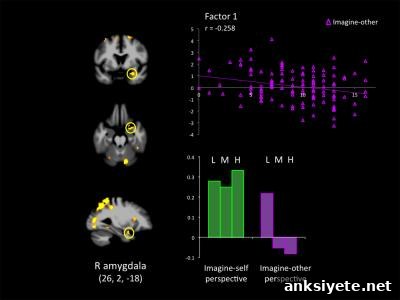
Results showed a striking divergence in how high‑psychopathy individuals processed imagined pain depending on perspective. When imagining pain to themselves, participants with high PCL‑R scores exhibited a typical empathic neural signature: increased activity in regions commonly linked to empathy for pain, including the anterior insula, the anterior midcingulate cortex (aMCC), primary somatosensory cortex, and the right amygdala. In fact, the increase in activity in these regions was unusually strong, indicating that people with psychopathic traits may be strongly responsive to the idea or feeling of their own pain.
However, when those same high‑psychopathy participants switched to imagining pain experienced by another person, those empathy-related regions largely failed to activate. Instead, the high‑psychopathy group showed heightened activity in the ventral striatum, a brain area frequently associated with reward and pleasure. In addition, the study reported a negative functional connectivity between the insula and the ventromedial prefrontal cortex (vmPFC) during imagine‑other trials in high‑psychopathy individuals.
Taken together, this pattern—reduced activation of empathy networks when considering another person’s suffering, increased recruitment of reward circuitry, and atypical connectivity with vmPFC—may indicate that some individuals with higher psychopathic traits experience imagining another’s pain as less aversive and potentially rewarding. The vmPFC is known to contribute to moral judgment and to decisions that take others’ wellbeing into account; a weakened or negative influence of the insula on vmPFC could undermine normal empathic and prosocial decision-making.
These findings help clarify the neural mechanisms that differentiate self-focused affective reactivity from other‑oriented empathy in psychopathy. They also suggest possible directions for interventions. Because imagining one’s own pain produced robust affective responses in some high‑psychopathy participants, therapeutic programs might explore perspective-taking exercises that begin with imagining self‑related distress to bootstrap affective engagement before introducing strategies aimed at recognizing and valuing others’ states. Altered functional connectivity, such as the insula–vmPFC relationship identified here, could also inform the development of targeted neuromodulation or cognitive‑behavioral approaches designed to strengthen empathic processing.
Notes about this neuropsychology research
Contact: Gozde Zorlu – Frontiers
Source: Frontiers press release
Image source: Image credited to Decety J., Chenyi C., Harenski C., and Kiehl K. A., adapted from the Frontiers press release.
Original research: “An fMRI study of affective perspective taking in individuals with psychopathy: imagining another in pain does not evoke empathy” by Jean Decety, Chenyi Chen, Carla Harenski and Kent A. Kiehl, published in Frontiers in Human Neuroscience (2013). DOI: 10.3389/fnhum.2013.00489.