
Summary: Measuring iron deposits in the brain with advanced MRI may help clinicians predict which people with Parkinson’s disease are at greater risk of cognitive decline and dementia.
Source: UCL
An advanced MRI method that maps iron in specific brain regions can track declines in thinking, memory and movement in Parkinson’s disease, according to a new UCL-led study.
The research, published in the Journal of Neurology, Neurosurgery, and Psychiatry, indicates that regional brain iron measurements could become a useful biomarker to identify people with Parkinson’s disease who are more likely to develop dementia.
“Brain iron is drawing growing attention across research into neurodegenerative disorders. Iron naturally accumulates with age, and excess iron is linked with harmful protein changes in the brain. We are beginning to see evidence that iron mapping could be valuable for monitoring disease progression and potentially for diagnostics,” said Dr Rimona Weil, lead author and researcher at the UCL Queen Square Institute of Neurology.
The study assessed 97 people diagnosed with Parkinson’s disease within the previous ten years and compared them with 37 age-matched control participants without the condition. Participants underwent cognitive and memory testing alongside standardized assessments of motor function.
Parkinson’s disease is a progressive neurodegenerative disorder characterized by tremor, rigidity and slowed movement. Around half of people with Parkinson’s eventually develop dementia, although the onset and severity vary widely. At present, clinicians primarily rely on symptom monitoring because conventional imaging detects brain changes only at relatively late stages, when substantial volume loss is already present.
Iron naturally accumulates in the ageing brain, partly due to increased permeability of the blood–brain barrier. Excess iron can have toxic effects and is known to co-localize with pathological proteins linked to dementia, such as amyloid and tau. Prior research has shown that when these proteins build up in specific regions, iron often accumulates in the same areas.
In this study, researchers used quantitative susceptibility mapping (QSM), an MRI technique that sensitively detects brain tissue iron, to map iron distribution across brain regions. They found that higher iron levels in the hippocampus and thalamus correlated with poorer memory and global cognitive scores, while elevated iron in the putamen correlated with worse motor impairment—consistent with the role these regions play in cognition and movement.
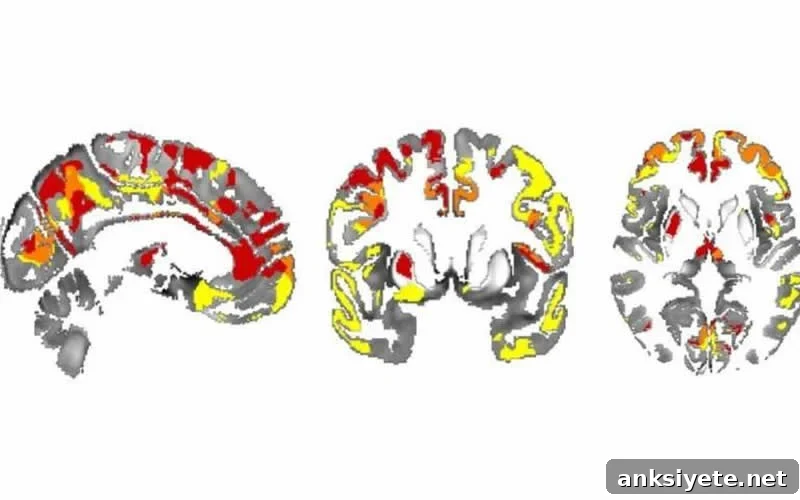
Their whole-brain analyses within the Parkinson’s group showed that increased QSM signals (indicating higher iron content) were associated with: lower Montreal Cognitive Assessment (MoCA) scores in the hippocampus and thalamus; poorer visuoperceptual performance and higher dementia-risk scores in parietal, frontal and medial occipital regions; and higher Movement Disorders Society UPDRS-III motor scores in the putamen. By contrast, conventional measures of brain atrophy did not differ between groups or correlate with clinical measures, suggesting iron mapping may detect disease involvement earlier than structural volume loss.
The authors suggest that regional brain iron measurement could be useful in several clinical contexts: to stratify participants in clinical trials, to monitor whether interventions affect disease biology, and potentially to support earlier diagnosis of cognitive involvement in Parkinson’s and other neurodegenerative disorders.
Dr Weil previously reported in 2019 that a set of vision tests might help predict cognitive decline in Parkinson’s. She and colleagues are now investigating whether combining vision assessments with iron mapping could improve prediction of who will go on to develop dementia.
First author George Thomas, a PhD student at the UCL Queen Square Institute of Neurology, said: “These measures are promising because they can reflect the differing ways Parkinson’s progresses in each person, which could help clinicians tailor treatment and monitoring to individual patients.”
Co-author Dr Julio Acosta-Cabronero (Tenoke Ltd. and Wellcome Centre for Human Neuroimaging, UCL) added: “We were surprised by how clearly regional iron levels measured by MRI correlated with cognitive and motor function. Measuring brain iron may prove useful across a range of conditions to assess which regions are affected and to estimate disease severity.”
The research team is following the same participants longitudinally to determine how iron levels change over time, how those changes relate to clinical progression, and whether iron measures can predict future dementia onset.
Funding: The study received support from Wellcome, the National Institute for Health Research, the Medical Research Council, Parkinson’s UK, the Movement Disorders Society, the ESRC, and the Cure Parkinson’s Trust.
Source:
UCL
Media Contacts:
Chris Lane – UCL
Image Source:
Image credited to George Thomas et al.
Original Research: Open access
“Brain iron deposition is linked with cognitive severity in Parkinson’s disease” by George Thomas et al., Journal of Neurology, Neurosurgery, and Psychiatry. DOI: 10.1136/jnnp-2019-322042.
Abstract
Brain iron deposition is linked with cognitive severity in Parkinson’s disease
Background Dementia is common in Parkinson’s disease (PD), but reliable measures to track cognitive change in PD are limited. Brain tissue iron increases with age and co-localises with pathological proteins associated with PD dementia. We used quantitative susceptibility mapping (QSM) to detect iron-related changes linked to cognitive impairment in PD.
Methods We assessed 100 patients with early- to mid-stage PD and 37 age-matched controls using the Montreal Cognitive Assessment (MoCA), a clinical algorithm predicting cognitive decline in PD, visuoperceptual tests, and the Movement Disorders Society UPDRS-III for motor assessment. We examined associations between these clinical measures and QSM, an MRI technique sensitive to tissue iron.
Results Compared with controls, PD participants showed increased QSM in prefrontal cortex and putamen (p < 0.05, corrected). Within the PD group, higher QSM covaried with lower MoCA scores in the hippocampus and thalamus; poorer visual function and higher dementia risk scores in parietal, frontal and medial occipital cortices; and higher UPDRS-III motor scores in the putamen (all p < 0.05, corrected). Voxel-based morphometry showed no group differences or clinical associations.
Conclusions Brain tissue iron measured with QSM tracks cognitive involvement in Parkinson’s disease. QSM may help detect early cognitive change, stratify participants for clinical trials, and monitor disease progression.