
Summary: Researchers developed a new computational brain model that reproduces brief, high-amplitude bursts of activity observed in human neuroimaging. These recurring moments — lasting only a few seconds — may offer new biomarkers for disorders such as depression, schizophrenia, dementia, and ADHD.
Source: Indiana University
Indiana University computational neuroscientists Maria Pope, Richard Betzel and Olaf Sporns have built a new model of whole-brain activity that reproduces striking, brief bursts of coordinated neural activity previously seen in human recordings but not fully explained. The team’s findings point to a structural origin for these events and suggest they could serve as sensitive indicators of brain health and disease.
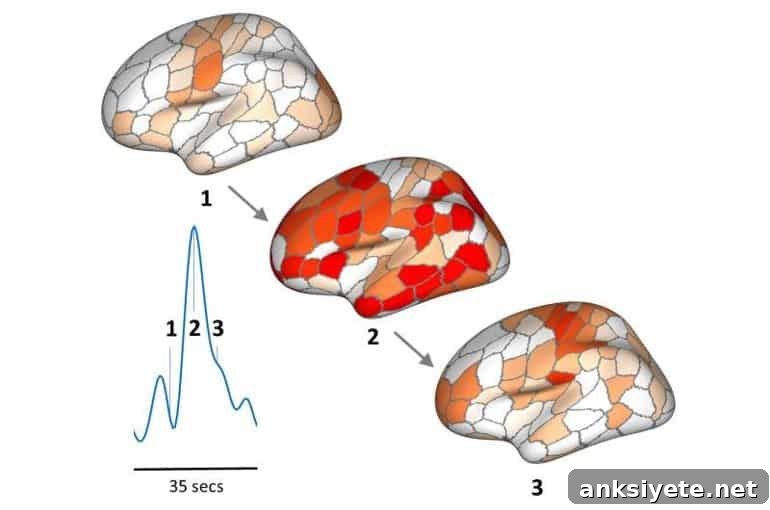
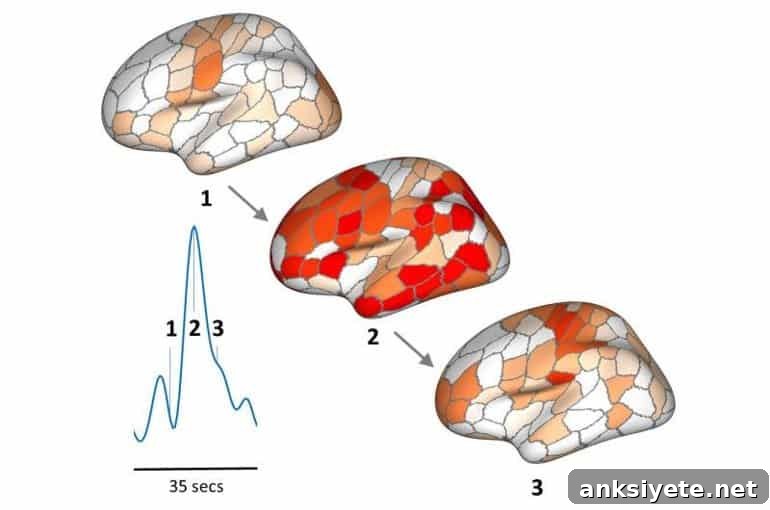
While analyzing human neuroimaging data, the researchers identified short, recurring episodes of synchronized activity they call “events.” These episodes occur continuously across different brain states and tasks. In a typical 10-minute scan the team observed roughly 10 to 20 such events, each lasting only a few seconds.
“What people had not seen is that how brain regions talk to each other is punctuated by these brief moments that are just a few seconds long during which there’s a lot happening,” said Olaf Sporns, Distinguished Professor and Robert H. Shaffer Chair in the Department of Psychological and Brain Sciences at Indiana University Bloomington.
Motivated by this observation, the group focused their analysis on those moments to better characterize how specific brain regions transiently link up and interact. To probe the mechanisms behind these events, the team constructed a computational model built from neuroimaging-derived structural connectivity of a human brain and simulated neuronal dynamics in a resting-like state. Using mathematical descriptions of neuronal activity, the model produced synthetic MRI signals that closely matched empirical recordings.
Crucially, simulated data reproduced burst-like high-amplitude cofluctuations that resemble the events observed in actual human scans. These modeled events showed several key features: they occur intermittently, contribute disproportionately to long-time estimates of functional connectivity, and form recurrent patterns that can be grouped into distinct families.
“The model shows us that these events are guided by the brain’s structural network,” said Maria Pope, a graduate student in Sporns’s lab and a dual Ph.D. candidate in neuroscience and informatics. “They are tied to the physical structure of brain.”
Detailed analysis revealed that events tend to originate within clusters of densely interconnected regions — modular structures in the brain’s wiring — which momentarily light up together. Sporns likened the phenomenon to an orchestra: brief, coordinated themes emerge and then recede, producing an ebb and flow of synchronization rather than a uniform signal.
“There are moments when the orchestra comes together and there’s a theme. They are not just playing a single note for 10 minutes. There are brief moments in which coordinated activity dominates and at other times there might be much less,” Sporns said. “This ebb and flow of coordination is something we also see in the brain, and our model can reproduce it. Clusters of brain regions combine in different ways. It’s not just one pattern, but multiple variations on a theme.”
The research connects event-related cofluctuations to the brain’s modular structural organization. In other words, the physical wiring of the brain appears to shape when and how these brief surges of coordinated activity occur. That insight carries potential clinical significance because functional connectivity has long been studied as a candidate biomarker for psychiatric and neurological disorders.
“Functional connectivity has been a strong focus in research as a potential biomarker for brain disorders and has been related to conditions such as depression, schizophrenia, dementia, and ADHD. And researchers have tried for years to use brain simulations in clinical applications for modeling lesions or diseases,” Sporns said. “This new model gives us a better lens through which to look at the brain, to see more clearly what goes on under both normal and abnormal conditions.”
The team is continuing to investigate why the brain exhibits these brief bursts. One possibility is that such episodes play a beneficial role in global communication across the brain, perhaps functioning like occasional system-wide updates that redistribute useful information across networks.
“Perhaps the brain has developed this type of activity because it’s beneficial. Something about the structure of events may be useful to the brain,” Pope said. “For example, many kinds of networked systems have to do occasional system updates or resets, taking some kind of globally useful information and communicating it to the rest of the system.”
Beyond basic neuroscience, the findings may inform studies of artificial neural networks and machine learning by clarifying how structure shapes transient patterns of coordinated activity. At the clinical level, improved mapping of individual structure-function relationships could refine diagnosis and enable personalized interventions for neurological and psychiatric conditions, noted Richard F. Betzel, professor in the Department of Psychological and Brain Sciences.
About this neuroscience research news
Author: Press Office
Source: Indiana University
Contact: Press Office – Indiana University
Image: The image is credited to Indiana University
Original Research: Open access.
“Modular origins of high-amplitude cofluctuations in fine-scale functional connectivity dynamics” by Maria Pope, Makoto Fukushima, Richard F. Betzel, and Olaf Sporns. PNAS
Abstract
Modular origins of high-amplitude cofluctuations in fine-scale functional connectivity dynamics
The topology of structural brain networks shapes brain dynamics, including the correlation structure of brain activity (functional connectivity) as estimated from functional neuroimaging data.
Empirical studies have shown that functional connectivity fluctuates over time, exhibiting patterns that vary in the spatial arrangement of correlations among segregated functional systems.
Recently, an exact decomposition of functional connectivity into frame-wise contributions has revealed fine-scale dynamics that are punctuated by brief and intermittent episodes (events) of high-amplitude cofluctuations involving large sets of brain regions. Their origin is currently unclear. Here, we demonstrate that similar episodes readily appear in silico using computational simulations of whole-brain dynamics.
As in empirical data, simulated events contribute disproportionately to long-time functional connectivity, involve recurrence of patterned cofluctuations, and can be clustered into distinct families. Importantly, comparison of event-related patterns of cofluctuations to underlying patterns of structural connectivity reveals that modular organization present in the coupling matrix shapes patterns of event-related cofluctuations.
Our work suggests that brief, intermittent events in functional dynamics are partly shaped by modular organization of structural connectivity.