
Summary: In men, a genetic variant in DUSP8 raises the risk of type 2 diabetes by weakening the brain’s insulin response.
Source: DZD
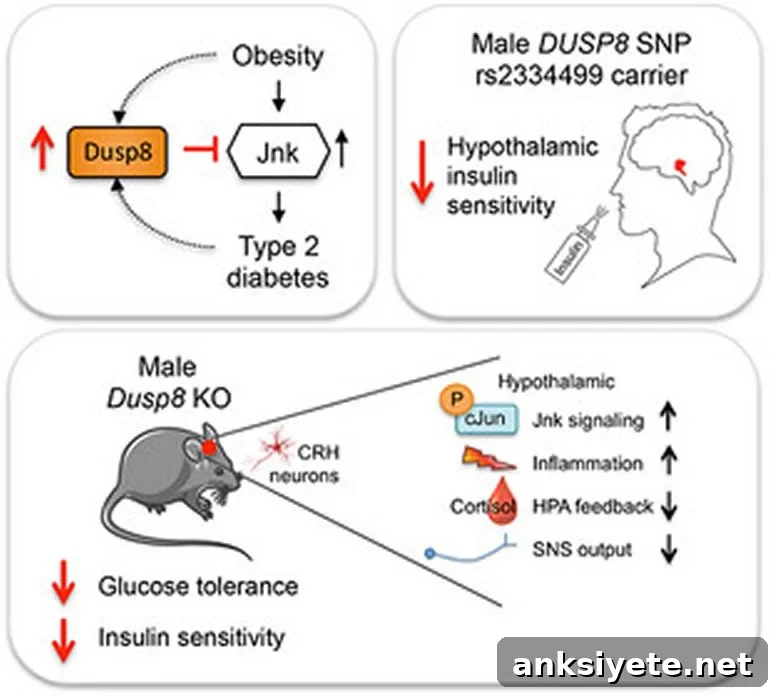
The brain is a central regulator of blood glucose, and dysfunction in this control contributes to type 2 diabetes. Although genetic factors have been implicated by recent studies, the mechanisms linking specific genes to impaired brain insulin signaling were unclear. Researchers at Helmholtz Zentrum München and the German Center for Diabetes Research (DZD) have revealed that a variant of the DUSP8 gene undermines hypothalamic insulin sensitivity in males, increasing the likelihood of developing type 2 diabetes.
Insulin, produced by the pancreas, lowers blood glucose by promoting glucose uptake in peripheral tissues and by acting within the brain—particularly the hypothalamus—to coordinate whole-body glucose and energy balance. In obesity and type 2 diabetes, inflammatory signaling pathways can blunt the cellular response to insulin after the receptor is activated, a condition known as insulin resistance. Genome-wide association studies (GWAS) previously highlighted DUSP8 as a diabetes susceptibility locus. The current work examined how the protein Dusp8 (dual-specificity phosphatase 8), encoded by DUSP8, influences glucose tolerance and insulin action in the hypothalamus.
Genetic variant of DUSP8 raises type 2 diabetes risk in men
“Carriers of a specific DUSP8 variant have a modestly elevated risk for type 2 diabetes, yet the biological role of Dusp8 in disease development was not established,” says Dr. Sonja C. Schriever, lead author. By integrating cell-based assays, mouse models with Dusp8 loss- and gain-of-function, and human functional MRI (fMRI) studies, the team identified Dusp8 as a critical regulator—an actual gatekeeper—of systemic glucose tolerance and hypothalamic insulin sensitivity. Dr. Paul Pfluger, senior author, notes that the multidisciplinary DZD team of biologists, epidemiologists and clinicians mapped molecular pathways that connect Dusp8 activity with metabolic control and diabetes risk.
Dusp8 controls hypothalamic inflammation and insulin responsiveness
Dusp8 modulates inflammatory signaling within the hypothalamus and influences the hypothalamic–pituitary–adrenal (HPA) axis. The protein appears to protect against excessive inflammatory activation that can hamper insulin signaling in the brain. In male mice lacking Dusp8—but not in females—the researchers observed increased hypothalamic inflammation, disrupted HPA axis feedback, and chronically raised stress hormone levels, all of which contributed to worsened insulin sensitivity. These sex-specific effects in mice aligned with human fMRI data showing reduced hypothalamic insulin responsiveness in men who carry the DUSP8 diabetes-risk variant, while female carriers did not show the same impairment.
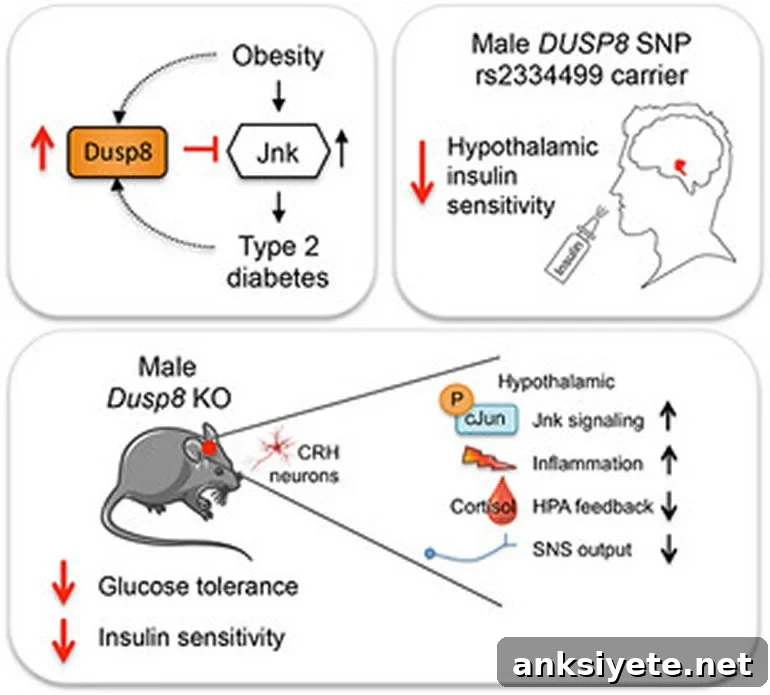
To uncover mechanisms, the investigators examined hypothalamic Jnk signaling (a MAP kinase pathway), which was hyperactivated in the absence of Dusp8. This hyperactivation contributed to impaired HPA feedback, blunted sympathetic responses and elevated corticosterone—factors that together undermined systemic glucose control. Interventions that reduced Jnk activity or restored Dusp8 function in the hypothalamus reversed the metabolic defects: global deletion of Jnk1, targeted overexpression of Dusp8 in the mediobasal hypothalamus using AAV vectors, or chemically lowering adrenal steroid production with metyrapone each improved glucose homeostasis in obese male Dusp8-deficient mice. These findings support a causal role for hypothalamic Dusp8 and its regulation of Jnk signaling in maintaining insulin sensitivity and glucose balance.
The sex-specific nature of the effect is a key observation: both the mouse experiments and human imaging point to a stronger impact of DUSP8 variation on hypothalamic insulin action in males. In addition, DUSP8 expression was found to be increased in the infundibular nucleus of people with type 2 diabetes, further linking this gene to human disease biology.
“Mapping the multi-system processes that lead to hypothalamic insulin resistance in our models helped reveal how DUSP8 contributes to diabetes risk,” Schriever summarizes. Future research will probe how central insulin signaling and the DUSP8 risk allele affect the HPA axis and metabolic regulation in human subjects, both with and without established type 2 diabetes.
About this neurology research article
Source:
DZD
Contacts:
Paul Pfluger – DZD
Image Source:
The image is credited to Helmholtz Zentrum München.
Original Research: Closed access
DOI: 10.1172/JCI136363
Title: “Type 2 diabetes risk gene Dusp8 regulates hypothalamic Jnk signaling and insulin sensitivity” by Schriever SC et al., Journal of Clinical Investigation.
Abstract
Type 2 diabetes risk gene Dusp8 regulates hypothalamic Jnk signaling and insulin sensitivity
Genome-wide association studies identified DUSP8, which encodes a dual-specificity phosphatase acting on MAP kinases, as a gene associated with type 2 diabetes risk. This study characterizes Dusp8 as a regulator of hypothalamic control over glucose homeostasis in mice and humans. Male—but not female—Dusp8 loss-of-function mice, whether carrying a global deletion or a CRH neuron-specific deletion, developed impaired systemic glucose tolerance and reduced insulin sensitivity when challenged with a high-fat diet. Mechanistic analysis revealed disrupted hypothalamic–pituitary–adrenal axis feedback, diminished sympathetic responsiveness, and persistently elevated corticosterone driven by hypothalamic overactivation of Jnk signaling. Interventions that removed Jnk1, overexpressed Dusp8 in the mediobasal hypothalamus, or chemically reduced adrenal steroid output with metyrapone each rescued glucose control in obese male Dusp8 knockout mice. Human fMRI data supported a sex-specific association of the DUSP8 rs2334499 risk variant with hypothalamic insulin resistance in men, and DUSP8 expression was elevated in the infundibular nucleus of people with type 2 diabetes. Together, these results position Dusp8 as a novel hypothalamic factor functionally linked to the development of type 2 diabetes.