
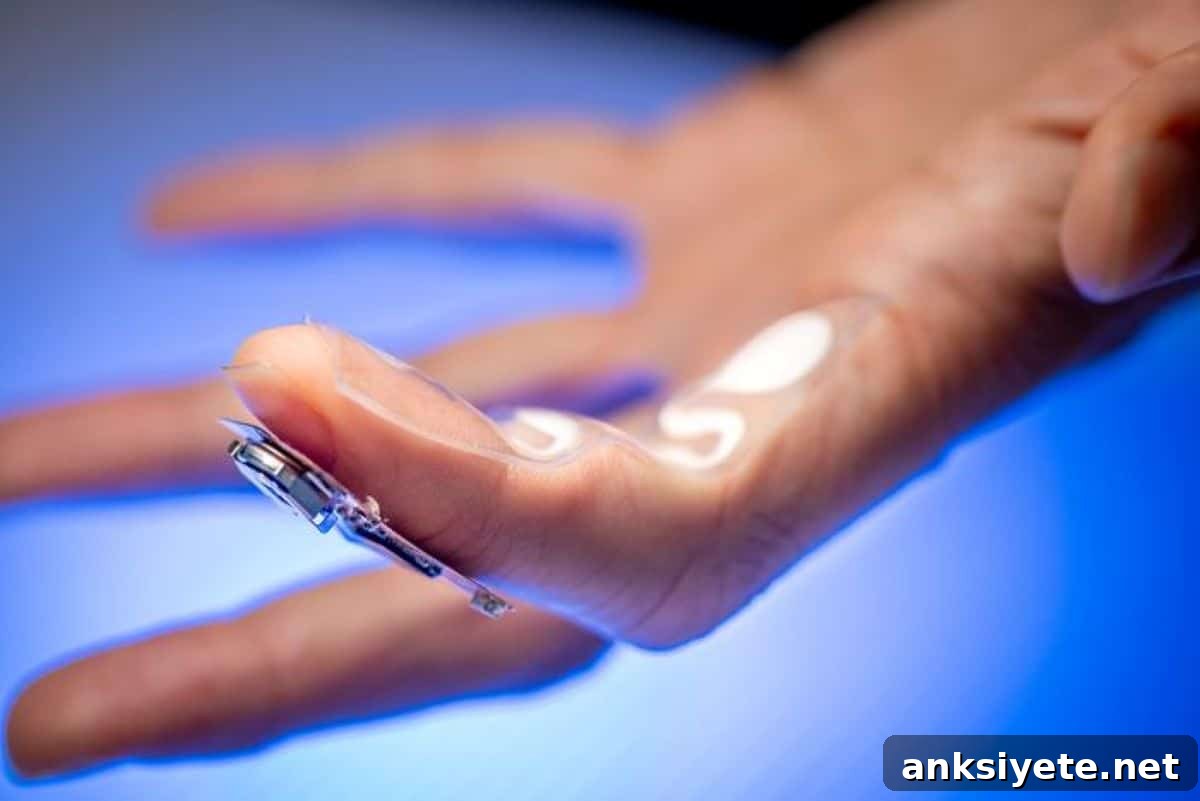
Summary: Engineers and neuroscientists have created a soft, battery-free fingertip patch that continuously measures levodopa levels in human sweat in real time, providing a noninvasive, wearable way to monitor Parkinson’s medication levels with lab-comparable accuracy.
This wearable uses an engineered absorbent salt gel to harvest sweat from the fingertip’s dense network of sweat glands. Enzymes embedded in the patch react with levodopa present in that sweat, driving a bioelectrochemical reaction that both generates the small electrical signal needed to operate the sensor and produces a voltage proportional to the drug concentration. Clinical testing showed the device matches quantitative blood tests while revealing that people with Parkinson’s tend to metabolize and clear levodopa more rapidly than healthy controls.
Key Facts
- Battery-free operation: The patch uses an enzymatic biofuel cell approach: levodopa in sweat reacts with enzymes in the device to produce the electrical voltage required for sensing and readout, eliminating the need for an external power source.
- Fingertip sweat collection: A tailored absorbent hydrogel loaded with salts and benign solvents creates osmotic pressure that passively draws sweat from fingertip pores without exercise, heat, or electrical stimulation.
- Clinical-grade accuracy: Human trials indicate the patch’s real-time electrochemical measurements align with standard laboratory blood assays (high-performance liquid chromatography), offering near-instant results without lab processing delays.
- Improved understanding of drug clearance: Continuous monitoring exposed faster levodopa clearance in Parkinson’s patients compared with healthy participants, a likely contributor to abrupt motor fluctuations and off-state episodes.
- Enables closed-loop therapies: By delivering continuous pharmacodynamic data, the technology lays the groundwork for systems that could automatically trigger controlled drug delivery when levodopa concentrations fall below a therapeutic threshold.
Source: UCSD
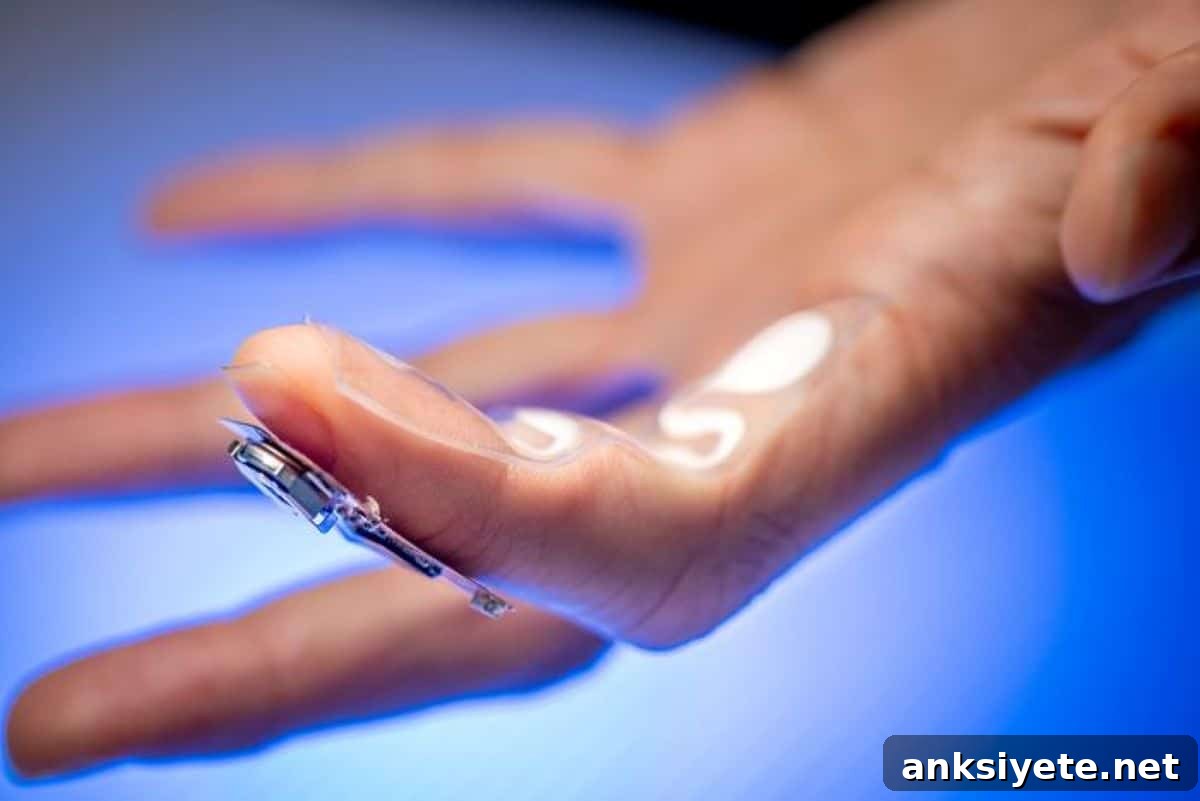
Overview: Researchers at the University of California San Diego developed a soft, fingertip-mounted patch that continuously monitors levodopa levels in sweat, using the sweat itself to power the sensor. The device provides a noninvasive way to track medication in real time and produced measurements comparable to conventional blood tests in clinical trials.
Published in Proceedings of the National Academy of Sciences, the study suggests this approach could let clinicians and patients fine-tune medication timing and dosing at home, potentially improving symptom control and quality of life for people with Parkinson’s disease.
Levodopa remains the primary medication for treating the motor symptoms of Parkinson’s disease. Correct dosing is essential: insufficient levodopa leaves patients rigid and immobile, while excessive levels can provoke dyskinesia—uncontrolled, often debilitating movements. Over time, patients frequently experience a narrowing of the drug’s therapeutic window, making precise timing and dosing increasingly critical.
Currently, clinicians often rely on patient diaries and intermittent blood testing to guide adjustments. Those methods are subjective or slow and can miss sudden drops in drug levels. The fingertip patch addresses these challenges by continuously estimating systemic levodopa concentration from sweat, without the need for batteries or active stimulation to induce sweating.
Development of the platform was led by co-first author Tamoghna Saha, a postdoctoral researcher in the lab of Joseph Wang at the UC San Diego Jacobs School of Engineering, in collaboration with the lab of Irene Litvan at the UC San Diego School of Medicine. The project builds on a longstanding collaboration between these groups to advance wearable levodopa monitoring for personalized Parkinson’s care.
The patch is placed on the fingertip to exploit a high density of sweat glands. Its hydrogel “sponge” contains a concentrated salt mixture and benign solvents that draw sweat by osmotic action. When levodopa in that sweat reaches the enzymatic sensor, a bioelectrochemical reaction produces a small voltage. That voltage both powers the measurement and provides a quantitative signal proportional to levodopa concentration: higher voltages indicate higher drug levels and vice versa.
In clinical testing with healthy volunteers and people with Parkinson’s, the sensor’s continuous measurements correlated closely with gold-standard blood assays while offering immediate data. The continuous traces revealed that levodopa can be cleared faster in Parkinson’s patients than in healthy controls—insight that helps explain abrupt symptom return between doses.
Beyond monitoring, the patch opens possibilities for closed-loop therapeutic systems: a wearable monitor could one day communicate with a programmable pump or delivery device to administer targeted doses when levels fall below the desired therapeutic range.
Full study: “A Wearable Patch for Continuous Levodopa Monitoring in Sweat: Towards Exertion and Power-Free Pharmacodynamic Assessment in Parkinson’s.” Co-first authors: Tamoghna Saha, Muhammad Inam Khan, Katherine Longardner, UC San Diego.
Funding: Supported by the UC San Diego Parkinson and Other Movement Disorders Center, the Center for Wearable Sensors, the National Institutes of Health (1R01NS141451-01), and Emory HPLC Bioanalytical Core (RRID:SCR_023531).
Key Questions Answered:
A: As Parkinson’s disease advances, the effective period after each levodopa dose often shortens significantly—sometimes under two hours. If drug levels drop below the therapeutic window, patients can become rigid and immobile; if levels are too high, they can develop severe involuntary movements (dyskinesia). Continuous, objective monitoring helps avoid both risks and supports timely dose adjustments.
A: The patch’s osmotic hydrogel contains salts and mild solvents that draw sweat from fingertip pores by creating a localized high-solute region. When levodopa in that sweat contacts enzymes on the sensor, it drives a bioelectrochemical reaction that generates a measurable voltage. That voltage both powers the sensing circuitry and reports the levodopa concentration.
A: Continuous sweat measurements showed that people with Parkinson’s often clear levodopa from their systems more rapidly than healthy participants. This faster clearance helps explain sudden and unpredictable returns of motor symptoms between scheduled doses.
Editorial Notes:
- This article was edited by a Neuroscience News editor.
- Journal paper reviewed in full.
- Additional context added by our staff.
About this neurotech and Parkinson’s disease research news
Author: Liezel Labios
Source: UCSD
Contact: Liezel Labios – UCSD
Image credit: David Baillot/UC San Diego Jacobs School of Engineering
Original Research: Open access. Title: “A wearable patch for continuous levodopa monitoring in sweat: Towards exertion and power-free pharmacodynamic assessment in Parkinson’s disease” by Tamoghna Saha, Muhammad Inam Khan, Katherine Longardner, Barak Sabbagh, Kaiwen Zheng, Hugo de Mendoza, Gaoyuan Ji, Bumsik Choi, Zongnan Wang, Rosie Pham, Michael Skipworth, Eshita Shah, Maria Reynoso, Chochanon Moonla, Abdulhameed Abdal, Debika Datta, Samar Singh Sandhu, Ponnusamy Nandhakumar, Artur Jedrzak, Shichao Ding, Lu Yin, Irene Litvan, Joseph Wang. DOI: 10.1073/pnas.2610453123
Abstract
A wearable patch for continuous levodopa monitoring in sweat: Towards exertion and power-free pharmacodynamic assessment in Parkinson’s disease
Precision management of Parkinson’s disease requires frequent levodopa dose adjustments, yet current monitoring depends on subjective symptom records and infrequent blood tests. This work presents a soft, fingertip-mounted wearable that continuously and noninvasively monitors levodopa by combining osmotically harvested passive sweat, soft hydrogels, a potentiometric sensing approach, and individualized calibration—without external power or iontophoresis.
The study found strong correlations between sweat-based measurements and high-performance liquid chromatography–measured blood levodopa concentrations in both healthy and Parkinson’s subjects after a single immediate-release levodopa/carbidopa dose. Low motor symptom scores aligned with peak levodopa levels, supporting the pharmacodynamic relevance of the signal. Despite similar bioavailability, levodopa cleared faster in Parkinson’s patients, and recorded hemodynamic responses showed short hypotensive trends in both groups. Machine-learning analysis identified sweat signals and blood pressure as important features for accurately estimating blood levodopa levels. Overall, this energy-efficient, easy-to-use wearable supports real-time, stimulation-free monitoring, which could enable at-home dosing adjustments and move toward future autonomous closed-loop levodopa delivery systems.