
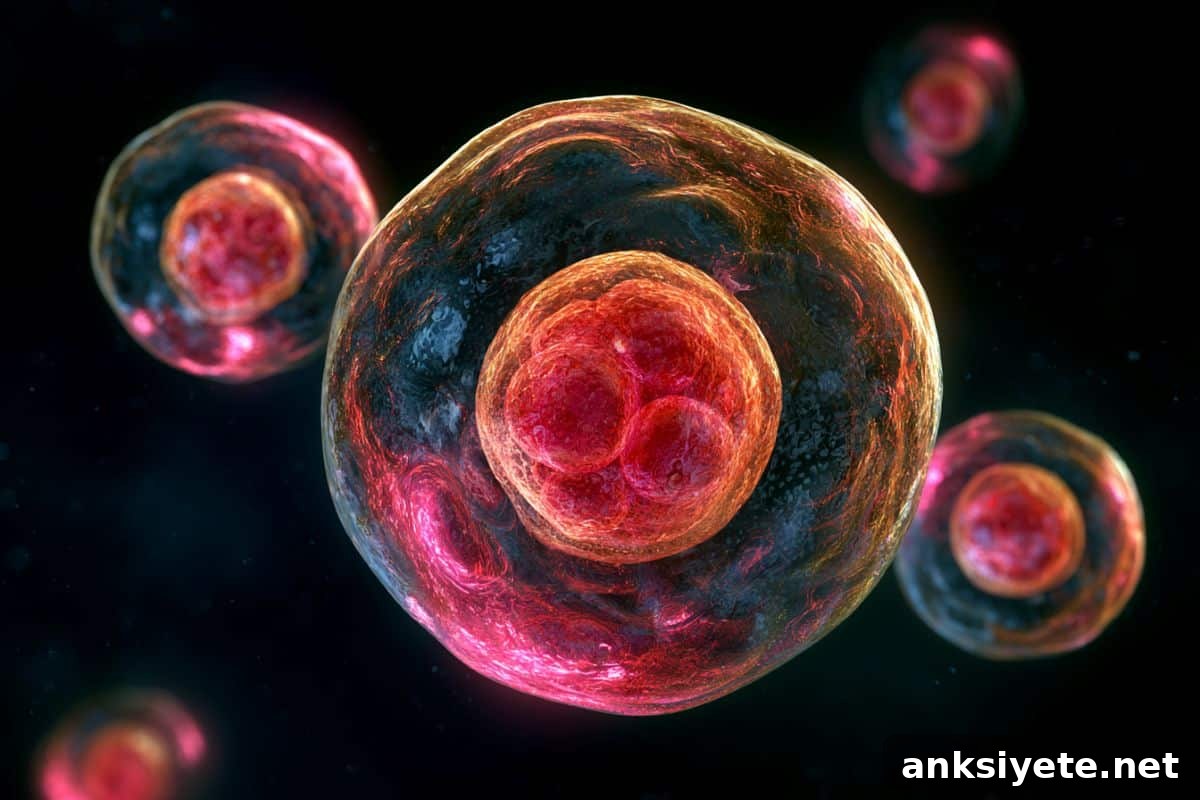
Summary: Researchers have identified a previously hidden metabolic pathway that helps explain why advanced maternal age (AMA) reduces female fertility and lowers the success rates of assisted reproductive technologies (ART). Using non-targeted lipidomics and proteomics together with multi-omics sequencing (RNA-seq, Cut&Tag, ATAC-seq), the team found that embryos from older females show a pronounced decline in autophagy, the cellular self-cleaning process critical for early development.
Loss of autophagy prevents degradation of the peroxisomal enzyme ACOX1, producing an abnormal overactivation of fatty acid beta-oxidation (beta-FAO). This metabolic overdrive depletes oxidized nicotinamide adenine dinucleotide (NAD+), interferes with required histone modifications (notably H3K9ac erasure), and blocks embryos from properly exiting minor zygotic genome activation. The result is early developmental arrest and impaired blastocyst formation.
Key Facts
- Autophagy declines with maternal age: Autophagy normally clears damaged proteins and regulates metabolism during early embryo growth. The study demonstrates a steady reduction in autophagic activity as maternal age increases, compromising cellular quality control.
- ACOX1 accumulates when autophagy fails: Molecular assays revealed that LC3B-mediated autophagic degradation keeps ACOX1 levels in check in young embryos. When autophagy is reduced in embryos from aged females, ACOX1 is not degraded and accumulates, altering lipid metabolism.
- Excessive beta-FAO: Elevated ACOX1 drives an abnormal surge in peroxisomal fatty acid beta-oxidation. This hyperactive lipid burning creates metabolic imbalance despite generating energy, which is detrimental to the tightly regulated early embryonic program.
- NAD+ depletion and epigenetic impact: The increased beta-FAO consumes NAD+, a cofactor required for chromatin-modifying reactions. NAD+ depletion prevents erasure of histone acetylation marks such as H3K9ac, blocking the timely transition out of minor zygotic genome activation and stalling development.
- Functional validation with Rapamycin: Adding the autophagy activator Rapamycin to embryo culture medium restored autophagic flux, reduced ACOX1 levels, normalized lipid metabolism, and improved blastocyst formation rates in aged mouse models, supporting causality.
- Clinical relevance to human IVF: The same molecular cascade—reduced autophagy, ACOX1 accumulation, hyperactive beta-FAO, NAD+ depletion, and failed H3K9ac erasure—was observed in embryos from women of advanced maternal age, highlighting potential metabolic targets to improve ART outcomes.
Source: Science China Press
Background
Advanced maternal age (AMA) is a major factor that impairs fertility and reduces assisted reproductive technology (ART) success by compromising early embryonic development. While autophagy is known to decline with age and to be essential for embryogenesis, the precise linkage between autophagy-mediated metabolic control and embryonic developmental potential has been unclear until now.
This collaborative study, led by researchers at Chongqing Medical University and Tongji University, examined embryos from aged female mice and compared them with younger controls. The investigators combined lipidomics, proteomics, and multiple sequencing approaches to trace how autophagy failure reshapes metabolism and chromatin state during the earliest developmental stages.
Key molecular experiments (including RIP-qPCR and RNA pull-down) showed that impaired autophagy prevents LC3B-dependent degradation of Acox1, raising ACOX1 levels and boosting beta-FAO. Functional manipulation confirmed the model: overexpressing Acox1 reduced blastocyst rates, while knocking down Acox1 partially rescued development in low-autophagy embryos. Downstream multi-omic profiling showed that this metabolic shift depletes NAD+, disrupts H3K9ac dynamics, and stalls exit from minor zygotic genome activation.
Future prospects
By elucidating an autophagy-dependent metabolic and epigenetic cascade that links maternal aging to embryonic arrest, this work identifies concrete molecular targets for intervention. The successful rescue of embryo development with an autophagy activator in mice and the conservation of the mechanism in human embryos suggest potential clinical strategies—such as metabolic or autophagy-supportive additives in culture media—to improve IVF outcomes for older patients. Further safety and efficacy studies will be needed before clinical application.
Key Questions Answered:
A: Maternal aging reduces autophagy, a cellular recycling system that removes excess or damaged proteins and regulates metabolism. When autophagy declines, ACOX1 accumulates, driving excessive fatty acid beta-oxidation. That metabolic imbalance disrupts key resources and chromatin changes the embryo needs to progress, increasing the likelihood of developmental arrest.
A: Excessive peroxisomal beta-FAO consumes NAD+, a cofactor required for enzymatic removal of histone acetylation marks like H3K9ac. Without NAD+, embryos cannot complete necessary epigenetic remodeling and thus fail to exit the minor zygotic genome activation phase, which halts progression to the blastocyst stage.
A: The Rapamycin experiments indicate that pharmacological activation of autophagy can counteract the metabolic defects caused by maternal aging, lowering ACOX1 levels and restoring developmental competence in mouse embryos. Because the same mechanism appears in human embryos from older women, this points to feasible metabolic interventions to support blastocyst development during IVF pending further safety testing.
Editorial Notes:
- This article was edited by a Neuroscience News editor.
- Journal paper reviewed in full by editorial staff.
- Additional context and clarifications were added by staff writers.
About this neurodevelopment and aging research news
Author: Siyun Qin
Source: Science China Press
Contact: Siyun Qin – Science China Press
Image: Image credited to Neuroscience News
Original Research: Open access. “Autophagy-dependent disruption of β-FAO-mediated histone acetylation in embryos during maternal aging” by Dongmei Deng, Chong Li, Ling Zhu, Yin Tian, Jie Wang, Chenshi Li, Mo Chen, Guoning Huang, Shaorong Gao, Shimeng Guo, and Jingyu Li. Science Bulletin. DOI: 10.1016/j.scib.2026.02.053
Abstract
Autophagy-dependent disruption of β-FAO-mediated histone acetylation in embryos during maternal aging
Advanced maternal age (AMA) impairs fertility and ART success by compromising early embryonic development. Declining autophagy during maternal aging disrupts lipid metabolic homeostasis in embryos, producing ACOX1 accumulation, hyperactive beta-FAO, NAD+ depletion, and a failure to remove H3K9ac marks. These linked metabolic and epigenetic defects prevent embryos from properly exiting minor zygotic genome activation and reduce blastocyst formation. The study identifies autophagy and lipid metabolism as actionable targets to improve embryonic developmental competence in the context of maternal aging.