
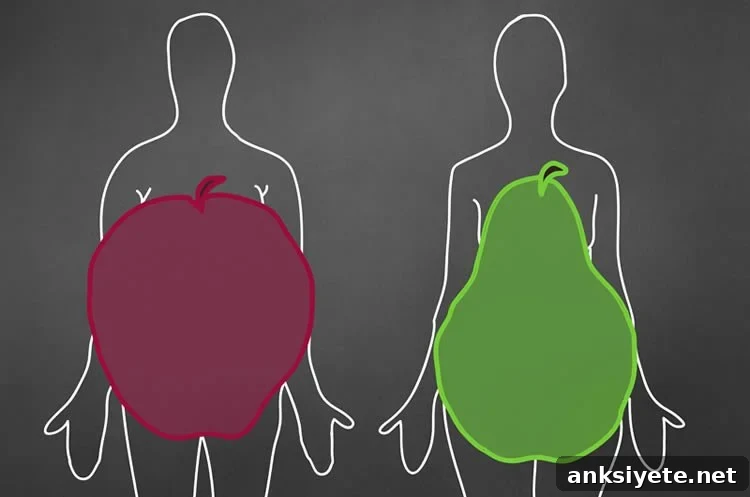
Women who carry more fat around their midsection—commonly described as an apple-shaped body—may face a higher risk of developing episodes of “loss-of-control” eating, according to new research from Drexel University. The study also found that greater central fat was linked with lower body satisfaction, a factor that may contribute to disordered eating behaviors.
This investigation is the first to examine longitudinal connections among body fat distribution, body image disturbance, and the emergence of loss-of-control eating.
“Early detection of eating disorders increases the likelihood of successful treatment,” said lead author Laura Berner, PhD, who conducted this research while completing her doctoral studies at Drexel. “While psychological risk factors are well established, we have relatively few biologically based predictors to identify who may be at greater risk for developing disordered eating.”
Berner and colleagues report that central fat deposition—fat concentrated in the trunk and abdominal regions—appears to be an important biological correlate and potential risk factor for loss-of-control eating. They suggest that recognizing this pattern of fat distribution could help refine prevention efforts and tailor interventions to address concerns tied specifically to midsection fat.
The study, titled “Examination of Central Body Fat Deposition as a Risk Factor for Loss-of-Control Eating,” was published in the American Journal of Clinical Nutrition.
Co-authors included Michael R. Lowe, PhD, Danielle Arigo, PhD, Laurel Mayer, MD, and David B. Sarwer, PhD. Berner is currently a postdoctoral fellow at the Eating Disorders Center for Treatment and Research at UC San Diego Health. The co-authors bring expertise from Drexel University, the University of Scranton, Columbia University, and the University of Pennsylvania.
Research increasingly highlights that the defining feature of binge-eating episodes is often the subjective experience of loss of control—feeling driven to keep eating or unable to stop—rather than the absolute amount of food consumed. This loss-of-control sensation crosses diagnostic categories, occurring in bulimia nervosa, binge-eating disorder, and the binge-eating/purging subtype of anorexia nervosa.
“We wanted to determine whether a measurable biological trait could predict who will develop this sense of loss of control,” Berner said. “Previous work shows that people who already report loss-of-control eating—even without a formal eating disorder diagnosis—are at increased risk of later developing an eating disorder.”
The study used a longitudinal dataset that tracked nearly 300 female college freshmen over two years. Participants completed assessments at baseline, six months, and 24 months. Measurements included height, weight, total body fat percentage, and regional fat distribution assessed by dual-energy X-ray absorptiometry (DXA). None of the participants met diagnostic criteria for an eating disorder at baseline. Disordered eating behaviors were evaluated with standardized clinical interviews that recorded self-reported experiences of loss of control while eating.
Analyses revealed that women with higher proportions of fat stored in the trunk—and especially the abdominal region—were more likely to develop loss-of-control eating over the two-year follow-up. These associations held even after accounting for total body mass and levels of depressive symptoms. In addition, greater central fat was associated with lower satisfaction with one’s body independent of overall weight or depression.
The results indicate that where fat is deposited matters: central fat in the trunk and abdomen predicted both the emergence and the escalation of loss-of-control eating over time, whereas total body fat percentage did not reliably predict these outcomes. For example, the researchers reported that a one-unit increase in the percentage of body fat stored in the abdominal region corresponded with a substantially higher risk of developing loss-of-control eating in the following two years.
Berner cautions that the study does not establish a specific biological mechanism, and she calls for further research to clarify why central fat might influence eating behaviors. One plausible explanation is that central fat alters physiological signals related to hunger and satiety. Fat tissue secretes hormones and signaling molecules that affect appetite regulation; if centrally deposited fat changes those signals, it might contribute to feelings of being out of control while eating. However, the study did not include hormone assays, so this hypothesis remains to be tested.
The authors note that these findings could have implications for other binge-related disorders, though additional research is needed. Body fat distribution has been studied extensively in anorexia nervosa but less so in disorders defined by binge-eating behaviors. While none of the participants developed a full eating disorder diagnosis during the two-year follow-up, the patterns observed suggest that greater central fat stores might increase risk for conditions such as bulimia nervosa and binge-eating disorder and should be explored in future studies.
Source: Alex McKechnie – Drexel University
Image Credit: Image adapted from the Drexel University press release
Original Research: Abstract for “Examination of Central Body Fat Deposition as a Risk Factor for Loss-of-Control Eating” by Laura A. Berner, Danielle Arigo, Laurel ES Mayer, David B. Sarwer, and Michael R Lowe in American Journal of Clinical Nutrition. Published online September 9, 2015. doi:10.3945/ajcn.115.107128
Abstract
Examination of Central Body Fat Deposition as a Risk Factor for Loss-of-Control Eating
Background: Research has considered elevated BMI, higher waist-to-hip ratio, and body dissatisfaction as potential risk factors for bulimic symptoms. Central fat deposition may be especially relevant, but longitudinal relationships among fat distribution, body dissatisfaction, and loss-of-control (LOC) eating have not been established.
Objective: To examine whether body fat distribution—independent of BMI and depressive symptoms—predicts body dissatisfaction and LOC eating both cross-sectionally and over a two-year follow-up.
Design: Body composition was measured by DXA in 294 adult women at baseline, 6 months, and 24 months. LOC eating, body dissatisfaction, and depressive symptoms were assessed repeatedly across the follow-up using standardized clinical interviews and validated questionnaires.
Results: Controlling for BMI, baseline measures of total body fat, trunk fat, and abdominal fat were associated with greater body dissatisfaction. Trunk and abdominal fat predicted increases in LOC eating episode frequency over time, with women carrying a greater percentage of trunk and abdominal fat showing rising LOC eating frequency while those with less central fat remained stable.
Conclusions: Increased central body fat deposition is linked with body-image dissatisfaction and may serve as a risk and maintenance factor for loss-of-control eating. This trial was registered at clinicaltrials.gov as NCT00456131.