
Summary: Researchers demonstrate how targeted electrical activity in face-selective brain regions can change visual perception.
Source: CalTech
How the brain’s electrical signals create the experience of faces and related objects
The human brain is alive with electrical signals as neurons respond to the sights around us. In primates, six distinct regions known as face patches contain neurons that respond far more strongly to faces than to most other objects. New work from Caltech reveals how brief electrical perturbations to these face-selective patches can alter what an animal perceives, clarifying a long-standing question in vision science about how neural activity causes perception.
The study was led by Doris Tsao (BS ’96), professor of biology and a Howard Hughes Medical Institute Investigator. Results were published online in the March 13 issue of Nature Neuroscience.
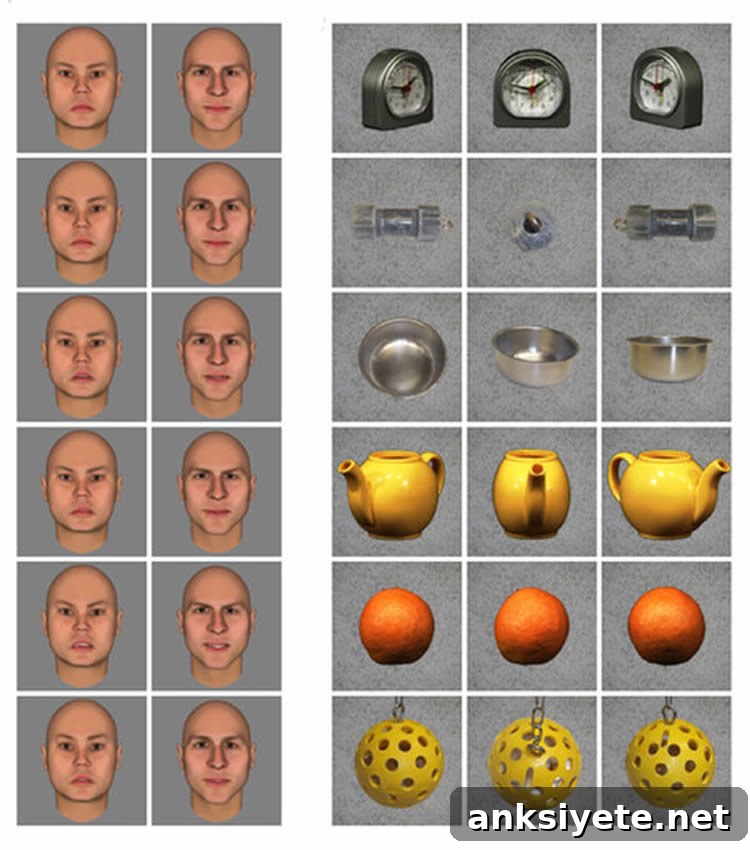
Face-selective neurons generate their strongest responses to faces, but they also show smaller responses to some round or face-like shapes—items such as apples or clocks. That observation raised an important question: do those modest responses contribute meaningfully to perception, or are they irrelevant byproducts of neural tuning? Tsao and colleagues designed experiments to test whether changing activity in face patches would change visual reports about faces and face-like objects.
In the core behavioral test, a macaque monkey was trained to report whether two sequentially shown images were identical (look left) or different (look right). On trials where both images were the same face, the researchers applied brief microstimulation to targeted face patches during presentation of the second image. Stimulation dramatically altered the monkey’s reports: when a face patch was stimulated, the animal usually indicated that the two identical faces were different. This shows that activity in face patch neurons causally contributes to the perception of facial identity.
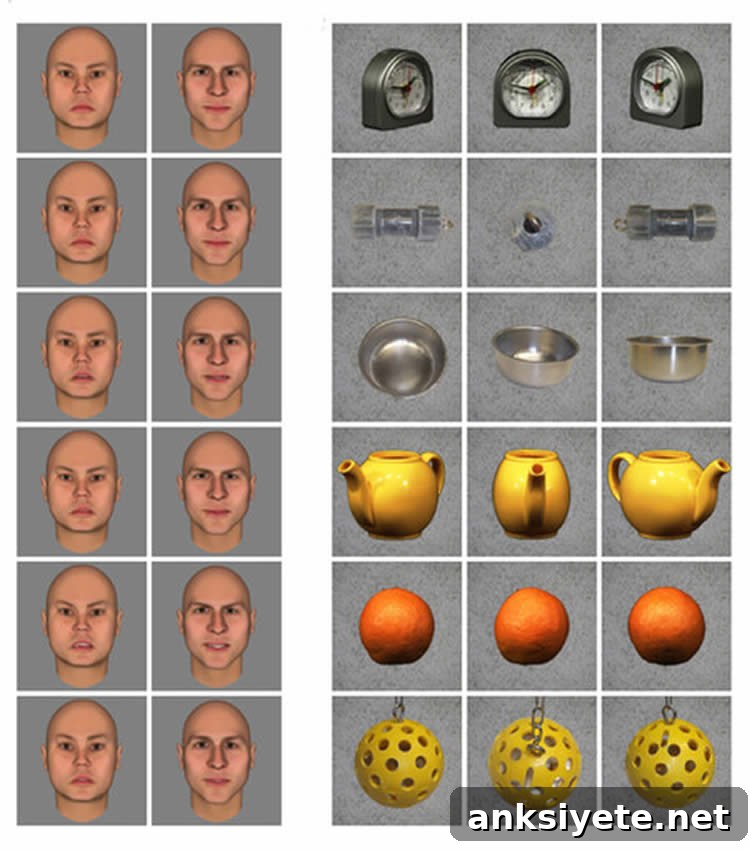
Beyond faces, the team found surprising cross-effects on perception of other images. Stimulating face patches altered reports not only for natural face photographs but also for cartoon faces, high-contrast “Mooney” faces, and in some cases for objects like apples that share a face-like shape. Remarkably, stimulation could bias perception for certain stimuli even when those stimuli produced little or no activity in the stimulated patch under normal conditions.
To explain these results, the researchers mapped responses across the face patch network in the temporal lobe. The most posterior face patch—the earliest processing stage in the chain—tended to respond more broadly and was permissive to objects whose percepts could be modified by stimulation. More anterior patches showed stronger specialization for faces. These findings indicate that face patches play a localized, causal role in encoding facial identity, but they are also embedded in a broader inferotemporal network that influences perception of a wider class of face-compatible objects.
The results carry implications beyond basic neuroscience. For engineers designing machine vision systems, the findings speak to how specialized processing should be organized. Rather than relying solely on many narrowly tuned modules (one for shoes, one for cars, one for bags), a hybrid architecture that mixes specialized and more general-purpose representations may be most effective.
Coauthors include former postdoctoral scholars Sebastian Moeller and Trinity Crapse, and current Caltech postdoctoral scholar Le Chang. Funding was provided by the Howard Hughes Medical Institute, the National Institutes of Health, and the Humboldt Foundation. Reporting and summary prepared by Lori Dajose, CalTech.
Key terms: face patches, face cells, microstimulation, inferotemporal cortex, perception, object recognition, machine vision.
Abstract
The effect of face patch microstimulation on perception of faces and objects
This study asked what range of stimuli is represented by face-selective regions in macaque inferotemporal cortex and how brief electrical microstimulation of those regions affects perception. Microstimulation delivered to the centers of face patches produced strong distortions of perceived facial identity. While many non-face objects were unaffected by stimulation, some non-face items whose shapes are compatible with faces (for example, apples) and some facelike abstract images (for example, cartoon houses or two-tone Mooney images) showed altered percepts. In several cases microstimulation changed perception of objects that did not normally activate the stimulated patch. Together, these results indicate that representation of facial identity is localized within face patches, yet activity in those patches can influence perception of face-compatible non-face objects, including items typically represented elsewhere in inferotemporal cortex.
Paper: “The effect of face patch microstimulation on perception of faces and objects” by Sebastian Moeller, Trinity Crapse, Le Chang & Doris Y. Tsao. Published online March 13, 2017. DOI: 10.1038/nn.4527