
Summary:
MIT neuroscientists report that the APOE4 gene variant disrupts essential Wnt signaling in oligodendrocytes, causing critical fatty lipids to accumulate in toxic intracellular droplets instead of being used to form protective myelin sheaths around axons. Through a genome-wide CRISPR knockout screen, chromatin accessibility profiling, and biochemical studies, the team showed that excessive GSK3B activity and reduced beta-catenin underlie this defect. Importantly, pharmacological inhibition of GSK3B reactivated Wnt signaling, cleared lipid droplets, and restored myelination in human brain organoids and in Alzheimer’s-model mice.
Key Facts:
- Genome-wide CRISPR screen: Systematic knockout of every protein-coding gene in human APOE4 oligodendrocytes pinpointed suppressed Wnt pathway activity as a direct driver of pathological lipid droplet accumulation.
- Biochemical imbalance: APOE4 reduces beta-catenin and increases the Wnt inhibitor GSK3B, preventing oligodendrocytes from mobilizing lipids to make myelin.
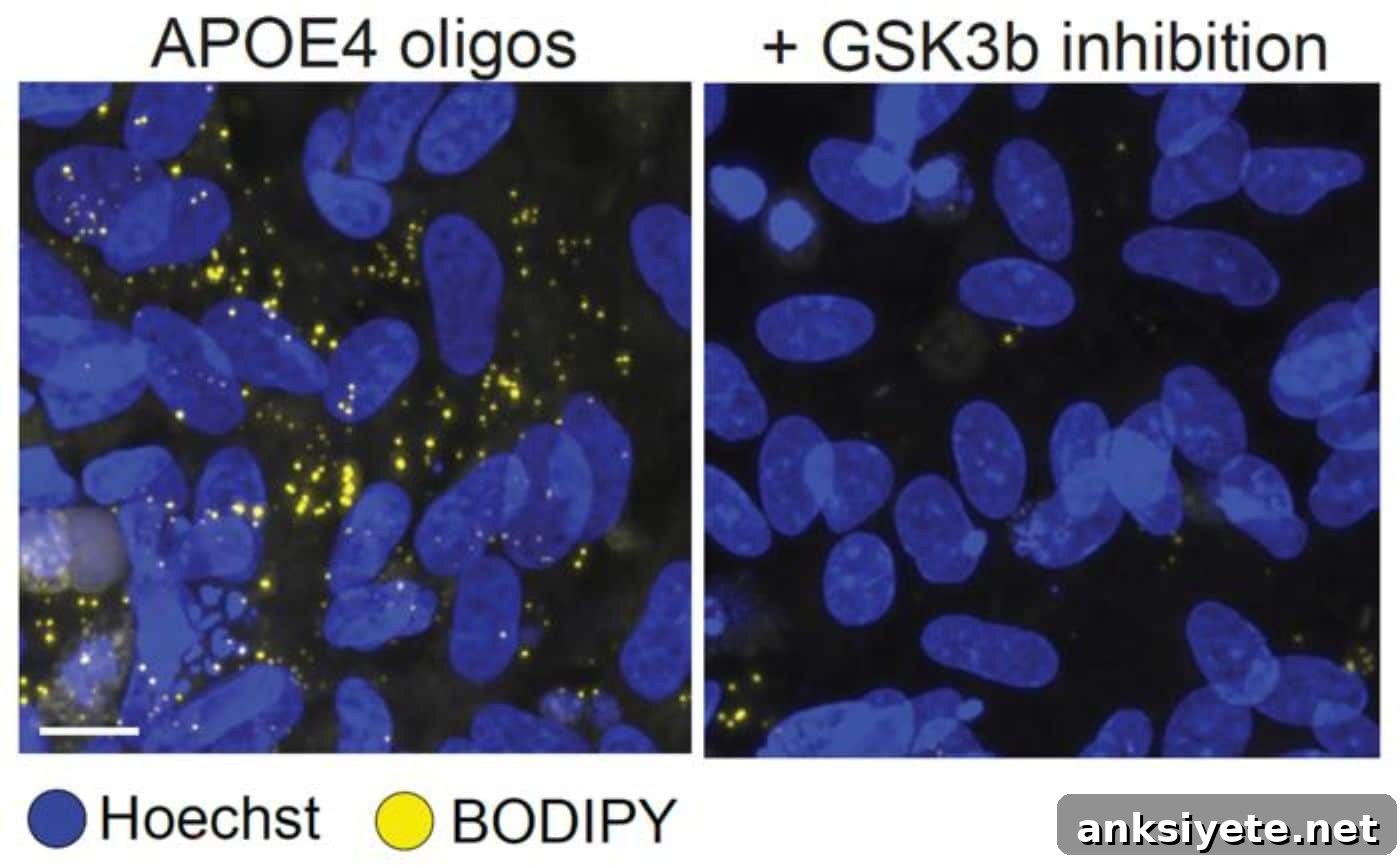
- Therapeutic reversal: Pharmacologic inhibition of GSK3B with CHIR99021 restored Wnt signaling, dissolved lipid droplets, promoted axonal growth, and improved myelination in human organoids and in Alzheimer’s mouse models.
Source: Picower Institute for Learning and Memory at MIT
The APOE4 gene variant is the strongest genetic risk factor for late-onset Alzheimer’s disease. Beyond its established links to amyloid and inflammation, APOE4 also compromises white matter by impairing oligodendrocyte function and myelin integrity.
A new study led by researchers at the Picower Institute for Learning and Memory at MIT identifies a precise molecular mechanism behind this myelin breakdown. Published in Cell Stem Cell, the work demonstrates that APOE4 suppresses Wnt signaling within oligodendrocytes. When Wnt activity is insufficient, these cells trap structural lipids in intracellular droplets rather than mobilizing them to wrap axons with myelin, diminishing neural insulation and potentially weakening circuit function.
Using complementary genetic and epigenomic approaches, the team shows that restoring Wnt signaling reverses lipid accumulation and recovers myelination in both human-derived cell systems and in vivo models, supporting Wnt/GSK3B as a promising therapeutic axis for APOE4-related white matter dysfunction.
An Unbiased Genetic Search
Previous work from the Tsai lab established that APOE4 drives lipid droplet accumulation in oligodendrocytes and reduces myelination, but the upstream causes were unclear. To identify causal regulators, lead author Leyla Akay performed a genome-wide CRISPR knockout screen across all protein-coding genes in human APOE4 oligodendrocytes. The screen revealed that loss of Wnt-promoting genes intensified droplet accumulation, while knocking out Wnt repressors removed droplets—strongly implicating Wnt pathway suppression as the central mechanism.
Concurrently, ATAC-seq analysis of chromatin accessibility in human oligodendrocyte cultures and post-mortem brain tissue from APOE4 versus APOE3 individuals confirmed reduced accessibility at genes that activate Wnt signaling in APOE4 carriers, supporting the genetic findings at the level of chromatin regulation.
“There was a striking overlap between ATAC-seq and CRISPR screen results,” said senior author Li-Huei Tsai, Picower Professor of Neuroscience. “Both pointed to a dysregulation of the Wnt signaling pathway.”
Overcoming the Wnt Deficit
Biochemical experiments clarified how the Wnt deficit arises: Wnt signaling is governed by a balance between beta-catenin, which promotes Wnt-driven transcription, and glycogen synthase kinase-3 beta (GSK3B), which targets beta-catenin for degradation. In APOE4 oligodendrocytes, beta-catenin levels fall while GSK3B expression rises, tipping the balance toward suppressed Wnt signaling.
The researchers tested small molecules to correct this imbalance. Elevating GSK3B in APOE3 cells induced lipid droplet formation, while inhibiting GSK3B with CHIR99021 in APOE4 cells reduced droplets. In three-dimensional human brain organoids that paired APOE4 oligodendrocytes with neurons, GSK3B inhibition promoted axon extension and restored myelin formation—showing functional recovery in a complex tissue-like model.
In Vivo Restoration in the Hippocampus
To assess effects in a living brain, the team treated mice expressing human APOE4 and carrying a tauopathy transgene with CHIR99021. Treated animals showed a clear reduction in lipid droplets in the hippocampus and increased myelination compared with untreated controls. These in vivo results support the translational potential of targeting the Wnt–GSK3B axis to repair oligodendrocyte lipid metabolism and myelin integrity.
Because GSK3B also contributes to tau hyperphosphorylation, modulating this kinase could offer a twofold therapeutic benefit—repairing myelin loss while attenuating tau pathology.
Funding: This research was supported by the National Institutes of Health, the Robert and Renee E. Belfer Family Foundation, the Manthripragada McManama Alzheimer’s Fund, the CAMA Seed Fund, the J. Crayton Pruitt Foundation, Joseph P. DiSabato and Nancy Sakamoto, and the Freedom Together Foundation.
Editorial Notes:
- Article edited by a Neuroscience News editor.
- Journal paper reviewed in full by staff.
- Additional context provided by editorial staff.
About this Alzheimer’s disease Research:
- Media Contact: David Orenstein
- Source: MIT
- Image Credit: Tsai Lab / Picower Institute, MIT
- Original Research (open access): Cell Stem Cell (Oct 1, 2026). Title: “Genome-wide CRISPR screen reveals Wnt signaling as a potential therapeutic target for lipid accumulation and impaired myelination in APOE4 oligodendrocytes.” Authors include Leyla Anne Akay and Li-Huei Tsai, et al.
- DOI: 10.1016/j.stem.2026.09.012
Abstract
Genome-wide CRISPR screen reveals Wnt signaling as a potential therapeutic target for lipid accumulation and impaired myelination in APOE4 oligodendrocytes
APOE4 is the strongest genetic risk factor for late-onset Alzheimer’s disease, but the cellular pathways linking APOE variants to disease risk are incompletely understood. Prior work showed that APOE4 drives lipid droplet accumulation in oligodendrocytes and reduces myelination; the underlying mechanisms were unclear. Using a genome-wide CRISPR screen and ATAC-seq in human iPSC-derived oligodendrocytes, this study identified decreased Wnt signaling and overactive GSK3B as central regulators of lipid-droplet accumulation. Genetic and pharmacological inhibition of GSK3B reduced lipid droplets in APOE4 oligodendrocytes and increased myelination in three-dimensional iPSC-derived brain organoids. Pharmacological GSK3B inhibition also reduced lipid droplets and improved myelination in APOE4;PS19 tau transgenic mice. Collectively, these findings link Wnt/GSK3B signaling to APOE4-driven disruptions in oligodendrocyte lipid metabolism and myelination, highlighting GSK3B as a candidate therapeutic target for APOE4-associated Alzheimer’s disease.