
Summary:
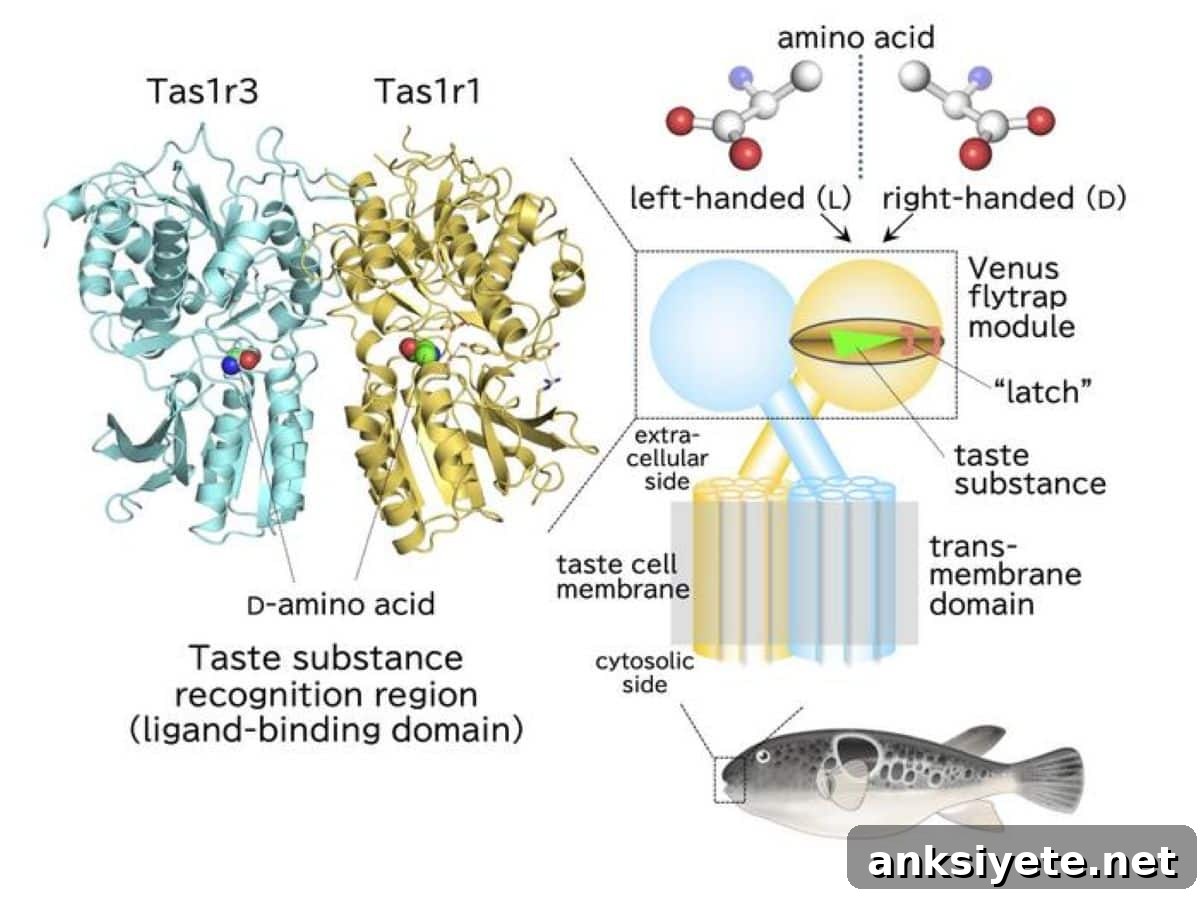
Scientists have resolved the first three-dimensional crystal structure of an umami taste receptor ortholog from pufferfish, revealing a distinctive molecular latch that enables the receptor to recognize both savory L-amino acids and sweet D-amino acids. This structural discovery shows how sensory receptors can evolve internal stabilizing interactions to expand taste recognition, with potential applications for flavor design and tailored animal feeds.
Key Facts:
- Uncommon stereochemical flexibility: Unlike mammalian taste receptors that usually distinguish strictly between mirror-image enantiomers, the pufferfish Tas1r1/Tas1r3 receptor binds and responds to both L-amino acids (commonly associated with umami) and D-amino acids (which can elicit sweet responses).
- Molecular “latch” mechanism: Structural studies reveal intersubdomain interactions that act like an internal latch, keeping the receptor’s clamshell-like ligand-binding cleft in a signaling-competent closed state even when the ligand does not match the canonical stereochemistry.
- Diet-driven adaptation: The receptor’s broadened specificity is likely linked to the pufferfish’s diet of mollusks and crustaceans, which accumulate significant amounts of D-amino acids in marine environments.
Source: University of Osaka
How Animals Sense the Chemistry of Food
Taste is a key sensory system that helps vertebrates detect nutrient-rich foods and avoid harmful substances. At the molecular level, the taste receptor type 1 (TAS1R) family—class C G protein–coupled receptors (GPCRs)—mediates detection of sugars, amino acids, and nucleotides across species. These receptors translate the chemical properties of food molecules into cellular signals that drive feeding behavior and nutrient choice.
In mammals, taste receptors typically show strict enantioselectivity: the umami receptor TAS1R1/TAS1R3 responds to L-amino acids, while the sweet receptor TAS1R2/TAS1R3 recognizes sugars and certain D-amino acids. Because these receptor complexes are delicate and difficult to purify and stabilize outside the cell, the structural principles that determine ligand recognition have remained incompletely understood.
A team led by researchers at the University of Osaka has now solved this problem for a fish ortholog by determining the crystal structure of the ligand-binding domain of Tas1r1/Tas1r3 from the pufferfish Takifugu rubripes. Published in the Proceedings of the National Academy of Sciences (PNAS), the study reveals an unexpected degree of stereochemical promiscuity that challenges conventional models of taste receptor specificity.
A Molecular Clamp with a Built-In Latch
Like other class C GPCR ligand-binding domains, TAS1R receptors have a large extracellular region shaped like a clamshell. When a complementary nutrient fits into the cleft, the clamshell closes, stabilizing an active conformation that triggers downstream signaling. If a ligand has the wrong three-dimensional shape or opposite chirality, the cleft normally cannot close fully and signaling does not occur.
The pufferfish Tas1r1/Tas1r3 behaves differently. Crystallography and site-directed mutagenesis identified intersubdomain contacts that act as a molecular latch, holding the cleft in a closed conformation even when bound to noncanonical D-amino acids. These intramolecular bridges reduce the receptor’s reliance on a perfect stereochemical fit and stabilize the active signaling state across a broader range of amino acid ligands.
“Most receptors fail to engage molecules with the wrong shape,” said senior author Atsuko Yamashita. “Finding that Tas1r1/Tas1r3 uses internal interactions to latch the cleft closed and accept both L- and D-amino acids provides a clear structural explanation for how receptor flexibility can evolve.”
Driven by Marine Diets
The receptor’s stereochemical promiscuity appears to be an evolutionary response to the pufferfish’s ecological niche. Mollusks and crustaceans—key components of the pufferfish diet—often contain elevated levels of D-amino acids produced by microbial activity or postmortem processes. A receptor capable of detecting both enantiomers would help the fish identify a wider range of nutrient sources in its environment.
Rather than evolving a new receptor family, pufferfish appear to have gained intramolecular interactions that bias the receptor’s conformational equilibrium toward the active state. This subtle structural tuning expands ligand recognition while retaining the conserved TAS1R framework shared across vertebrates.
From Evolutionary Biology to Flavor Engineering
Resolving the atomic details of Tas1r1/Tas1r3 opens avenues beyond fundamental evolution and sensory biology. Because TAS1R receptors share a conserved core architecture, the discovery of intramolecular latches that modulate ligand binding could inform rational design of taste modulators and flavor enhancers. Food scientists and biotechnologists might use these structural insights to develop novel umami compounds for human nutrition or to create targeted feed additives that enhance palatability in aquaculture and livestock production.
Understanding how specific intramolecular contacts shift receptor conformational landscapes provides a practical blueprint for modulating receptor activation without introducing new receptor genes—an approach that could accelerate development of safe, effective flavor and feed solutions.
Editorial Notes:
- This article was edited by a Neuroscience News editor.
- The journal paper was reviewed in full.
- Additional context was added by editorial staff.
About this Genetics and Neurology Research:
- Media Contact: Saori Obayashi
- Source: University of Osaka
- Image Credit: Image credited to Atsuko Yamashita
- Original Research: PNAS (September 15, 2026). Title: “Identification and structural characterization of stereochemical promiscuity in a taste receptor.” Authors: Rakuto Mizoguchi, Yasuka Toda, Mana Nagae, Takashi Yoshida, Hiroaki Matsuura, Kunio Hirata, Vi Toan Lam, Duy Phuoc Tran, Akio Kitao, Yohei Miyanoiri, Maiko Hosotani, Yuji Ashikawa, Chiaki Ito, Naotaka Tsutsumi, Norihisa Yasui, Yoshiro Ishimaru, and Atsuko Yamashita.
- DOI: 10.1073/pnas.2534924123
Abstract
Identification and structural characterization of stereochemical promiscuity in a taste receptor
Taste receptor type 1 (TAS1R), which includes the sweet and umami receptors in humans, senses nutrients such as sugars and amino acids. Substrate specificity of TAS1Rs is often broad and varies between species and receptor subtypes, but the structural determinants of this diversity remain poorly understood.
Here, we report the crystal structure of the ligand-binding domain (LBD) of the Tas1r1/Tas1r3 heterodimer from pufferfish, an ortholog of the human umami receptor. The overall architecture resembles previously reported TAS1R structures, reflecting a conserved core across the family.
Despite this conserved framework, the pufferfish Tas1r1/Tas1r3 receptor binds and responds to both l- and d-amino acids, whereas TAS1Rs are typically thought to respond preferentially to a single enantiomer. Structural and mutational analyses reveal that intersubdomain interactions function as a latch that limits cleft opening and stabilizes the active conformation, allowing nonrigorous stereochemical recognition even when ligand chirality differs from the canonical form.
These findings indicate that TAS1R substrate specificity can evolve not only through changes in direct ligand contacts but also by acquiring intramolecular interactions that shift the receptor’s conformational equilibrium toward signaling-competent states.