
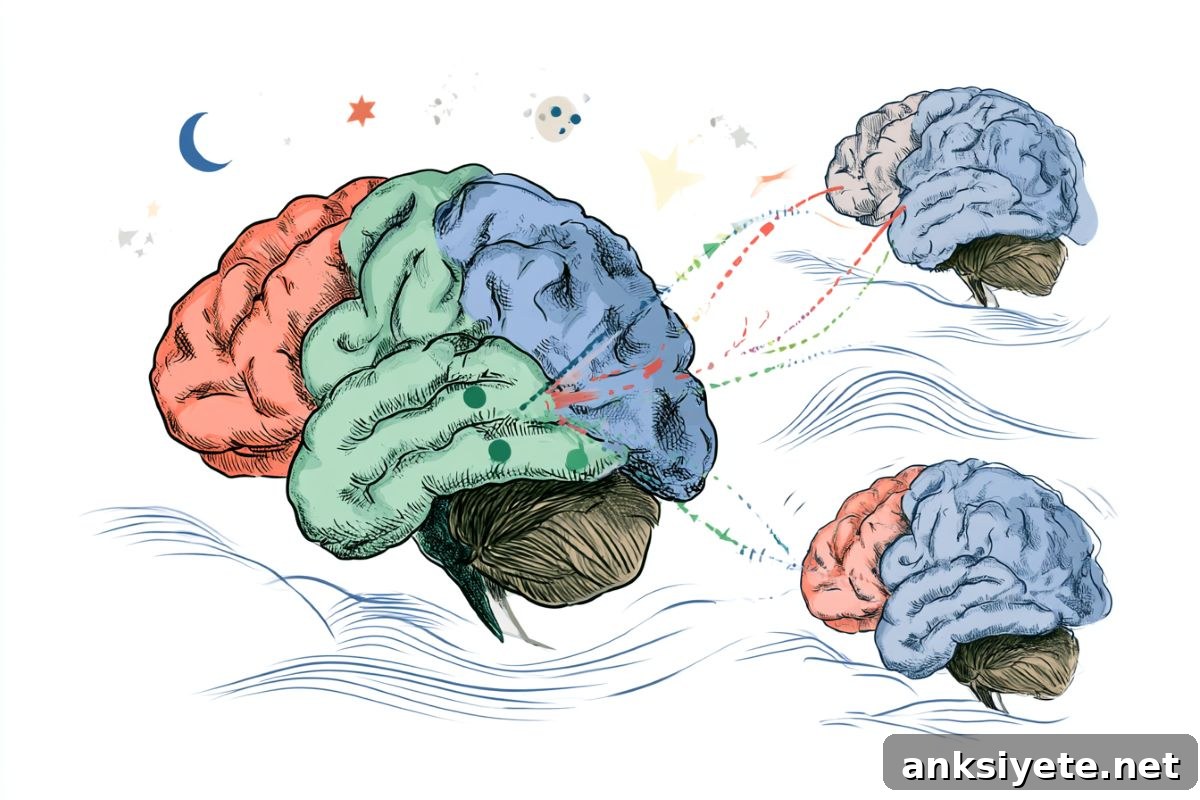
Summary: Intracranial recordings in humans reveal that sleep-dependent memory consolidation requires tightly coordinated activity among three brain regions—the orbitofrontal cortex, the thalamus, and the hippocampus. This coordinated cascade of slow oscillations, sleep spindles, and hippocampal ripples strengthens memory traces, while interictal epileptic spikes disrupt that timing and impair memory.
Researchers used simultaneous intracranial recordings to track neural oscillations across these regions during sleep and related those patterns to overnight memory performance. The study provides the first direct human evidence that real-time cross-regional coupling of these sleep rhythms supports memory consolidation and identifies how pathological epileptic spikes interfere with the process.
Key Facts
- First direct human intracranial evidence: Coordinated, real-time coupling among the orbitofrontal cortex, thalamus, and hippocampus during sleep is necessary for memory consolidation.
- Hierarchical oscillatory cascade: Memory stabilization depends on the alignment of slow oscillations from the orbitofrontal cortex, thalamic sleep spindles, and high-frequency hippocampal sharp-wave ripples.
- Epileptic spikes disrupt timing: Interictal epileptic spikes break the precise phase relationships between these rhythms, producing immediate disruption of sleep-dependent memory processing.
- Explains cognitive deficits in epilepsy: The identified mechanism helps account for why people with epilepsy often experience memory and learning problems even when daytime cognitive testing appears normal.
- Therapeutic implications: Mapping this tripartite circuit suggests targets for neuromodulation and closed-loop stimulation designed to suppress nocturnal epileptic spikes and restore memory function.
Source: Kennedy Krieger Institute
Overview of the research
Investigators at Kennedy Krieger Institute and Johns Hopkins Medicine recorded intracranial electroencephalography (iEEG) from 19 patients with epilepsy to observe how sleep rhythms interact across the orbitofrontal cortex, thalamus, and hippocampus. Using a validated motor memory task, they measured overnight changes in performance and related those behavioral outcomes to the timing and rates of slow oscillations, sleep spindles, and hippocampal ripples during sleep.
Analysis showed that orbitofrontal slow oscillations strongly modulate spindle and ripple activity both within and across regions. Combinations of these oscillations generally predicted improved overnight memory, with hippocampal ripple rates and coordinated hippocampal–orbitofrontal ripple coupling emerging as particularly reliable predictors of performance gains.
By contrast, when sleep oscillations co-occurred with epileptic spikes, the predictive relationship reversed: high rates of oscillations coupled to spikes correlated with poorer overnight memory. Slow oscillations coinciding with epileptic spikes were among the most consistent negative predictors across subjects, indicating that epileptic activity hijacks the normal memory-supporting cascade of sleep rhythms.
These results deliver a direct link between the microsecond-scale coordination of sleep rhythms across multiple brain areas and behavioral memory consolidation in humans, while also explaining how interictal epileptic discharges can undermine that process.
“We haven’t understood why patients with epilepsy have problems with memory,” said Dr. Catherine Chu, study co-author and vice president of neurology at Kennedy Krieger and director of child neurology and pediatric epilepsy at Johns Hopkins University. “This helps to close that gap.”
Mark Kramer, co-author and professor of applied mathematics and statistics at Johns Hopkins University, added that rigorous mathematical and statistical methods were essential to sift meaningful patterns from large-scale intracranial recordings: these interdisciplinary tools made it possible to detect microsecond oscillatory coupling and link it to clinical outcomes.
Funding: The study was supported by a grant from the National Institutes of Health.
Key Questions Answered
A: During sleep these regions synchronize distinct electrical rhythms: the orbitofrontal cortex provides slow oscillations, the thalamus produces sleep spindles, and the hippocampus generates sharp-wave ripples. Precise phase alignment among these events enables transfer and stabilization of daytime memory traces into long-term cortical storage.
A: Epileptic spikes act as abrupt electrical disturbances that disrupt the finely timed coupling between slow waves, spindles, and ripples. When spikes interrupt this timing, the coordinated cascade that supports memory consolidation breaks down and overnight memory performance declines.
A: Intracranial EEG produces very large, complex datasets that capture continuous voltage fluctuations across multiple depth electrodes. Advanced analytical methods are needed to remove noise, detect brief oscillatory coupling events, and map cross-regional coordination that occurs at millisecond timescales.
Editorial Notes
- Article edited by a Neuroscience News editor.
- Journal paper reviewed in full by the editorial team.
- Additional context added by staff to clarify findings and implications.
About this memory and sleep research news
Author: Jessica Gregg
Source: Kennedy Krieger Institute
Contact: Jessica Gregg – Kennedy Krieger Institute
Image: The image is credited to Neuroscience News
Original Research: Open access.
“A hierarchical cascade of sleep rhythms supports motor memory and is hijacked by epileptic spikes in human epilepsy” by Anirudh Wodeyar, Dhinakaran Chinappen, Hunki Kwon, Wen Shi, R. Mark Richardson, Mark A. Kramer, Catherine J. Chu. PNAS. DOI: 10.1073/pnas.2517454123
Abstract
A hierarchical cascade of sleep rhythms supports motor memory and is hijacked by epileptic spikes in human epilepsy
The cross-regional interplay of slow oscillations, spindles, and ripples during sleep is widely believed to support systems memory consolidation but has been understudied in humans. Using a validated behavioral task and simultaneous intracranial recordings from the orbitofrontal cortex, thalamus, and hippocampus in 19 patients with epilepsy, the investigators examined how slow oscillations, spindles, ripples, and epileptic spikes relate to motor memory consolidation.
Orbitofrontal slow oscillations robustly modulate spindle and ripple oscillations within and across regions. Although many oscillation combinations positively predicted overnight improvement on a motor task, hippocampal ripple rate and coupled hippocampal–orbitofrontal ripple rates were the most consistent positive predictors across subjects. Conversely, rates of sleep oscillations that coincided with epileptic spikes were generally negative predictors of overnight performance change, with slow oscillations co-occurring with spikes being among the strongest negative indicators.
These findings provide direct evidence for a hierarchical cascade of sleep oscillations supporting human motor memory processing and show that epileptic spikes coupled to sleep rhythms interfere with this consolidation in patients with epilepsy.