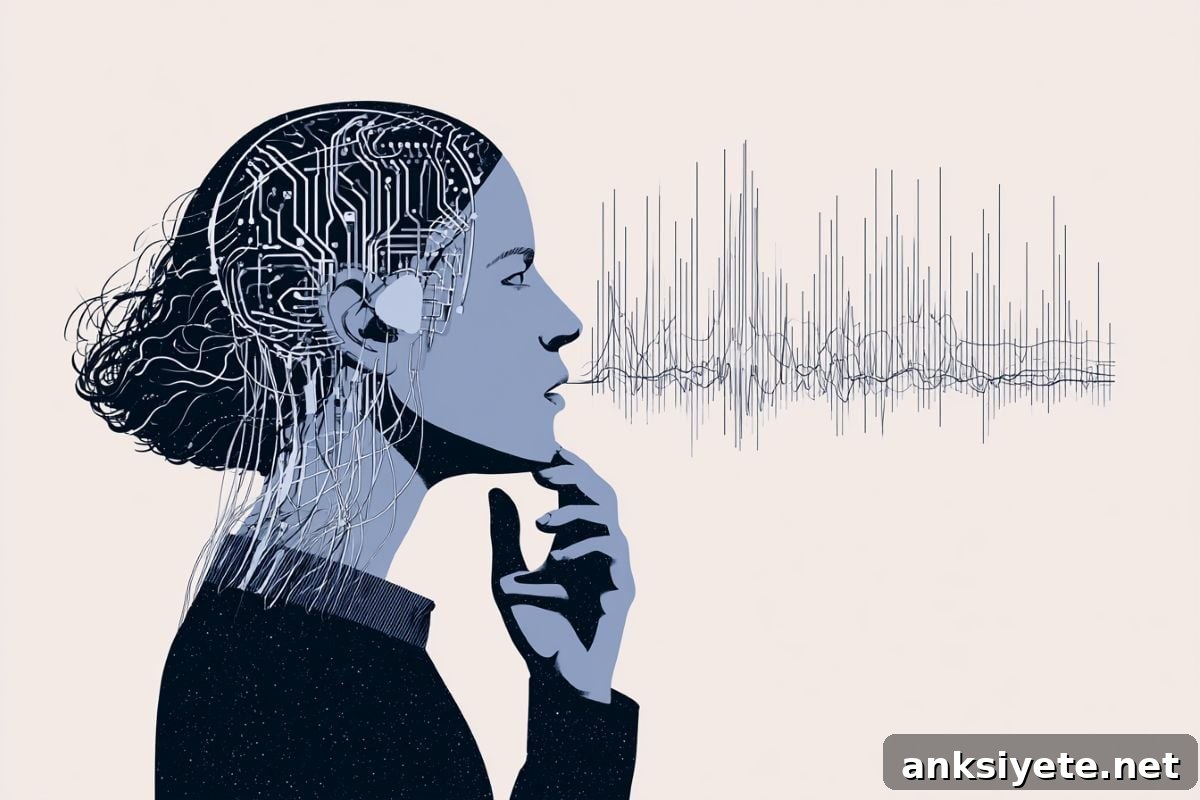
Summary: Researchers have built an AI-driven speech neuroprosthesis that decodes high-density intracortical signals into fluent, high-quality synthetic speech. The system uses a two-stage deep learning pipeline—a phonetic decoding layer followed by a large language model-based linguistic processor—to reach better than 99% word accuracy while operating with about 30 milliseconds of processing latency.
Tested with a person living with advanced amyotrophic lateral sclerosis (ALS), the interface supported real-time speech production and expression over a two-year period, enabling 2.7 million words, modulation of vocal intonation, and even singing. This work represents a major advance for clinical brain-computer interfaces (BCIs).
Key Facts
- Managing massive neural data: Modern intracortical electrode arrays record activity from hundreds of neurons simultaneously. Traditional statistical approaches struggle to interpret this volume and complexity in real time. By applying advanced AI models, Stavisky and colleagues can rapidly sort, interpret, and decode these rich neural patterns into meaningful speech signals.
- Two-stage AI decoding: The prosthesis converts cortical activity into speech through a specialized, two-step deep learning architecture:
- Phonetic layer: The first model translates neural activity into phonemes, the elemental sound units of spoken language.
- Linguistic layer: The second model, based on large language model techniques, sequences those phonemes into words and coherent sentences in real time.
- Immediate voice synthesis and expression: Beyond producing text, the system employs a direct-to-voice deep learning model that synthesizes speech in real time. The participant’s synthetic voice is modeled from his pre-ALS recordings, allowing natural-sounding speech with tone, intonation, and musical expression. With only about 30 milliseconds of latency, the output approximates the timing of normal conversation.
- Real-world impact: During a two-year home deployment, the participant produced roughly 2.7 million words using only brain signals. The BCI restored everyday communicative independence: the user held rich conversations with family, operated a personal computer, and maintained full-time employment.
- Patient-centered research shift: Early in his career, Dr. Sergey Stavisky focused on motor BCIs, such as robotic arm control. Repeated feedback from people with paralysis made clear that regaining a voice was often a higher priority than restoring limb movement. That feedback, combined with rapid progress in machine learning starting around 2018, prompted a pivot toward speech-focused neuroprosthetics.
- Long-term goals: The team aims to develop a high-fidelity surrogate voice indistinguishable from a user’s natural voice on a standard phone call. Future work will also concentrate on shrinking the hardware into fully implantable, wireless systems and expanding access to people with stroke-related aphasia, cerebral palsy, or other communication disorders.
Source: AAAS
Origins and motivation
Sergey Stavisky first became interested in brain-computer interfaces as an undergraduate at Brown University. He was drawn to building practical tools for medicine while also wanting to understand the brain. That combination led him into a field now rapidly changing how we think about loss and restoration of speech.
Today an associate professor of neurological surgery at the University of California, Davis, Stavisky is a leading researcher on AI-powered speech neuroprostheses. His work—recognized by awards from the Chen Institute and the Science Prize for AI-Accelerated Research—brings together neuroscience, clinical care, and machine learning, all with the practical aim of restoring speech for people who have lost it.
One participant in the team’s research, a man with advanced ALS who could no longer speak intelligibly, illustrates the system’s potential. With an implanted array and AI models trained on his brain activity, he now generates fluent sentences as text and as real-time synthetic speech modeled on his pre-ALS voice. Over daily use, that ability translated into millions of words communicated through brain signals alone.
Addressing data complexity
The technical challenge is the sheer complexity of neural signals. Where early work recorded single neurons, contemporary arrays capture hundreds of channels at once. Speech is an especially difficult target because it requires millisecond-scale coordination of many muscles and rapid sequences of neural commands. Classic statistical methods can fail under this scale and complexity.
Stavisky’s team turned to AI because modern models excel at finding structure in massive, high-dimensional datasets. Their approach separates the decoding task into stages—first mapping neural activity to phonemes, then using language models to assemble those phonemes into words and sentences. An alternate pathway reconstructs acoustic features directly for instantaneous voice synthesis.
The result is a system that reliably translates intended speech into audible output with latencies short enough to preserve conversational timing—around 30 milliseconds in the reported implementation. A study in Nature Medicine described how this BCI helped its participant maintain daily communication, control a computer independently, and continue working full time.
Yury V. Suleymanov, a senior editor at Science, summarized the outcome: the neuroprosthesis restored communication with over 99% word accuracy and enabled the participant to express 2.7 million words over two years, including real-time voice synthesis with modulated intonation and singing.
Key Questions Answered:
A: Motor tasks like moving a cursor are relatively low-dimensional: the brain issues spatial commands such as “up” or “left.” Speech, by contrast, is a highly intricate motor behavior. Producing a single word requires precisely timed coordination of dozens or hundreds of muscles across the vocal tract. Even when a person can no longer speak, the brain continues to generate complex, high-density electrical patterns. Traditional statistical approaches cannot reliably parse that flood of data; advanced AI is needed to organize and interpret the signals into meaningful linguistic units.
A: The system’s conversational fluency arises from its very low processing delay—roughly 30 milliseconds—and from bypassing slow letter-by-letter selection methods that many assistive devices use. The first AI layer identifies phonemes quickly from neural data, and a second layer predicts words and phrases in context using language-model techniques. This two-stage pipeline allows the user’s intentions to be converted to audible speech virtually as fast as natural thought and planning.
A: Demonstrating an AI-driven interface that translates brain activity into accurate, expressive speech is a strong proof of concept for broader neuro-restoration. The same dual-stage decoding approach can be adapted and refined for people with stroke-induced aphasia, cerebral palsy, traumatic brain injury, or other disorders that impair communication. The underlying idea is that the neural machinery for language often remains available; we need reliable digital interfaces to unlock it.
Editorial Notes:
- This article was edited by a Neuroscience News editor.
- Journal paper reviewed in full.
- Additional context added by staff.
About this AI and neurotech research news
Author: Meagan Phelan
Source: AAAS
Contact: Meagan Phelan – AAAS
Image: The image is credited to Neuroscience News