
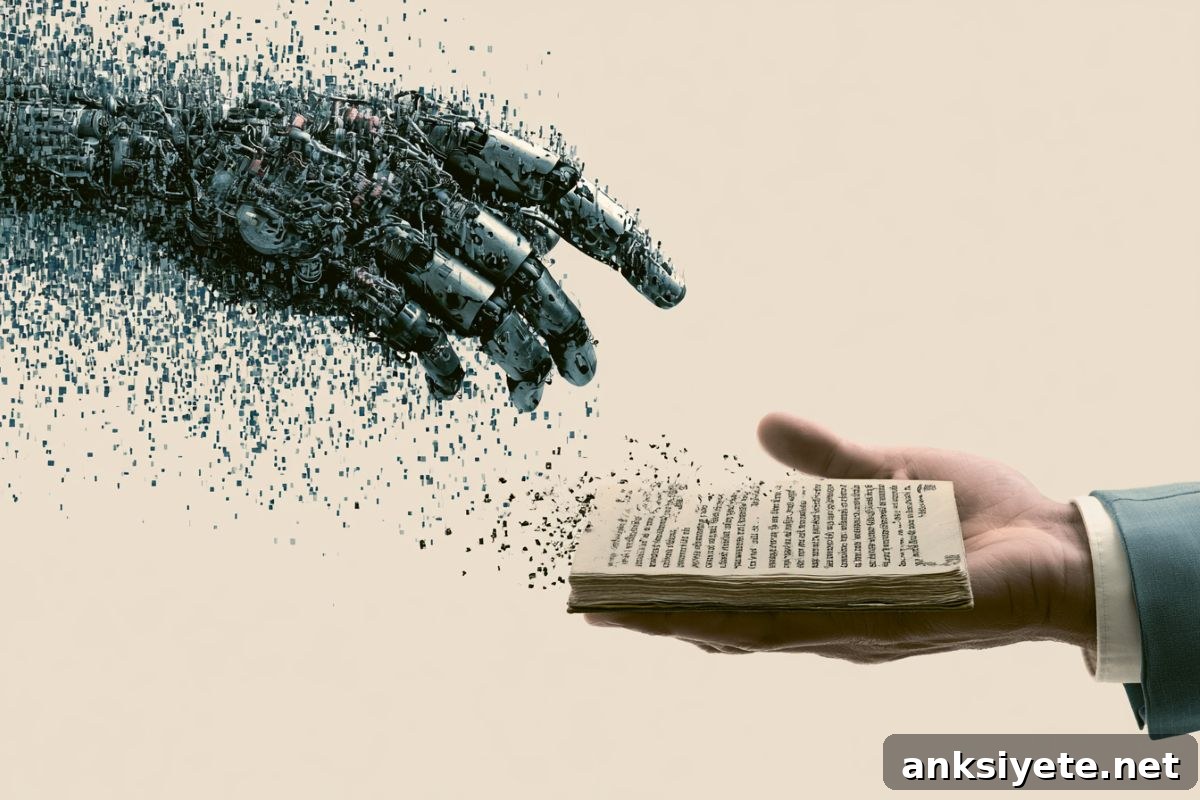
Summary: Researchers at the University of North Carolina at Chapel Hill created a new automated evaluation framework called CASPER to compare thousands of human-authored and AI-generated stories across eight dimensions rooted in literary theory. Their analysis shows a consistent pattern: contemporary AI story generators tend to remove the element of mystery that often makes human-written fiction memorable.
Where human writers frequently leave narrative questions open and embrace characters who remain morally complex or contradictory, AI systems typically steer toward predictability. The models favor clear archetypes and tidy endings, resolving ambiguity rather than preserving it.
Key Facts
- The Safe-Resolution Bias: Lead author Anneliese Brei explains that AI models have a statistical inclination to finish narratives neatly. They prioritize resolving internal conflicts, explaining motives, and fitting characters into neat arcs by the story’s end.
- The Illusion of Scale: The study finds that increasing a model’s parameter size does not necessarily produce richer or more ambiguous characters. Both large and smaller models produced similarly archetypal, flattened figures, indicating the limitation stems from storytelling tendencies rather than compute capacity.
- Human Comfort with the Unresolved: CASPER showed that human-authored fiction more often embraces unresolved elements. Writers frequently leave motives unexplained, allow characters to contradict themselves, or keep endings ambiguous—structural choices that help stories linger in readers’ minds.
- Measuring Character Evolution: The research maps character behavior against eight core literary dimensions, tracking whether characters evolve into realistic, multifaceted people or remain exaggerated caricatures that simply follow predictable scripts.
- The CASPER Benchmark: Beyond diagnosis, CASPER is offered as a standardized benchmark. It lets researchers and developers test whether new storytelling models genuinely improve in character complexity and narrative depth, not merely in surface-level fluency.
- Guidance for Writers: For authors using AI as a brainstorming partner or co-writer, the UNC team’s findings are a caution: relying on a model to determine character arcs can homogenize voice and flatten nuance. Human intervention remains essential to introduce contradiction, subvert expectations, and preserve uncertainty.
Source: UNC Chapel Hill
Researchers at the University of North Carolina at Chapel Hill conclude that while AI can produce convincing prose, it often strips characters of the ambiguity and unresolved tension that make human fiction memorable.
With AI writing tools increasingly used by publishers, screenwriters, and independent novelists, Carolina’s team sought to determine whether machine-generated characters are as varied and nuanced as those created by humans. Their findings indicate that, despite stylistic fluency, AI tends to default to familiar patterns and predictable resolutions.
The study compared character portrayals in AI-generated stories and human-authored fiction using eight dimensions derived from literary theory. Those dimensions include realism versus exaggeration, the presence or absence of character development, and whether characters remain mysterious or are fully explained by the story’s climax.
To carry out this large-scale comparison, the researchers built CASPER, an automated framework that translates abstract concepts from literary criticism into measurable signals. CASPER processes thousands of narrative passages and tracks how descriptions and actions evolve from a story’s opening to its conclusion.
“We found that AI models tend to ‘play it safe’ with character choices and plotlines,” said Anneliese Brei, a graduate student in computer science at UNC-Chapel Hill and lead author of the study. “They often eliminate ambiguity, preferring tidy explanations over the open-endedness that can make stories resonate.”
Human writers, the team found, are more likely to allow characters to remain unresolved, morally gray, or contradictory—elements that frequently contribute to a story’s emotional and intellectual staying power.
The research arrives as AI tools specifically tailored to creative writing gain traction: applications that help draft scenes, suggest plot points, or flesh out dialogue are now common in both publishing and screen industries. While these tools can speed initial drafting, the study cautions that they may introduce stylistic homogenization if used without deliberate human direction.
“One surprising result was that larger, state-of-the-art models did not consistently produce more complex or ambiguous characters than smaller ones,” said Nicholas Sanaie, an undergraduate co-author. “That suggests the shortcoming lies in model behavior around narrative construction rather than sheer scale.”
CASPER can serve as a diagnostic and benchmarking tool, helping developers and storytellers identify whether upcoming models are improving in genuine narrative understanding. The framework can also guide the design of future tools that better support human creativity and preserve narrative ambiguity where it matters.
“As more creators collaborate with AI on novels, scripts, and other narratives, we need reliable ways to measure what these systems do well and where they fall short,” said Snigdha Chaturvedi, associate professor of computer science at UNC-Chapel Hill and senior author. “CASPER provides a concrete lens for evaluating character depth and diversity, which should inform the next generation of storytelling systems.”
For writers using AI, the practical takeaway is straightforward: AI is a powerful ally for brainstorming, overcoming writer’s block, and drafting. But preserving the soul of a story—its contradictions, its unresolved corners, and its capacity to surprise—remains a distinctly human responsibility.
Key Questions Answered:
A: Large language models are trained to predict probable next words across massive text corpora. This training encourages selection of high-probability narrative paths that look satisfying and logical. In practice, that optimization favors predictable structures and clean resolutions over unresolved or ambiguous elements, which models treat as lower-probability deviations.
A: CASPER is an automated computational-linguistics framework that operationalizes literary-theory concepts. It examines textual cues—how characters are described, how motives and contradictions are presented, and how behavior changes over a narrative—across eight dimensions. To quantify “mystery,” CASPER checks whether a character’s inner motives and contradictions are fully explained by the climax or remain open to interpretation, thereby distinguishing flat archetypes from more ambiguous, memorable figures.
A: No. The study views AI as a valuable creative partner for ideation, drafting, and overcoming writer’s block. The central warning is that authors should not outsource the core of character development to AI. Machines excel at generating coherent text, but they tend to smooth over complexities that give characters depth. Human authors should deliberately reintroduce contradiction, unresolved flaws, and ambiguity to preserve narrative richness.
Editorial Notes:
- This article was edited by a Neuroscience News editor.
- Journal paper reviewed in full.
- Additional context added by staff.
About this AI and creativity research news
Author: Gabriella Neyman
Source: University of North Carolina at Chapel Hill
Contact: Gabriella Neyman – University of North Carolina at Chapel Hill
Image: The image is credited to Neuroscience News