
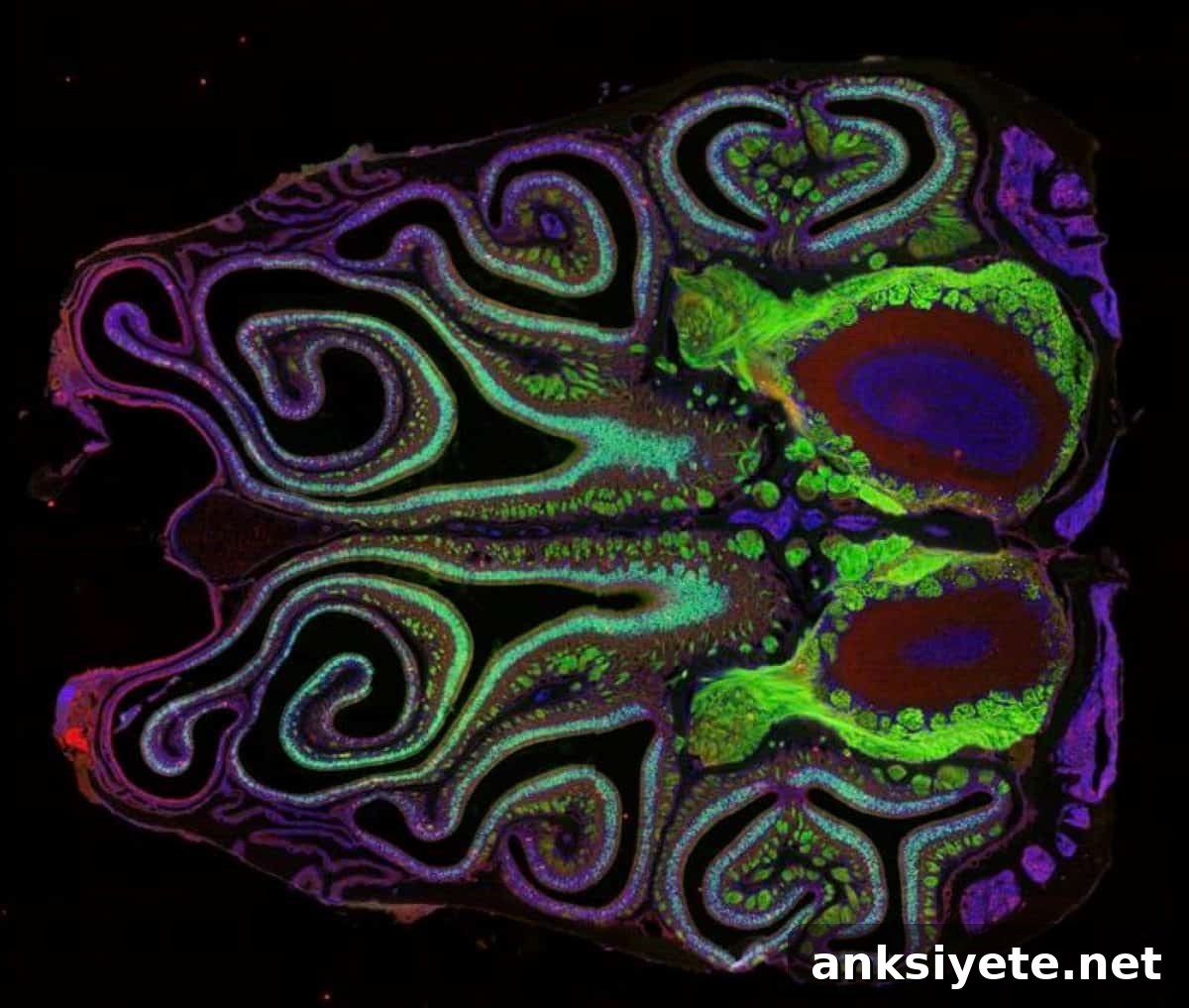
Summary: For more than three decades, the sense of smell has remained the “black box” of neuroscience. While precise spatial maps exist for vision, hearing, and touch, the organization of the olfactory system was long assumed to be disordered and largely random.
A new large-scale genetic study overturns that assumption. Using single-cell sequencing and spatial transcriptomics at unprecedented scale, researchers have shown that the olfactory epithelium is arranged in precise, overlapping horizontal stripes. This nasal “smell map” mirrors corresponding maps in the brain and supplies essential information for developing therapies for smell loss.
Key Facts
- Stripe organization: Instead of random distribution, the 1,000+ olfactory receptor types in mice are concentrated in tight, overlapping dorsoventral stripes running from the top to the bottom of the nose.
- Molecular guidance: A gradient of retinoic acid acts as a spatial cue, guiding neurons to express specific receptors according to their precise position along the nasal dorsoventral axis.
- Conserved brain-body mapping: The receptor arrangement in the nose aligns directly with topographic odor maps in the olfactory bulb, analogous to the retina-to-visual-cortex relationship.
- Massive dataset: The analysis encompassed roughly 5.5 million olfactory sensory neurons from over 300 mice, making it one of the most comprehensive neural-mapping efforts to date.
- Clinical implications: Defining this spatial code is a critical step toward rebuilding functional olfactory circuits—vital for therapies for anosmia and for mitigating associated risks like depression and reduced safety.
Source: Harvard Medical School
The sense of smell shapes everyday life
Smell provides vital information about the environment, signals danger, enriches taste, and triggers powerful emotions and memories. Despite its importance, olfaction has remained less well understood than other senses.
“Olfaction is super-mysterious,” said Sandeep (Robert) Datta, professor of neurobiology at the Blavatnik Institute, Harvard Medical School. Basic organizational principles of smell lagged far behind what scientists have mapped for vision, hearing, and touch.
Working in mice, Datta and colleagues have produced the first high-resolution map showing how the more than one thousand olfactory receptor types are distributed across the nasal epithelium.
Contrary to prior assumptions, neurons expressing distinct receptor types are not scattered randomly but instead form consistent horizontal stripes along the dorsoventral axis of the nose.
“Our results bring order to a system that was previously thought to lack order, which changes conceptually how we think this works,” Datta said, emphasizing the study’s impact on the foundational understanding of olfaction.
The team further demonstrated that this peripheral receptor map corresponds to spatial maps in the olfactory bulb, offering insight into how odor information is relayed and organized from the nose into the brain.
Beyond the basic science advance, Datta notes the discovery provides a necessary blueprint for developing treatments to restore smell, a capability currently limited by incomplete knowledge of olfactory wiring.
“We cannot fix smell without understanding how it works on a basic level,” he said. The findings were published April 28 in Cell.
A missing sensory map
Topographic maps are well established for the eye, ear, and skin, and researchers have long understood how those peripheral maps align with maps inside the brain. Olfaction, however, was the notable exception: its peripheral organization remained unclear.
Part of the difficulty is biological complexity. Mice have roughly 20 million olfactory sensory neurons that choose to express more than a thousand distinct olfactory receptors, while, by contrast, the visual system relies on a few receptor classes for color detection. Each olfactory receptor type responds to a different subset of odor molecules, making the system inherently high dimensional.
Since the first identification of olfactory receptor genes in 1991, researchers observed only broad zonal patterns in receptor expression, which led many to conclude that receptor choice was largely random within those zones. As sequencing and spatial methods advanced, researchers revisited the question with much greater cellular resolution.
Unveiling a coherent organization
Datta’s team combined single-cell sequencing with spatial transcriptomics to analyze approximately 5.5 million neurons from over 300 individual mice. Single-cell sequencing identified which receptors individual neurons expressed, while spatial methods determined where those neurons resided in the epithelium.
“This is now arguably the most sequenced neural tissue ever, but we needed that scale of data in order to understand the system,” Datta said.
Their analyses revealed that each receptor type has a characteristic mean dorsoventral position. Together, these positions form a reproducible striped map across animals. The peripheral map aligns with the organization of receptor-specific projection patterns in the olfactory bulb, showing an ordered, continuous representation of receptor identity from nose to brain.
Investigating developmental mechanisms, the researchers identified retinoic acid as a key spatial signal. A dorsoventral gradient of retinoic acid establishes a transcriptional program that biases which receptors a given neuron can express based on its position. Experimental increases or decreases in retinoic acid shifted receptor distributions upward or downward, demonstrating causal control over map layout.
“We show that development can achieve this feat of organizing a thousand different smell receptors into an incredibly precise map that’s consistent across animals,” Datta said. A separate study from Catherine Dulac’s laboratory published in the same Cell issue reported consistent conclusions.
Implications and next steps
The research team is now exploring why receptor stripes are ordered in the particular sequence observed, and whether the same spatial code holds in human olfactory tissue. Understanding cross-species conservation will be vital for translating basic discoveries into medical interventions.
Accurate maps of receptor position and the molecular signals that produce them will inform approaches such as stem cell–based regeneration or neural-interface strategies to repair or replace damaged olfactory circuits. Restoring smell has implications not only for sensory function and safety but also for mental health and quality of life.
“Smell has a really profound and pervasive effect on human health,” Datta said. “Restoring it is not just for pleasure and safety but also for psychological well-being. Without understanding this map, we’re unlikely to succeed in developing new treatments.”
Authorship, funding, disclosures
Additional authors include David Brann, Tatsuya Tsukahara, Cyrus Tau, Dennis Kalloor, Rylin Lubash, Lakshanyaa Kannan, Nell Klimpert, Mihaly Kollo, Martín Escamilla-Del-Arenal, Bogdan Bintu, Andreas Schaefer, Alexander Fleischmann, and Thomas Bozza.
Funding: Research support came from National Institutes of Health grants (R01DC021669, R01DC021422, R01DC021965, and F31DC019017), the Yang Tan Collective at Harvard, and an NSF Graduate Research Fellowship.
Key Questions Answered:
A: The olfactory system’s complexity hid fine-grained spatial patterns from earlier methods. Humans have only a few visual receptor types, while mice have over a thousand olfactory receptors. Only with large-scale single-cell and spatial sequencing could researchers resolve consistent horizontal patterns that previously appeared as noise.
A: Yes. The striped organization places certain receptor types at specific dorsoventral positions, so receptors tuned to particular odor features are physically enriched at higher or lower locations. This spatial arrangement likely aids early categorization of odor information before signals reach the brain.
A: Potentially. Understanding the spatial “wiring diagram” is a prerequisite for rebuilding functional olfactory neurons in correct positions. Datta’s prior work on COVID-19–related anosmia, combined with this map, provides a framework for regenerative strategies to restore smell.
Editorial Notes:
- This article was edited by a Neuroscience News editor.
- Journal paper reviewed in full.
- Additional context added by staff.
About this olfaction and brain mapping research news
Author: Katie Brace
Source: Harvard Medical School
Contact: Katie Brace, Harvard Medical School
Image: Image credit: Datta Lab
Original Research: Closed access. A spatial code governs olfactory receptor choice and aligns sensory maps in the nose and brain by David H. Brann et al., Cell. DOI: 10.1016/j.cell.2026.03.051
Abstract
A spatial code governs olfactory receptor choice and aligns sensory maps in the nose and brain
Although many peripheral sensory systems are organized by topographic maps, mouse olfactory sensory neurons (OSNs) were thought to choose among ~1,100 olfactory receptors (ORs) randomly, with only a few broad anatomical “zones” constraining receptor choice. In contrast, this work shows that each OR is expressed at a characteristic mean dorsoventral position, establishing a stereotyped receptor map in the olfactory epithelium. OSN dorsoventral identities are encoded by a coordinated gene expression program that includes transcription factors and axon guidance molecules. A dorsoventral gradient of retinoic acid translates physical position into a spatially appropriate distribution of potential OR choices and aligns receptor maps in the nose and brain. Thus, spatial order in olfaction arises from a continuously varying transcriptional code that precisely organizes hundreds of discrete olfactory channels.