
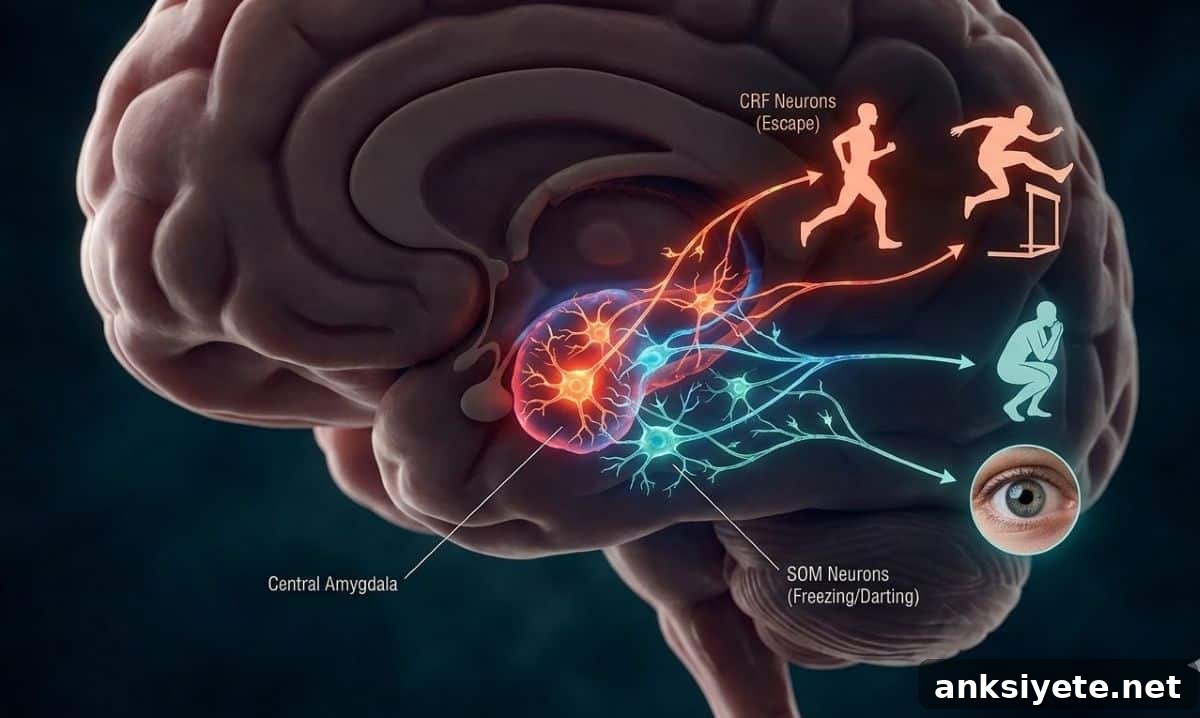
Summary: New research pinpoints specific brain circuits that shape how animals respond to danger and how those responses change as a threat subsides. Whereas much fear research has emphasized passive freezing, this study shows the central amygdala functions as a decision center that selects between passive responses (freezing) and active escape behaviors such as darting or jumping.
Using mice, the researchers show that fear extinction—the process by which a learned fear response diminishes—is not simply the erasure of a memory but a recalibration of which neural pathways control behavior. This refined view helps explain why disorders like post-traumatic stress disorder (PTSD) can present so differently across individuals, with some people remaining stuck in hypervigilant freezing and others exhibiting panic-like flight reactions.
Key Facts
- Beyond Freezing: The study monitored a range of defensive behaviors, including freezing, escape jumping, and darting, demonstrating that fear responses exist on a continuum rather than as an on/off state.
- The Neural Switch: Two distinct neuron types in the central amygdala bias the animal toward different defensive strategies:
- CRF neurons: Associated with higher-intensity, panic-like escape responses such as jumping.
- SOM neurons: Linked to lower-intensity states like freezing and to regulated darting behavior.
- Extinction as Recalibration: As a threat fades, the brain shifts control from circuits that produce high-intensity escape to those that favor lower-intensity defensive states, rather than wiping the fear memory away.
- PTSD Implications: Disruptions in these specific circuits may underlie why some people with PTSD remain locked in flight or freeze responses and why symptoms vary across individuals.
Source: Tulane University
Researchers at Tulane University have identified brain circuits that help determine how fear responses change as perceived threats diminish, offering new insight into how the brain regulates defensive behavior and why those processes may break down in conditions such as post-traumatic stress disorder.
The study, led by neuroscientist Jonathan Fadok at the Tulane Brain Institute, explores how cell populations deep in the brain shape a spectrum of fear behaviors—from passive freezing to active escape.
Funded in part by the National Institutes of Health and the U.S. Department of Veterans Affairs, the research investigates how neural activity changes as a perceived threat loses its significance.
“For decades, most fear research has focused on freezing,” said Fadok, associate professor of psychology in Tulane University’s School of Science and Engineering. “That approach has been valuable, but it misses other real-world responses. In natural contexts, fear can also trigger more active behaviors like darting or trying to escape.”
The team used a modified conditioning paradigm in mice to capture multiple defensive behaviors within a single experiment, allowing observation of transitions among freezing, escape jumping, and darting.
This experimental design made it possible to follow how those behaviors change during fear extinction—the process by which repeated exposure to a cue that previously predicted danger reduces the behavioral response to that cue.
Rather than seeing fear vanish during extinction, researchers observed a progressive recalibration of defensive responses. “At the neural level, extinction looks less like erasing fear and more like reshaping it,” Fadok explained. “Different circuits determine whether an animal responds with intense escape, freezing, or a lower-intensity defensive state.”
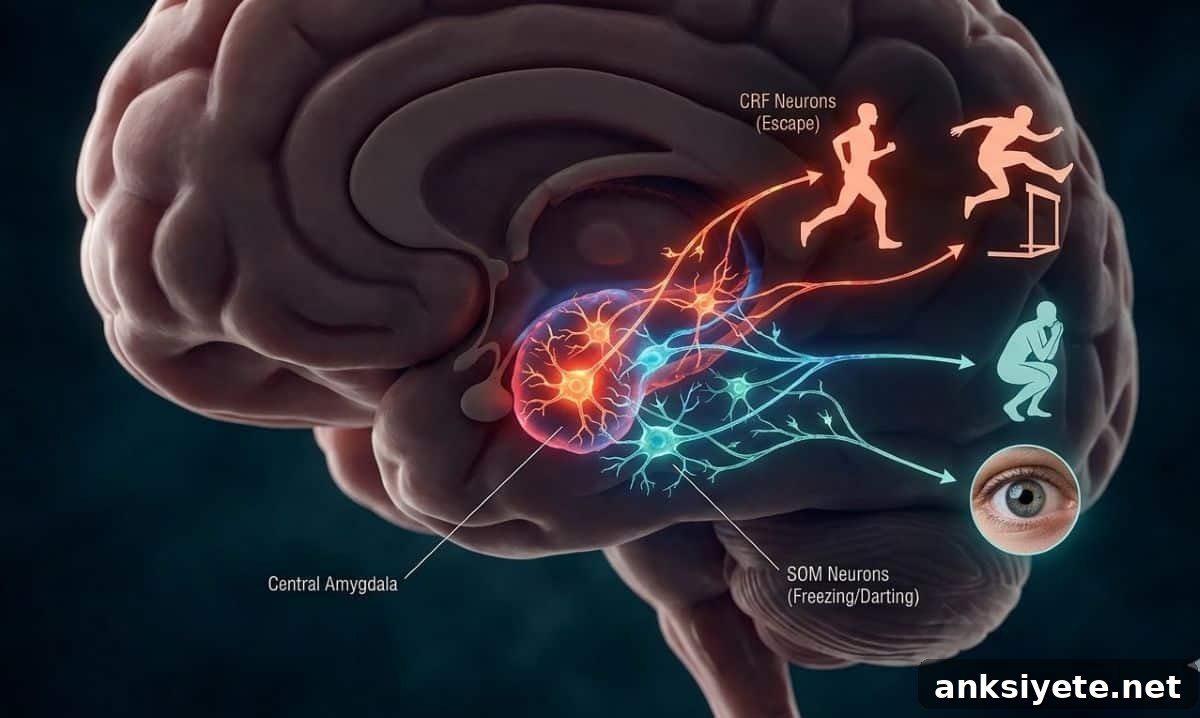
The investigators identified distinct contributions from two neuron types within the central amygdala, a brain region central to emotional processing. Corticotropin-releasing factor (CRF) neurons supported high-intensity escape-like responses such as jumping. Somatostatin (SOM) neurons supported freezing and helped regulate lower-intensity behaviors such as darting.
Using optogenetic tools to manipulate these neuron groups, the team directly altered animals’ reactions to threat cues. Inhibiting CRF neurons reduced escape jumping, while activating SOM neurons shifted behavior away from flight and toward freezing. Both excitation and inhibition of SOM neurons affected darting behavior during extinction.
Together these results indicate that the central amygdala organizes fear responses along a continuum and actively selects which defensive behavior is expressed as threat levels change.
This more nuanced understanding of fear regulation has implications for psychiatric conditions such as PTSD, where fear responses can be chronic and resistant to change. “PTSD is often framed as persistent fear, but its expression varies widely,” Fadok noted. “Some individuals remain hypervigilant, while others experience sudden, panic-like reactions. Our work highlights brain mechanisms that could underlie those different patterns.”
While these findings do not immediately yield new treatments, they identify biological pathways that may become targets for therapies designed to facilitate more adaptive fear extinction—by nudging circuits away from high-intensity escape states and toward regulated, lower-intensity responses.
“If extinction relies on shifting responses away from high-intensity states, then dysfunction in these circuits could explain why fear remains hard to regulate for some individuals,” Fadok said. “The central amygdala is not just producing fear—it helps decide what that fear looks like.”
Key Questions Answered:
A: The choice originates deep in the central amygdala. When CRF neurons dominate, animals tend to produce high-intensity flight behaviors like jumping. When SOM neurons are more active, freezing is more likely.
A: No. The research suggests extinction does not erase the memory. Instead, the brain learns to route responses through different circuits, reducing high-intensity reactions and favoring lower-intensity defensive states.
A: By pinpointing the neural “valves” that control fear intensity, scientists may develop strategies that shift activity away from persistent high-intensity escape states and toward more regulated responses, improving outcomes for people whose fear responses are difficult to extinguish.
Editorial Notes:
- This article was edited by a Neuroscience News editor.
- Journal paper reviewed in full.
- Additional context added by staff.
About this neuroscience research news
Author: Stacey Jenkins
Source: Tulane University
Contact: Stacey Jenkins – Tulane University
Image: Image credit: Neuroscience News
Original Research: Closed access. “Corticotropin-releasing factor and somatostatin neurons in the central amygdala mediate dynamic defensive behaviors during fear extinction” by Quan-Son Eric Le, Emma Lardant, Yumnah Siddiqui, Thamidul Alam, Kylie Evans and Jonathan P. Fadok. Journal of Neuroscience. DOI: 10.1523/JNEUROSCI.1049-25.2026
Abstract
Corticotropin-releasing factor and somatostatin neurons in the central amygdala mediate dynamic defensive behaviors during fear extinction
Traumatic experiences can produce heightened fear responses to reminders of the trauma, and those responses are often difficult to extinguish. Identifying neuronal targets that facilitate fear extinction is therefore important for developing new interventions.
Many rodent studies measure conditioned fear primarily by freezing, but other defensive behaviors such as flight are also present during conditioning. The central amygdala mediates both conditioned freezing and flight through corticotropin-releasing factor-positive (CRF+) and somatostatin-positive (SOM+) neuron populations.
How these cell types regulate shifts in freezing and flight during extinction was previously unclear. The study used a modified Pavlovian conditioned flight paradigm in male and female mice that paired a footshock with a serial compound stimulus (tone followed by white noise), producing freezing during the tone and rapid transition to flight behaviors—escape jumping and darting—during the white noise.
Optogenetic manipulation of CRF+ and SOM+ central amygdala neurons during white noise presentation showed that inhibiting CRF+ cells reduced jumping and led to a later context-specific reduction in tone-evoked freezing. Exciting SOM+ cells during extinction replaced early white-noise-evoked flight with freezing, and both excitation and inhibition of SOM+ neurons reduced white-noise-evoked darting.
Overall, these findings demonstrate that activity in CRF+ and SOM+ central amygdala neurons modulates multiple defensive behaviors during extinction, suggesting mechanisms for attenuating both flight and darting as fear responses are reshaped.