
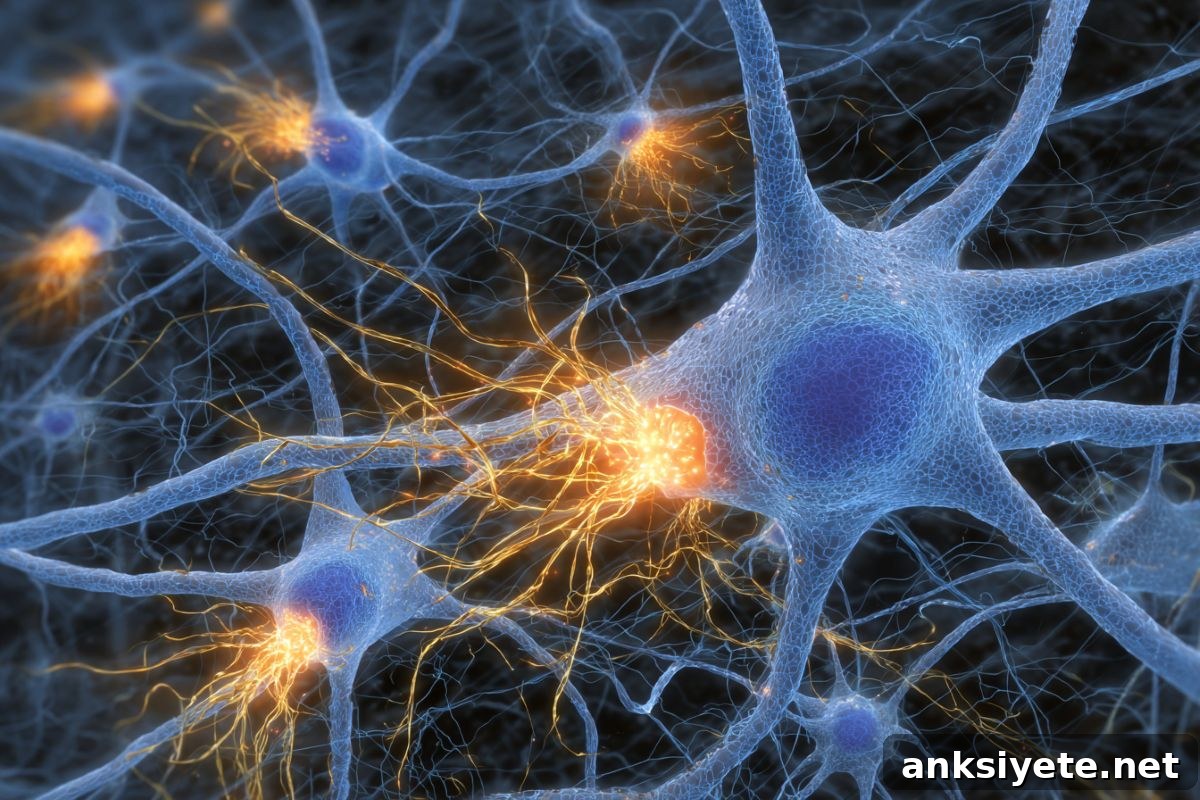
Summary: Researchers have identified a central coordination mechanism in the brain that reshapes how we think about chemical imbalances. A new study shows that in the striatum — a key region for movement and learning — acetylcholine not only works alongside serotonin but can directly drive serotonin release, effectively “taking the wheel.”
Specialized neurons called cholinergic interneurons act like conductors, triggering nearby serotonin fibers to release their signals. This tight coupling means that when acetylcholine signaling becomes excessive, it pulls serotonin levels up with it, offering a possible explanation for the pathological loops seen in conditions such as obsessive-compulsive disorder (OCD).
Key Facts
- The master conductor: Cholinergic interneurons (CINs) were already known to influence dopamine, but this study demonstrates they also directly control local serotonergic release.
- Immediate response: Using optogenetics to activate CINs with light, researchers observed near-instant serotonin release from nearby fibers.
- OCD overdrive: In brain states that model OCD, CINs are overly active, driving a large, unwanted surge of serotonin that may reinforce repetitive behaviors.
- A new model of imbalance: Rather than simple excess or deficiency of a single transmitter, psychiatric disorders may reflect a breakdown in coordination where one system forces another into a pathological state.
- Treatment implications: Because SSRIs target serotonin and are frontline treatments for depression and OCD, the results suggest that upstream acetylcholine dysfunction may be an important therapeutic target.
Source: Hebrew University of Jerusalem
Overview
This study examined how chemical signaling systems interact within the striatum, a brain area critical for learning, habit formation and movement. The team found that acetylcholine, a neurotransmitter that signals salient events and modulates attention and learning, can directly prompt local serotonin release. That interaction is mediated by nicotinic acetylcholine receptors (nAChRs) on serotonergic axons, creating a rapid and spatially specific form of cross-talk.
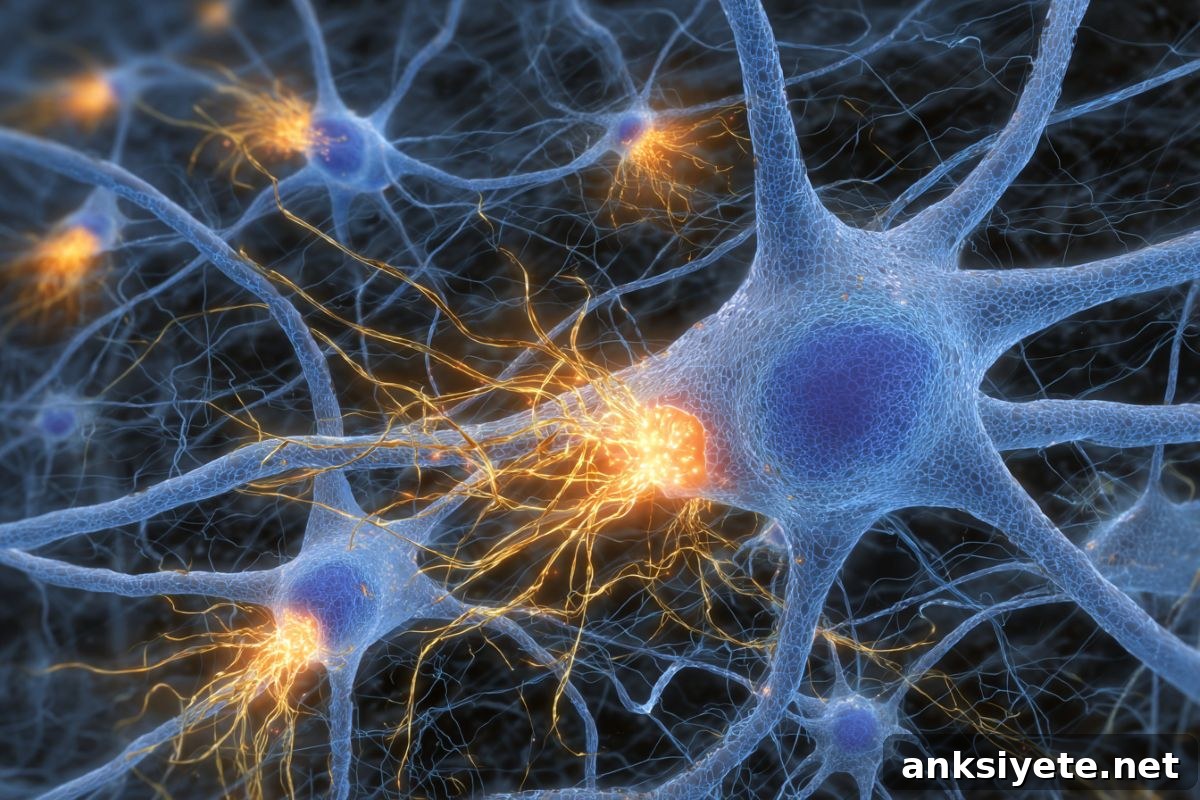
Because the cholinergic control over serotonin is so strong, pathological shifts in acetylcholine signaling can produce parallel, and potentially harmful, changes in serotonin dynamics. In experimental models that resemble OCD, the cholinergic system becomes hyperactive, amplifying the nAChR-dependent component of monoamine release and broadening the spatial footprint of serotonergic signaling.
The research team — led by Prof. Joshua Goldberg (Hebrew University) and Prof. Joshua Plotkin (Stony Brook University) — focused on a small population of striatal cholinergic interneurons that function as timing hubs. Using precise light-driven manipulation, they found that synchronous activation of these CINs causes nearby serotonin fibers to discharge almost immediately into the surrounding tissue.
Under conditions that model obsessive-compulsive behavior, CINs showed heightened activity, producing a large surge in local serotonin. What appears to be a normal coordination mechanism that helps fine-tune behavior and learning can become maladaptive when pushed beyond its normal range.
The authors emphasize that this form of internal coordination means many psychiatric symptoms previously attributed to a single chemical imbalance may instead reflect dysregulated interactions between systems. If acetylcholine acts as a driver of serotonin in specific regions, then interventions targeting the cholinergic “conductor” could offer complementary or alternative strategies to current serotonin-focused treatments.
Key Questions Answered:
A: Not entirely. Serotonin changes are important, but this study suggests those changes can be driven by overactive acetylcholine signaling. In other words, serotonin surges in OCD might often be a downstream response to a hyperactive cholinergic system.
A: SSRIs remain useful for managing symptoms by regulating serotonin levels. However, these findings point to the possibility of additional treatments that act upstream, by calming the cholinergic conductors and preventing pathological serotonin surges.
A: In a healthy brain, acetylcholine rises and falls to mark important events, guiding attention, learning and adaptive movement. By prompting localized serotonin release, it helps fine-tune these responses. Problems arise when the system is stuck in a persistently high state, amplifying signals that should be transient.
Editorial Notes:
- This article was edited by a Neuroscience News editor.
- The journal paper was reviewed in full.
- Additional context was provided by staff.
About this neuroscience research news
Author: Danae Marx
Source: Hebrew University of Jerusalem
Contact: Danae Marx – Hebrew University of Jerusalem
Image: The image is credited to Neuroscience News
Original Research: Open access.
“Synchronous activation of striatal cholinergic interneurons induces local serotonin release” by Lior Matityahu, Zachary B. Hobel, Noa Berkowitz, Jeffrey M. Malgady, Naomi Gilin, Joshua L. Plotkin & Joshua A. Goldberg. Nature Communications
DOI:10.1038/s41467-026-70359-6
Abstract
Synchronous activation of striatal cholinergic interneurons induces local serotonin release
Striatal cholinergic interneurons (CINs) can drive local dopamine release via nicotinic acetylcholine receptors (nAChRs) on dopaminergic axons, but their influence on serotonin (5-HT) signaling was unclear. This study shows that synchronous CIN activation directly triggers local 5-HT release in the dorsal striatum through nAChRs on serotonergic axons, while this effect was not detectable in the ventral striatum despite its denser serotonergic input.
The nAChR-dependent mechanism increases dorsal striatal 5-HT levels and expands the spatial reach of serotonergic signaling. In Sapap3–/– mice, a model that exhibits OCD-like behaviors, a hypercholinergic state selectively amplifies this nAChR-dependent component of monoamine release. These results reveal a regionally specific form of acetylcholine–serotonin cross-talk in the striatum and identify CINs as key regulators of 5-HT dynamics in both normal and pathological conditions.