
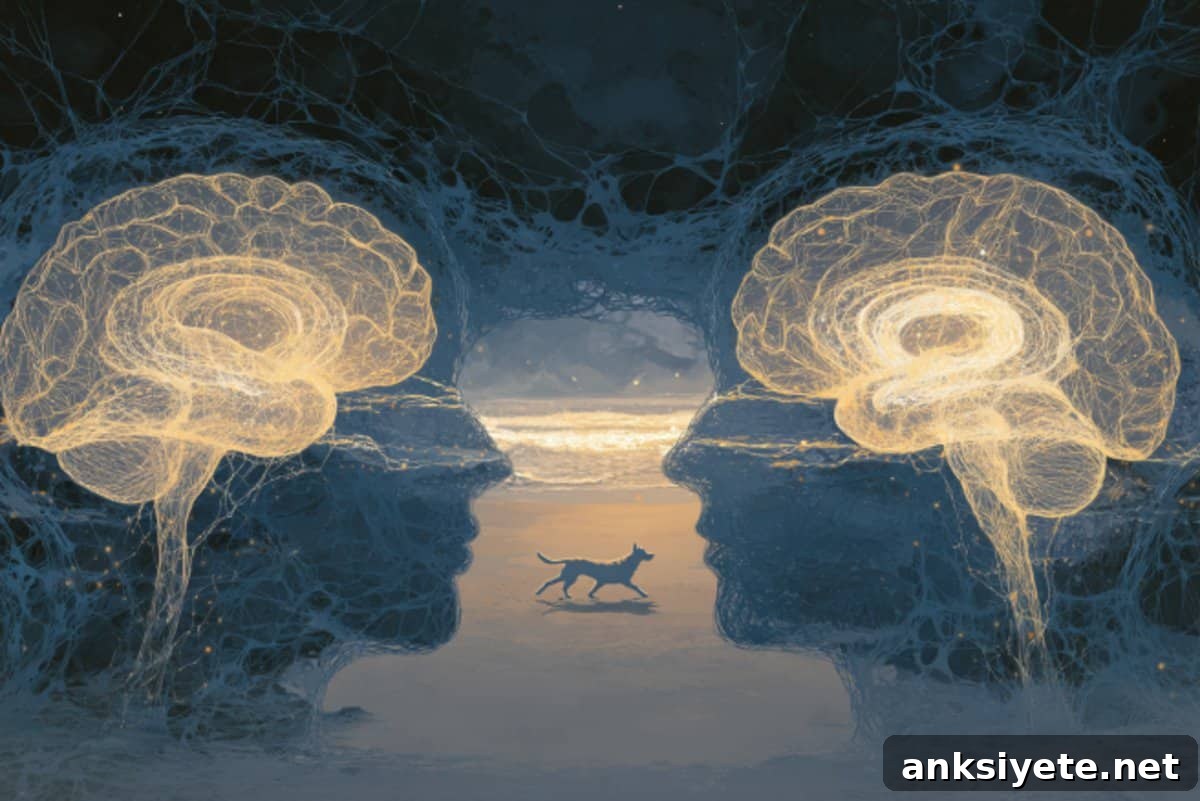
Summary: A new study shows that although individual human brains are wired differently, they can represent the world in remarkably similar ways. Researchers recorded live neuronal activity from patients with epilepsy and found that while the exact neurons that respond to an image vary between people, the relationships among those responses—the pattern of similarities and differences—are preserved across individuals.
This shared relational structure helps explain why different brains can arrive at the same perception—for example, both observers describing a scene as “a dog running on the beach.” The findings clarify a fundamental organizing principle of perception and may inform the design of artificial intelligence systems modeled on the brain.
Key Facts:
- Unique but consistent: Individuals show different raw neural activation patterns, yet the relationship between those patterns is consistent across people.
- Shared perception: A common relational code helps explain why people interpret the same scenes in similar ways despite individualized brain wiring.
- AI relevance: Insights into the brain’s relational coding could guide the development of more efficient artificial neural networks.
Source: Reichman Institute
How do different brains see the same thing?
Imagine sitting with a friend in a café, both of you looking at a phone showing a dog running along the shore. Each brain is a unique network of billions of neurons with individualized connections and activity patterns, yet both people will identify the scene the same way. What accounts for this shared experience?
A collaborative team from Reichman University and the Weizmann Institute of Science set out to answer that question by observing neuronal activity directly. Every image and sound is encoded by neurons—tiny processing units many times smaller than a human hair—whose activation patterns form the brain’s internal representation of the world.
Most noninvasive imaging methods capture only a coarse view of brain activity, comparable to a satellite image that shows highways but not the people on the streets. To achieve high-resolution recordings, the researchers used data from epilepsy patients who had electrodes implanted for clinical monitoring. While these implants are primarily used to localize seizure activity, they also provide a rare opportunity to record single-neuron and local population activity in real time while subjects view images.
As seen previously in artificial neural networks, the specific pattern of neuronal activity differs across individuals. A stimulus that activates certain cells in one person may activate a different set of cells in another. The surprising discovery of this study is that, although the raw activation patterns vary, the pattern of relationships among responses—how similar the brain’s response to a cat is to its response to a dog, for example—remains consistent across people.
Put another way: if, within one brain, the response to a cat is more similar to the response to a dog than to an elephant, that same relational ordering tends to appear in other brains, even if the underlying neurons differ. This invariant relational structure provides a stable scaffold for shared perception despite individual differences in neural wiring.
“This work brings us closer to decoding the brain’s representational language—the way the brain stores and organizes information,” says Ofer Lipman, the study’s lead researcher. The team, supervised by Prof. Rafi Malach and Dr. Shany Grossman from the Weizmann Institute and Prof. Doron Friedman and Prof. Yacov Hel-Or from Reichman University, emphasizes that relational coding may be the key feature that supports common perceptual content across people.
Beyond neuroscience, these findings are relevant to artificial intelligence. Understanding the brain’s preferred representational scheme can inspire new architectures and training methods for artificial networks. Conversely, artificial models continue to offer hypotheses and tools for testing how biological systems represent information.
Next time you glance at a dog running on the beach and think simply “a dog,” remember that behind that quick judgment lies a complex pattern of relationships among neural responses—an organizing principle scientists are beginning to untangle.
Key Questions Answered:
A: Although the specific neurons that fire differ across individuals, the relationships among neural responses to objects—how responses to one object compare to responses to another—follow a common pattern across brains.
A: The team analyzed intracranial recordings from epilepsy patients who had clinical electrodes implanted. These direct recordings allowed researchers to observe real-time neural representations while patients performed a visual recognition task.
A: Revealing the brain’s consistent relational code links human cognition and artificial intelligence. It suggests representation strategies that could improve AI models and shows how comparing artificial and biological networks can deepen understanding of both.
About this perception and neuroscience research news
Author: Lital Ben Ari
Source: Reichman Institute
Contact: Lital Ben Ari – Reichman Institute
Image: Image credit: Neuroscience News
Original Research: Open access. “Invariant inter-subject relational structures in high order human visual cortex” by Ofer Lipman et al., published in Nature Communications.
Abstract
Invariant inter-subject relational structures in high order human visual cortex
People generally perceive the world in similar ways, a foundation for communication and cooperation. Yet the neural basis for these inter-subject commonalities has remained unclear.
This study examines which aspects of neural coding remain invariant across individuals. Using intracranial recordings from patients performing a visual recognition task (19 patients and 244 high-order visual contacts included in analyses), the researchers evaluated several coding schemes to determine which representation was most consistent across participants’ visual cortex.
The results point to relational coding—the pattern of similarity distances among activation profiles—as the most consistent representation across individuals. Other schemes, such as raw activation-pattern coding or simple linear coding, did not show comparable inter-subject consistency.
These findings support relational coding as a central neural mechanism underlying the shared content of human visual perception.