
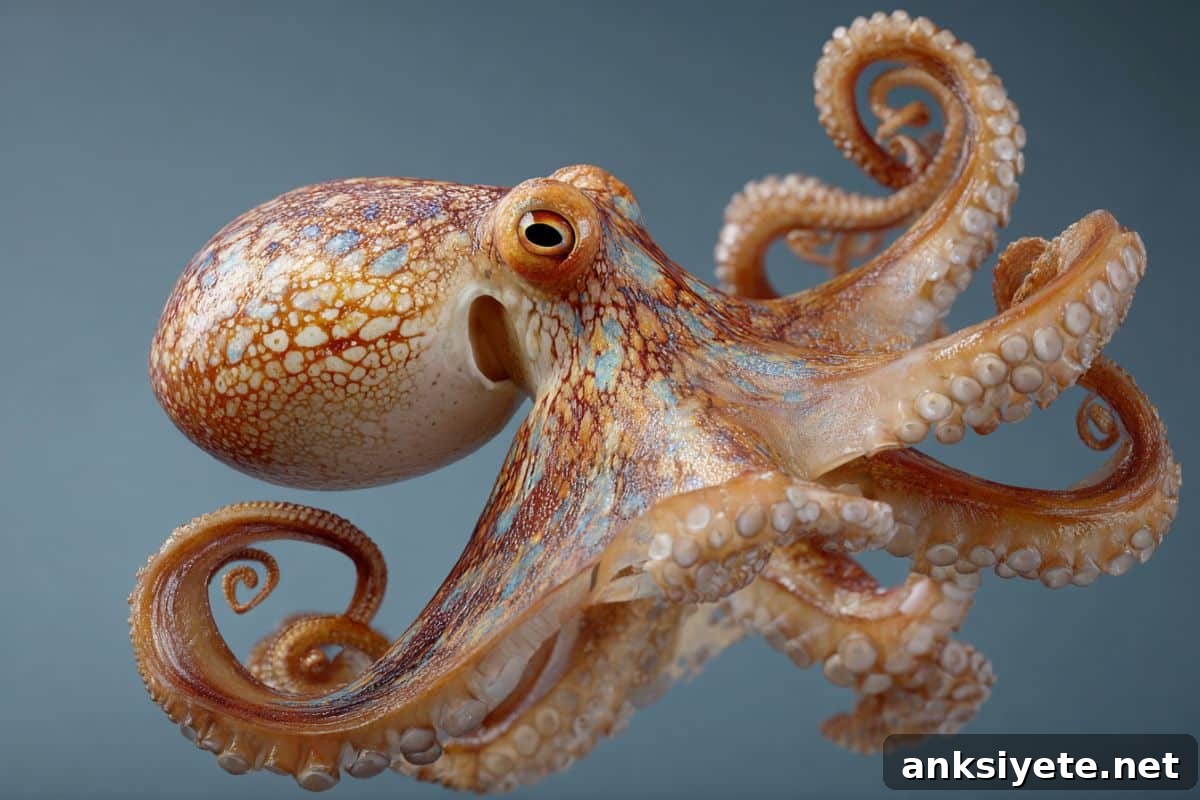
Summary: Researchers have produced the first comprehensive catalog of octopus arm movements by analyzing video of 25 wild octopuses filmed in their natural environments. The study identifies 12 distinct arm actions—including elongation, shortening, bending, and probing—and shows that different regions of the arm are specialized for particular motions.
Each arm, equipped with roughly 100 chemo-tactile suckers, combines delicate manipulation and strong movements. These insights are already informing the design of flexible, sensor-rich robotic appendages for applications such as search-and-rescue and underwater exploration.
Key Facts
- 12 distinct movements: The field study documents a dozen separate types of arm actions observed in natural behaviors.
- Regional specialization: Different arm regions (proximal, medial, distal) are biased toward particular deformations and actions—e.g., elongation and shortening occur more at the base, while bending predominates near the tip.
- Robotics potential: The combination of flexibility and sensory integration in octopus arms can guide soft-robotics designs for medical, disaster-relief, and remote operations.
Source: Marine Biological Laboratory
Octopus arms rank among the most flexible structures in the biological world.
Their extraordinary agility has attracted interest from engineers and neuroscientists who want to translate biological principles into practical technologies. Soft, tactile robotic limbs inspired by octopus arms could navigate tight spaces, probe complex structures, and deliver supplies or medical aid in places inaccessible to rigid manipulators—such as collapsed buildings or confined subsea wreckage.
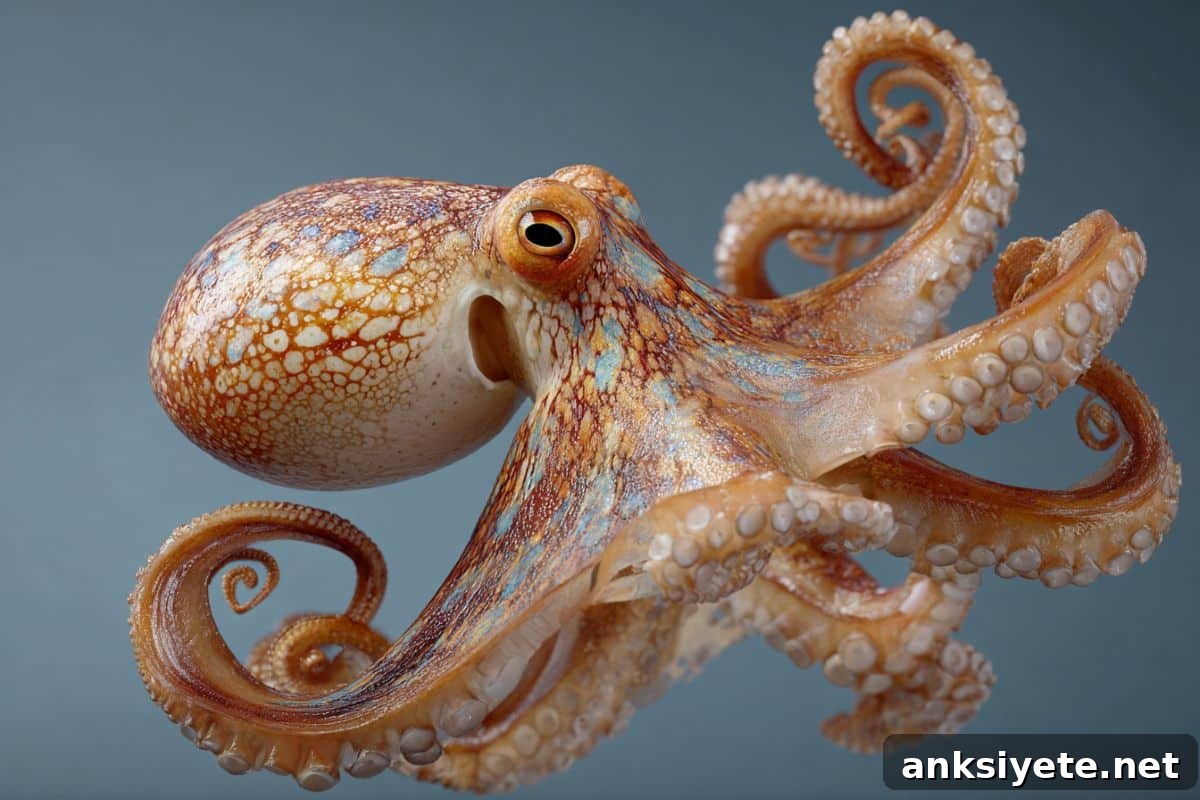
Researchers from the Marine Biological Laboratory (MBL) in Woods Hole and Florida Atlantic University (FAU) present the most detailed field-based analysis to date of octopus arm kinematics. They recorded 25 octopuses in six distinct natural habitats across the Atlantic, Caribbean, and Spain, then developed a systematic ethogram linking arm actions to behaviors such as foraging, locomotion, and object manipulation.
The results are reported in the journal Scientific Reports.
“I’ve been trying for a long time to work out the natural behavior of cephalopods in their natural habitat,” said MBL Senior Scientist Roger Hanlon, whose lab led the project. This study delivers the first full ethogram of wild octopus arm behaviors, extending earlier laboratory-based analyses to much richer, more complex field settings.
FAU research fellow and first author Chelsea Bennice noted that recording octopuses in situ allowed the team to capture a broader repertoire of behaviors and better understand how arms coordinate to perform complex tasks.
Octopus gardens and sensory guidance
Octopus behavior relies heavily on chemo-tactile information gathered by the suckers rather than on visual cues. “The octopus is a very tactile animal – it’s more tactile than visual,” Hanlon observed. Their exceptional camouflage abilities and secretive denning habits made locating and documenting natural behaviors a major logistical challenge.
Field teams located likely octopus dens by spotting food debris and other signs of recent feeding, then observed returning animals over multiple days. Octopuses typically spend about 80 percent of their time in dens, emerging periodically to forage, explore, and interact with their environment.
The six study sites ranged from smooth sandy seafloors to structurally complex coral reefs, enabling the researchers to observe arm use across diverse benthic contexts. Hanlon emphasized that immersive fieldwork—accessing animals in their sensory world—is essential to understanding natural behaviors.
Methodical breakdown of arm activity
The research team examined video frame-by-frame to catalog every motion of each of the eight arms on every animal. For the first time in a field study, they divided each arm into three regions—proximal, medial, and distal—and recorded movements and deformations region by region.
Co-author Kendra Buresch of MBL highlights that this analysis revealed the full set of 12 arm actions that together form the building blocks of octopus behavior. Overall, the dataset includes 3,907 recorded arm actions and 6,871 documented arm deformations, demonstrating that every arm can perform all action types, though frequencies vary by arm position and region.
Anterior arms were used more frequently than posterior arms, but no consistent left-right differences emerged. The four principal arm deformations—shortening, elongation, bending, and torsion—appear across all actions, combined in many ways to achieve tasks ranging from “walking” on the seafloor and swimming to probing crevices for prey and manipulating objects.
Each sucker functions as an integrated chemo-tactile sensor that supports complex sensing and decision-making at the arm level. Hanlon summarized these sensory abilities by calling each sucker “a chemo-tactile genius,” combining the functions of nose, lips, and tongue in a compact organ.
Implications for robotics and neuroscience
The study’s detailed ethogram and quantitative breakdown of arm deformations provide a rich blueprint for engineers and neuroscientists. Funding from agencies such as the U.S. Office of Naval Research reflects interest in developing robotic manipulators that match octopus arms in flexibility and sensory capacity. Practical applications include tools that can snake into confined spaces to deliver supplies, perform inspections, or assist in medical interventions after structural collapse.
About this robotics and neuroscience research news
Author: Diana Kenney
Source: Marine Biological Laboratory
Contact: Diana Kenney – Marine Biological Laboratory
Image: The image is credited to Neuroscience News
Original Research: Open access. “Octopus arm flexibility facilitates complex behaviors in diverse natural environments” by Roger Hanlon et al., Scientific Reports
Abstract
Octopus arm flexibility facilitates complex behaviors in diverse natural environments
Octopus arms are among the most flexible biological structures, yet their full range of movements has been little studied in the wild, where habitat complexity far exceeds aquarium conditions. This field study used a hierarchical analysis of behaviors, arm actions, and arm deformations to quantify arm flexibility across diverse benthic habitats.
Twenty-five videos of naturally behaving octopuses were analyzed from five Caribbean sites and one site in Spain. Researchers delineated behavior into 12 arm actions composed of four arm deformations—shorten, elongate, bend, and torsion. The analysis recorded 3,907 arm action occurrences and 6,871 arm deformation occurrences, showing that all arms can perform all actions and deformations, though the frequency of particular deformations varies by arm region (proximal, medial, distal).
Anterior arms performed more actions than posterior arms, and no consistent left-right differences were observed. The diverse combinations of deformations and actions illustrate extreme arm flexibility and coordination across a wide range of functions. These findings are relevant to ethologists, sensory ecologists, neuroscientists, and engineers designing soft robotic appendages.