
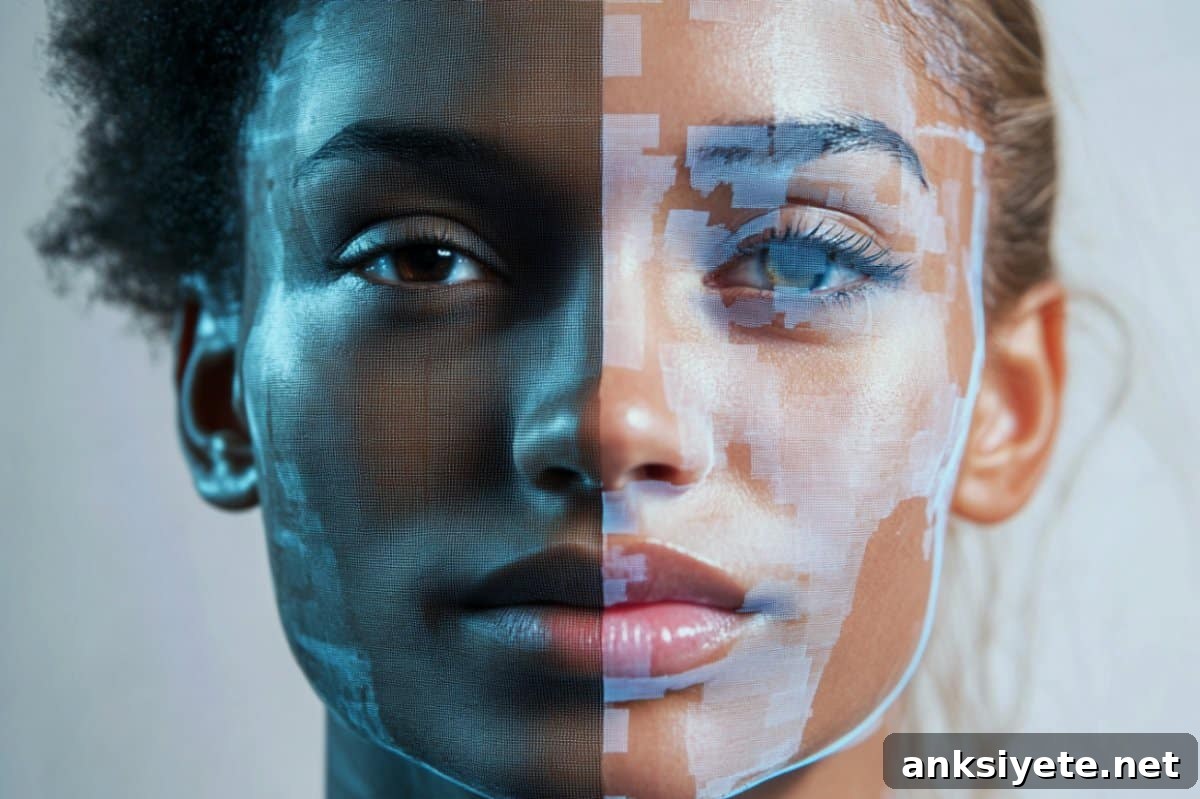
Summary: Researchers at the University of Toronto Scarborough combined artificial intelligence and EEG brain recordings to investigate the Other-Race Effect (ORE), the well-documented tendency for people to recognize faces of their own racial group more accurately than faces of other groups. Two complementary studies show that other-race faces are represented with less neural detail and are mentally reconstructed as more average, younger, and more emotionally expressive than same-race faces. These perceptual differences help explain recognition failures and may contribute to implicit bias, with implications for technology, forensics, and clinical assessment.
Using a blend of generative AI and electroencephalography, the research team reconstructed the visual representations people form when they view faces. The results reveal that brains encode same-race faces with finer, more distinctive detail, while other-race faces are processed more generally—collapsed toward an average appearance. This summary explains the methods, the main findings, and potential real-world applications.
Key findings
- Reduced neural differentiation: EEG recordings indicate that other-race faces evoke less distinct visual representations in the first 600 milliseconds after viewing, suggesting coarser encoding and reduced detail.
- Biases in reconstructed images: When participants’ internal face representations were reconstructed using generative AI, other-race faces tended to look more average, younger, and more expressive than same-race reconstructions.
- Consistent across groups: The effect appeared in both East Asian and White participant groups tested, mirroring the behavioral Other-Race Effect in recognition accuracy.
- Practical implications: Improved understanding of these perceptual distortions can inform better facial recognition algorithms, more accurate interpretation of eyewitness testimony, and potentially aid diagnosis and treatment planning for some mental health disorders.
Research approach
The team conducted two studies. In the first, published in Behavior Research Methods, participants from two racial groups (East Asian and White) viewed many pairs of faces and provided similarity ratings. The researchers used StyleGAN2, a state-of-the-art generative adversarial network, to convert those pairwise similarity judgments into visual reconstructions of the mental images people hold when they see faces. The GAN-based reconstructions were highly realistic and revealed that reconstructions of same-race faces matched the stimuli more accurately than reconstructions of other-race faces.
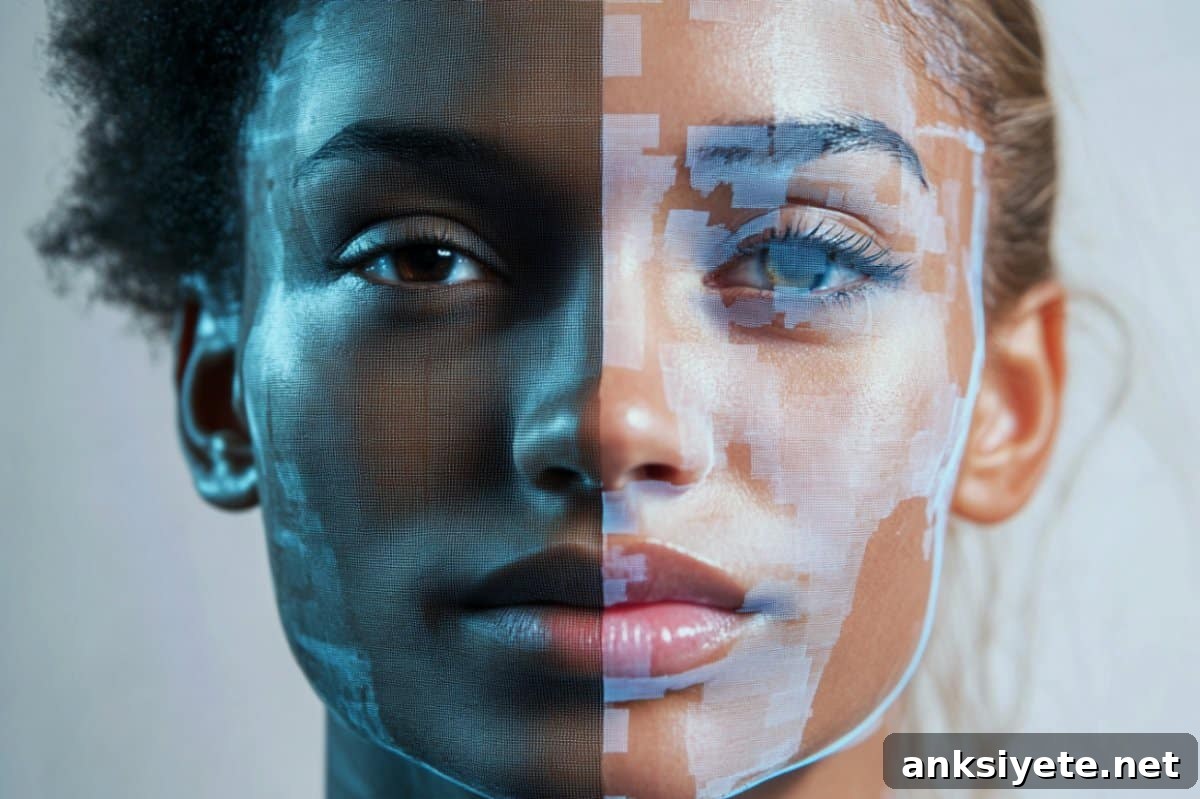
In the second study, published in Frontiers, the researchers added neural data. They recorded EEG while participants viewed faces, then used machine learning to map EEG patterns to visual features and reconstruct the face representations unfolding in the first 600 milliseconds of perception. This neural reconstruction confirmed the behavioral findings: brain activity represents same-race faces with greater specificity, while other-race faces show patterns consistent with grouping and averaging.
What the findings mean
Together, these studies provide converging behavioral and neural evidence that the Other-Race Effect arises in part from how faces are represented in perception. When the brain encodes other-race faces with less distinctiveness, individuals are more likely to confuse different faces from that group, reducing recognition accuracy. The surprising observation that other-race reconstructions appeared younger and more emotionally expressive suggests specific perceptual biases that could shape social judgments beyond simple recognition errors.
Adrian Nestor, associate professor in the Department of Psychology and co-author of the studies, emphasizes that understanding these perceptual distortions matters because they can influence behaviour in everyday social interactions as well as in high-stakes situations like eyewitness identification. Moaz Shoura, a PhD student and co-author, adds that the neural evidence indicates a generalized, lower-resolution code for other-race faces that helps explain persistent recognition gaps.
Applications and future directions
The findings suggest several practical uses. Better models of human face perception could guide the design of facial recognition systems that compensate for human perceptual biases. Forensic contexts might benefit from awareness of these distortions when evaluating eyewitness accounts. Clinically, the approach of reconstructing internal representations from EEG could help characterize how patients misperceive facial expressions—information that could aid diagnosis or the development of targeted therapies for conditions that involve social-perceptual disruptions.
Nestor notes that visualizing exactly how people misperceive emotions—such as misreading disgust or misunderstanding positive expressions—could improve diagnostic precision and treatment planning in psychiatry. Shoura points out that reducing the real-world impact of perceptual bias, for example in hiring or policing contexts, will require translating laboratory findings into practical training or technological interventions.
About this research and reporting
Author: Suniya Kukaswadia
Source: University of Toronto
Contact: Suniya Kukaswadia – University of Toronto
Image: Image credited to Neuroscience News
Original Research: Closed access. “Unraveling other‑race face perception with GAN‑based image reconstruction” by Adrian Nestor et al., Behavior Research Methods. DOI reference provided in the original publication.
Abstract
Unraveling other‑race face perception with GAN‑based image reconstruction
The other-race effect (ORE) is the disadvantage of recognizing faces of another race than one’s own. While its prevalence is behaviorally well documented, the representational basis of ORE remains unclear. This study employs StyleGAN2, a deep learning technique for generating photorealistic images, to uncover face representations and investigate the representational basis of ORE. The authors collected pairwise visual similarity ratings for same- and other-race faces across East Asian and White participants who exhibited robust ORE. Leveraging overlap between the GAN’s latent space and human perceptual representations, they developed an image reconstruction method to reveal internal face representations from behavioral data. The method produced highly realistic reconstructions with accuracy above chance and demonstrated an accuracy advantage for same-race over other-race reconstructions, reflecting ORE. Comparison across participant groups also revealed a novel age bias: other-race reconstructions appeared younger than same-race counterparts. The work presents a new method for using GANs in image reconstruction and opens new directions for studying ORE.