
Summary: Researchers show that honey bees can grasp complex numerical concepts, including the notion of zero as smaller than any whole number.
Honey Bees Learn the Concept of Zero and Numerical Ordering
Source: CNRS
Overview
While complex numerical abilities such as addition, ordering, and the concept of zero have been documented in several vertebrates, evidence for similar capacities in insects was previously lacking. New experiments demonstrate that honey bees (Apis mellifera) can be trained to understand numerical inequalities — specifically “greater than” and “less than” — and can extend that understanding to include zero, treating an empty set as smaller than any positive number.
How the experiment worked
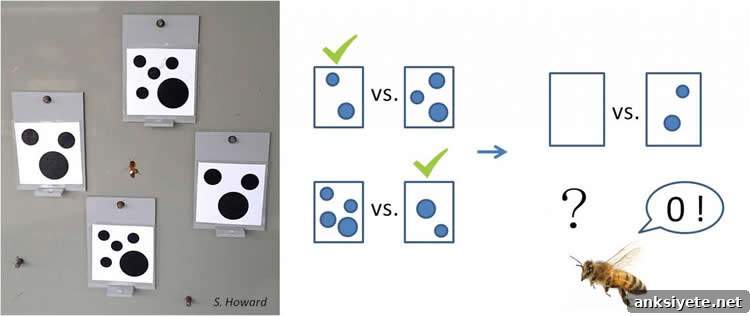
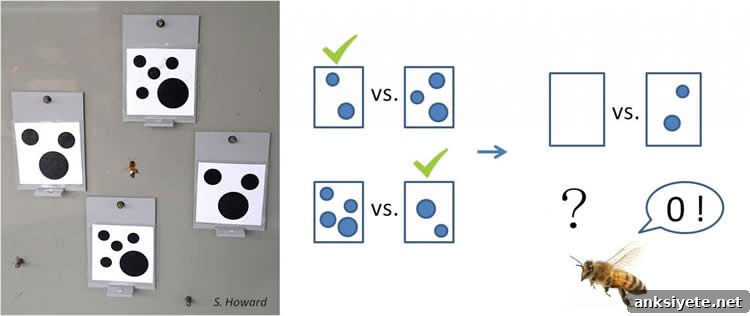
Research teams trained individual bees to associate visual patterns with rewards or deterrents. In an experimental arena, platforms were paired with printed images containing various numbers of discrete elements (dots). Bees were presented with two images and rewarded with a sugar solution when they chose the image depicting the smaller number of elements. When they chose incorrectly, they received a bitter quinine solution. This reinforcement scheme encouraged the bees to learn the rule “choose fewer.”
After the bees reliably chose the smaller numerosity among images showing one to five elements, researchers tested whether the insects could extend the learned rule to a novel situation: a choice between a blank image (representing zero) and an image showing one or more dots. The bees consistently selected the blank image, indicating they perceived the empty display as the smallest numerosity. In other words, they had extrapolated their “less than” concept to include zero and placed zero at the lower end of the numerical scale.
Why this matters
Honey bees have brains containing approximately one million neurons — far fewer than the human brain — yet they demonstrated an abstract understanding of absence as a numerical value. The concept of zero is a major cognitive milestone in the history of human mathematics because it represents “nothing” while functioning as a manipulable symbolic quantity. These findings suggest that the capacity to represent absence as part of a numerical continuum may not require a large brain or human-like language and could instead arise from more general neural mechanisms that evolved to process sensory information.
The study highlights that even species primarily adapted for perception and motor tasks can form higher-level cognitive constructs. Recognizing zero as the lower bound of the numerical order indicates a cognitive flexibility that parallels results reported for some vertebrates, including certain birds, primates, and young children.
Article source: Juliette Dunglas – CNRS
Publisher: NeuroscienceNews.com (organization)
Image credit: Scarlett Howard & Aurore Avarguès-Weber
Original research: Abstract for “Numerical ordering of zero in honey bees” by Scarlett R. Howard, Aurore Avarguès-Weber, Jair E. Garcia, Andrew D. Greentree, and Adrian G. Dyer in Science. Published June 8, 2018. DOI: 10.1126/science.aar4975
- Honey bees can learn comparative numerical rules such as “less than.”
- Bees generalized that rule to a blank display, treating zero as smaller than any positive whole number.
- The finding suggests abstract numerical concepts, including the representation of absence, may be present in animals with relatively small brains.
- These results invite further inquiry into how numerical cognition evolved and how simple neural circuits can support abstract thought.
How to cite: CNRS, “Bees and the Thought of Naught.” NeuroscienceNews. June 8, 2018.
Abstract (from the original research)
Numerical ordering of zero in honey bees
Some vertebrates demonstrate complex numerosity concepts — including addition, sequential ordering of numbers, or even the concept of zero — but whether an insect can develop an understanding for such concepts remained unknown. In this study, individual honey bees were trained on numerical comparisons using visual stimuli containing one to six elements. After learning the rule “less than” or “greater than,” bees could extrapolate the concept of “less than” to place zero at the lower end of the numerical continuum. The bees’ performance parallels that observed in certain birds, nonhuman primates, and young children.