Summary: New research shows how the gene CD2AP may increase susceptibility to Alzheimer’s disease by altering synaptic protein balance and impairing neuronal communication.
Source: Baylor College of Medicine
A multi-institutional study led by researchers at Baylor College of Medicine, published in the journal Cell Reports, provides new insight into how the Alzheimer’s risk gene CD2AP influences brain function. Using a combination of experiments in fruit flies, genetically modified mice, and analysis of human postmortem brain tissue, the team found that CD2AP plays an important role at synapses—the points of communication between neurons—by controlling levels of key regulatory proteins that maintain synaptic function and protein homeostasis (proteostasis).
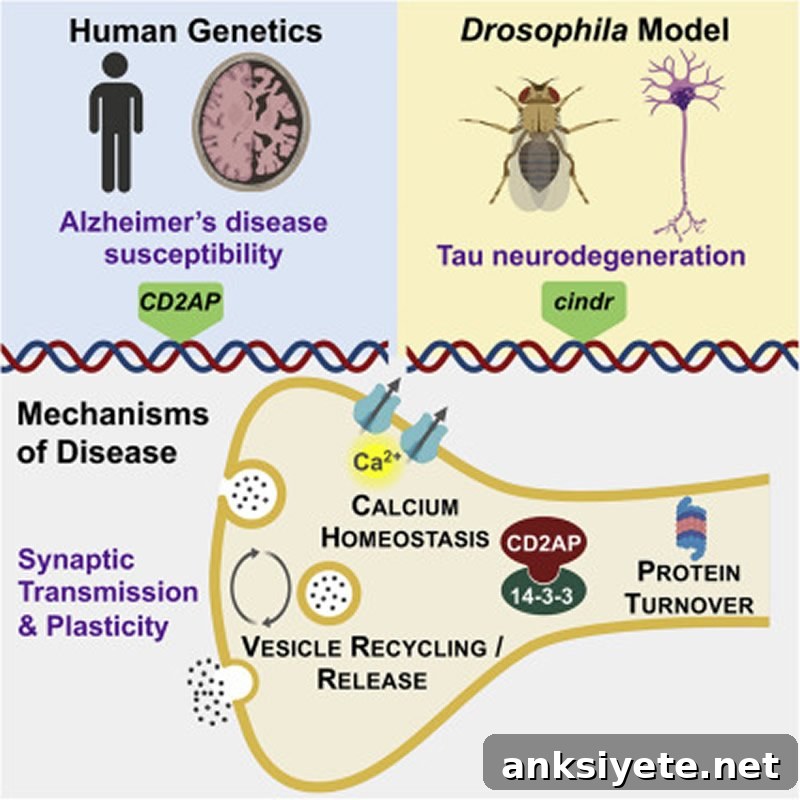
The research team, led by Dr. Joshua Shulman, associate professor of neurology at Baylor and corresponding author of the study, began by examining the Drosophila equivalent of CD2AP, a gene known as cindr. Deleting cindr in the fly nervous system produced clear defects in synapse structure and function. Flies lacking cindr showed disrupted synaptic maturation, impaired synaptic vesicle recycling and release, and evidence of abnormal accumulation of several synaptic proteins.
Among the proteins that accumulated in mutant flies were regulators of synaptic transmission and proteins involved in proteostasis. The investigators identified a functional relationship between Cindr and the conserved protein 14-3-3ζ. Their data indicate that Cindr and 14-3-3ζ together influence the ubiquitin-proteasome system, a central pathway for protein turnover, and they affect presynaptic calcium handling by modulating levels of the plasma membrane calcium ATPase (PMCA). Loss of cindr elevated PMCA abundance and reduced cytosolic calcium in neurons, changes that can alter neurotransmitter release and synaptic plasticity.
To test whether these findings extend beyond flies, the team analyzed a mouse model lacking Cd2ap. The Cd2ap-null mice exhibited brain changes consistent with the fly data, supporting a conserved role for CD2AP in synaptic proteostasis and function across species. Finally, the researchers examined more than 800 human postmortem brain samples and found that lower CD2AP protein levels were significantly associated with altered turnover of synaptic proteins, including an inverse relationship between CD2AP and Synapsin abundance. These associations were strongest in brains affected by Alzheimer’s disease, linking CD2AP-related synaptic dysfunction to human AD pathology.
Together, the fly, mouse, and human results indicate that CD2AP is required in neurons to maintain healthy synaptic structure and function through regulation of proteostasis and calcium homeostasis. Because synaptic failure is a central feature of Alzheimer’s disease and closely correlates with cognitive decline, these findings provide a plausible mechanism by which variation in CD2AP could increase AD susceptibility. The work highlights synaptic proteostasis, calcium handling, and synapse structure as potential downstream pathways through which CD2AP influences neurodegeneration risk.
Source:
Baylor College of Medicine
Media Contacts:
Molly Chiu – Baylor College of Medicine
Image Source:
Image credited to Shamsideen A. Ojelade et al.
Original Research: Open access
“cindr, the Drosophila Homolog of the CD2AP Alzheimer’s Disease Risk Gene, Is Required for Synaptic Transmission and Proteostasis.” Shamsideen A. Ojelade et al., Cell Reports.
Abstract
cindr, the Drosophila Homolog of the CD2AP Alzheimer’s Disease Risk Gene, Is Required for Synaptic Transmission and Proteostasis
Highlights
• cindr, the fly homolog of the Alzheimer’s risk gene CD2AP, encodes a synaptic protein.
• cindr mutants impair synaptic vesicle recycling and release and disrupt synaptic plasticity.
• Cindr and 14-3-3ζ cooperate to regulate the ubiquitin-proteasome system and presynaptic calcium homeostasis.
• Studies in Cd2ap-null mice and human brain tissue support a conserved role for CD2AP in synaptic proteostasis and protein turnover.
Summary
CD2-associated protein (CD2AP) is an actin-binding adaptor with genetic links to Alzheimer’s disease, but its neuronal functions were previously unclear. In Drosophila, the CD2AP ortholog cindr is expressed in neurons and localized at synaptic terminals. Loss of cindr disrupts synapse maturation, impairs vesicle recycling and neurotransmitter release, and alters levels of synaptic proteins. Cindr physically associates and genetically interacts with 14-3-3ζ, influencing the ubiquitin-proteasome system and the turnover of Synapsin and PMCA. Reduced cindr elevates PMCA levels and lowers cytosolic calcium, which can impair presynaptic calcium signaling. Mouse models lacking Cd2ap recapitulate key features observed in flies, and analysis of human postmortem brains links lower CD2AP protein levels with increased Synapsin abundance and altered synaptic protein turnover, particularly in Alzheimer’s disease. These findings identify neuronal requirements for CD2AP that are relevant to AD susceptibility, highlighting mechanisms involving proteostasis, calcium handling, and synaptic integrity.