Face-Likeness (Pareidolia) Arises During Early Visual Processing—Around 100 ms After Seeing an Object
Summary: New research identifies the stage of visual processing when humans perceive face-likeness (pareidolia), showing that this judgment occurs very early—around 100 milliseconds after an object is seen—and links that timing to specific EEG components.
Source: Toyohashi University of Technology
Researchers at the Visual Perception and Cognition Laboratory of Toyohashi University of Technology report that the recognition of face-likeness — the tendency to see faces in non-face objects — is determined during an early stage of visual processing roughly 100 ms after stimulus onset. Their findings, published in the open-access journal Frontiers in Human Neuroscience, combine behavioral evaluation with EEG measures to clarify when and how face-like impressions arise in the brain.
Pareidolia, the human tendency to perceive meaningful images such as faces in patterns, objects, or scenes that are not actual faces, is a common experience. It can explain why people sometimes see faces in clouds, appliances, or photographs. Although many studies have suggested pareidolia involves relatively low-level visual processing, until now the precise stage and neural signature of this effect were not clearly established.
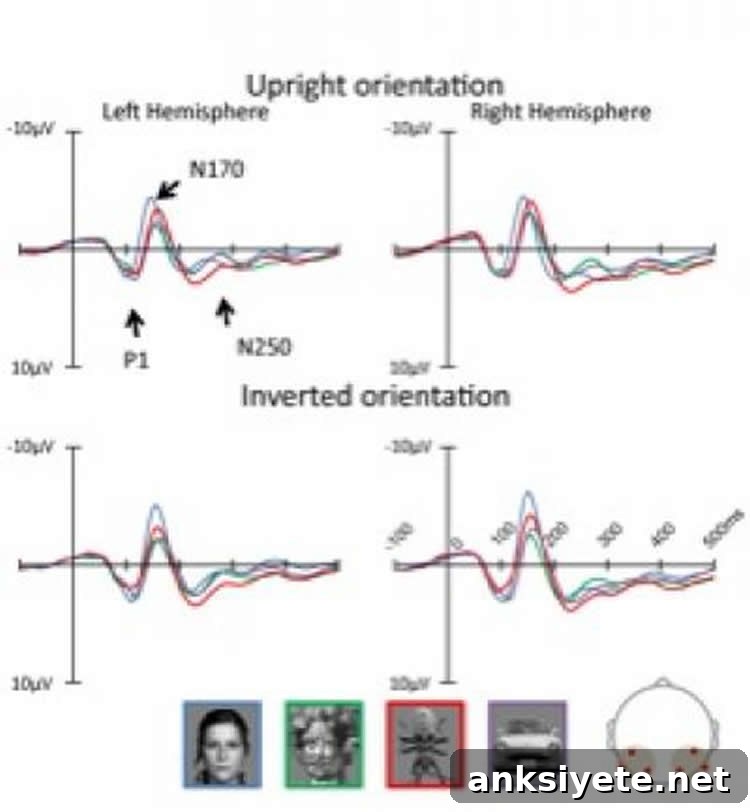
The Toyohashi University research team examined the relationship between subjective judgments of face-likeness and brain activity recorded with electroencephalography (EEG). By comparing participants’ face-like evaluations with event-related potentials (ERPs) elicited by images that ranged from clear human faces to objects and face-like artworks, the team identified specific early neural markers that correlate with the subjective sense that an object looks like a face.
PhD student and lead author Yuji Nihei explains the research framework: “Face processing in the brain can be thought of as occurring in stages. The initial stage is early visual processing, which gives a rough categorization of a stimulus. If the stimulus appears face-like, subsequent stages differentiate facial parts and their configuration, and later stages process expressions and individual identity. Our data indicate that face-likeness judgments begin at that first stage—very quickly, about 100 ms after viewing—suggesting the brain flags face-like patterns before conscious recognition.”
Associate Professor Tetsuto Minami, leader of the research team, emphasizes the functional importance of these findings: “Although perceiving face-likeness in inanimate objects could be dismissed as a mistake in object recognition, the phenomenon likely reflects an adaptive cognitive mechanism. Early detection of face-like patterns may rapidly direct attention to socially relevant features in the environment. We plan to continue investigating face-likeness using objective, neural measures to better understand this process.”
The study’s results suggest that face-like objects are first flagged by early visual mechanisms and then, in later stages of processing, are handled in ways similar to actual human faces. This cascade—initial rapid detection followed by more detailed face-sensitive processing—helps explain why pareidolia can evoke strong attentional and emotional responses despite originating in non-face stimuli.
Funding: This study was supported by Grants-in-Aid for Scientific Research A (26240043) and C (25330169) from the Japan Society for the Promotion of Science. Lead author Yuji Nihei also received support through the Program for Leading Graduate Schools (R03) administered by the Japan Society for the Promotion of Science.
Source and Publication: Toyohashi University of Technology. The research article, “Brain Activity Related to the Judgment of Face-Likeness: Correlation between EEG and Face-Like Evaluation” by Yuji Nihei, Tetsuto Minami, and Shigeki Nakauchi, was published in Frontiers in Human Neuroscience on February 16, 2018.
Brain Activity Related to the Judgment of Face-Likeness: Correlation between EEG and Face-Like Evaluation
Faces carry vital social information—identity, expression, gender—that the human visual system prioritizes. As a result, people often detect faces automatically, even in non-face objects. To understand why face-likeness is perceived in such stimuli, the authors examined face-related event-related potential components while participants performed face-like evaluations. Stimuli included natural faces, cars, insects, and Arcimboldo paintings presented upright and inverted. Prior work has identified the P1 component (associated with early visual processing), the N170 (face detection), and the N250 (personal recognition) as key face-sensitive ERP markers. The present study found significant correlations between participants’ face-likeness ratings and inversion effect indices in the P1 component across both hemispheres, and in the N170 component in the right hemisphere. These findings indicate that the judgment of face-likeness arises at a relatively early stage of face processing, consistent with a rapid, automatic neural mechanism that flags face-like configurations shortly after stimulus onset.
Original research DOI: 10.3389/fnhum.2018.00056