New technique holds promise for better understanding of brain disorders
Researchers at the University of Washington have developed a highly targeted method to stimulate individual cells using quantum dots—nanoscale semiconductor particles that emit light when excited. This approach promises finer control over neuronal activity than traditional electrical stimulation, and could improve our ability to study and ultimately treat brain disorders such as Parkinson’s disease, Alzheimer’s disease, and severe depression. The work appears in the open-access journal Biomedical Optics Express.
Why targeted stimulation matters
Current clinical and research stimulation methods often use electrodes placed on the scalp or implanted in the brain. While effective at broadly activating neural tissue, electrodes stimulate large populations of diverse cells simultaneously. That makes it difficult to isolate the contributions of specific cell types or single cells to circuit behavior and disease mechanisms. To understand how individual neurons and defined neural populations contribute to function and dysfunction, researchers need tools that combine noninvasiveness with precise spatial and temporal control.
Photostimulation with and without genetic modification
Photostimulation—controlling cells with light—has emerged as a powerful option. For example, optogenetics uses genetically encoded light-sensitive proteins to switch neurons on or off with millisecond precision. However, optogenetics requires genetic modification of the target cells, which can limit clinical translation and complicate some experimental applications.
Quantum dots as a non-genetic alternative
The University of Washington team, led by electrical engineer Lih Y. Lin and biophysicist Fred Rieke, pursued an alternative that does not require genetic modification: quantum dots. These tiny semiconductor particles, a few billionths of a meter across, confine electrons in all three spatial dimensions. When excited by light, quantum dots emit photons at wavelengths determined by their size and composition. Their size-dependent optical properties have already made them useful in imaging, displays, photovoltaics, and LEDs.
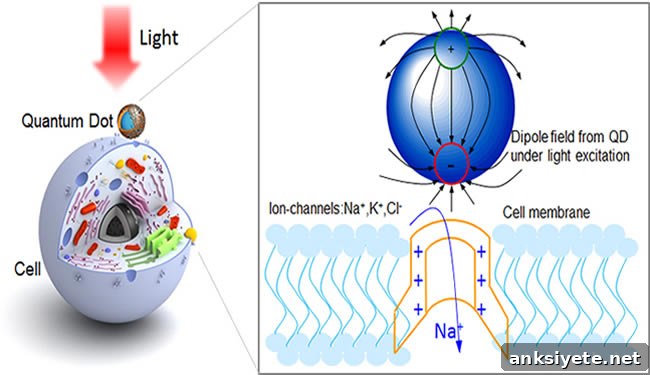
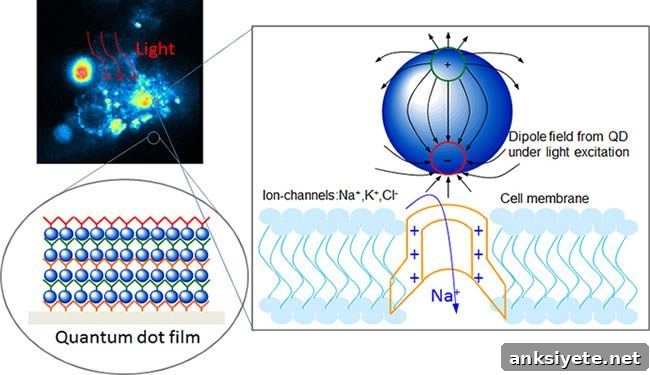
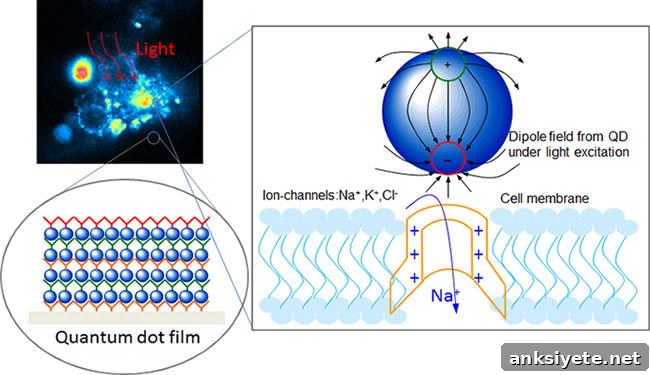
In the new study, Lin, Rieke and colleagues applied quantum dots to control cells in culture. Cells were grown on thin films coated with quantum dots so their membranes sat in close proximity to the light-emitting particles. When the researchers exposed the films to flashes of light at selected wavelengths, the quantum dots produced local electrical fields that triggered ion channels and evoked spiking activity in nearby cells. By changing the light wavelength and timing, the team could control cellular responses with spatial and temporal precision.
Laboratory results and next steps
The team first tested the method on prostate cancer cells—chosen because a collaborating lab already maintained the line and because the cells tolerate culture conditions well. After confirming controlled activation on those cells, the researchers applied the technique to cortical neurons. The experiments demonstrated that optically excited quantum dots can evoke and modulate activity in both neurons and other cell types without direct electrical contact.
Lin emphasizes that this method offers flexibility for probing cells at different locations while reducing side effects associated with broader stimulation techniques. Rieke notes that many neurological and retinal disorders stem from imbalanced neural activity. A method that selectively manipulates specific cell types or small groups of neurons could restore balanced circuit dynamics and rescued function in damaged retinal tissue. More broadly, spatially and temporally precise stimulation can help researchers perturb neural circuits, monitor the resulting changes, and map how activity patterns give rise to behavior and dysfunction.
Challenges toward in vivo and clinical use
To move beyond cultured cells and toward clinical or in vivo research, several challenges remain. The quantum dots used in the present experiments were not optimized for biocompatibility and in some cases harmed cells. For in vivo applications, the particle surfaces must be engineered to target specific cell types and to avoid toxicity. The authors suggest one path forward is developing non-toxic quantum dots such as silicon-based nanoparticles, and modifying their surfaces so the particles selectively bind to desired cells when delivered into living tissue.
Notes about this neuroscience research article
The study authors include Lih Y. Lin and Fred Rieke, with coauthors Katherine Lugo and Xiaoyu Miao. The paper, titled “Remote switching of cellular activity and cell signaling using light in conjunction with quantum dots,” was published in Biomedical Optics Express (Vol. 3, Issue 3, pp. 447–454, 2012).
Contact: Angela Stark – The Optical Society. Source: The Optical Society press release. Image credits: Lugo et al., University of Washington; image adapted from Jiang et al., Chem. Mater., 2006, 18 (20), pp. 4845–4854.